Language shapes culture, and nowhere is this more evident than in the way we label our leaders. Words carry an invisible weight, shifting how people feel about their work every single day.
For decades, organizations defaulted to clinical, uninspiring titles to describe their top tiers. But corporate dynamics have shifted dramatically, and the vocabulary we use must keep pace.
Redefining the Top Tier: Why Your Leadership Team Name Matters
When we talk about finding the perfect names for leadership teams, we are not just playing with corporate vocabulary. We are addressing a fundamental shift in how human beings collaborate, look for guidance, and build trust in modern environments.
People frequently search for new terminology because the old titles feel cold and distant. Traditional names often create an invisible barrier between the executives and the people who keep the organization running.
Choosing a thoughtful name solves a massive internal communication puzzle. It bridges the psychological gap between “us” and “them,” transforming a group of overseers into a unified collective that people actually want to follow.
Names for Leadership Teams – Quick Meaning
At its core, a leadership team name is the collective title given to the group of individuals responsible for strategic decision-making, operational guidance, and organizational health.
Instead of relying on rigid, hierarchical terms, modern organizations use these names to signal their internal values, their communication style, and their cultural identity.
“The name of your leadership group sets the tone for your entire organizational culture before a single directive is ever spoken.”
“When we changed our executive title from ‘Management Committee’ to ‘The Catalyst Group,’ employee engagement metrics shifted because the name implied action, not supervision.”
Origin & Background of Leadership Titles
The terminology of leadership has undergone a massive evolution over the past century, deeply influenced by societal shifts and cultural changes.
The Industrial Era Foundations
Historically, corporate names for leadership teams were borrowed directly from military structures and industrial factories. Terms like “Command and Control” or “Board of Directors” reflected a rigid, top-down approach where decisions were passed down to the masses.
The Tech Boom and Digital Transformation
With the rise of Silicon Valley in the early 2000s, the internet culture began to dismantle traditional hierarchies. Startups rejected stuffy titles in favor of flatter structures, heavily influencing how leadership teams branded themselves on social media and public platforms.
Modern Workplace Evolution
Today, the shift toward emotional intelligence and psychological safety has fundamentally altered corporate language. The modern workforce demands transparency, and leadership names have evolved from expressing absolute authority to emphasizing collaboration, stewardship, and shared vision.
Real-Life Conversations
To understand how these names impact daily office life, let’s look at how people talk about their leadership teams across different modern communication platforms.
WhatsApp (Internal Project Team)
Sarah: Hey team, did the new strategic budget get approved yet?
Marcus: Not yet, it’s still sitting with the Guidance Council for final review.
Sarah: Oh great, they usually look at things through a growth lens, so I’m optimistic!
Instagram DMs (Company Culture Feature)
Alex: Just saw your company’s story! What exactly is the “Impact Collective”?
Taylor: Haha, that’s just our official name for our leadership team!
Alex: Wow, that sounds way less intimidating than “The Executives.” Love that vibe.
TikTok Comments (Workplace Humor Video)
User1: My boss just said “the corporate overlords” rejected my PTO 💀
User2: Oof, time to move to a company with a “Stewardship Team” instead!
User3: Real, a good leadership name changes the whole energy of the office.
Text Messages (Between Colleagues)
Dave: Are you going to the all-hands meeting this afternoon?
Elena: Yeah, the Catalyst Team is sharing the five-year roadmap.
Dave: Cool, I always like hearing their perspective on where we’re heading next.
Emotional & Psychological Meaning of Group Names
The words we choose to describe a leadership team trigger specific psychological responses within an organization, dictating how approachable or distant those leaders feel.
The Psychology of Inclusion
When a company uses an inclusive name, it validates the psychological need for belonging among employees. It shifts the perception from a group that hoards power to a group that distributes opportunity.
Breaking the Fear Barrier
Traditional titles can inadvertently induce anxiety or hesitation. A warmer, purpose-driven team name fosters an environment of psychological safety, encouraging open communication, creative risk-taking, and honest feedback from all levels.
A Real-World Leadership Scenario
During a severe organizational restructuring at a mid-sized firm I advised, the executives chose to stop calling themselves the “Executive Suite” and adopted the name “The Navigation Team.” This simple linguistic shift transformed how employees viewed their decisions; they no longer saw them as arbitrary dictates from above, but as necessary course corrections to keep the entire ship afloat.
Usage in Different Contexts
A leadership team name must function smoothly across various communication channels, adapting to the context while retaining its core identity.
Social Media and Employer Branding
On platforms like LinkedIn or corporate culture blogs, a creative leadership name serves as a powerful recruitment tool. It broadcasts to potential talent that your organization values modern management principles over archaic hierarchies.
Friends & Relationships
When employees talk to their loved ones about work, the name of the leadership team shapes their narrative. Saying “I am presenting to our Vision Circle” sounds empowering, whereas “I am going before the Board” often carries a stressful connotation.
Work and Professional Settings
In formal business reports, shareholder meetings, and official documentation, the name must strike a balance. It needs to be distinct enough to reflect company culture, yet professional enough to command respect from external stakeholders.
Casual vs. Serious Tones
The best names for leadership teams hold up well under pressure. They should feel natural when celebrating a major milestone, yet remaining respectful and grounding during a crisis or organizational pivot.
When NOT to Use Creative Leadership Names
While modernizing your vocabulary is generally positive, there are times when unconventional names can backfire or cause unnecessary friction.
Highly Regulated Industries
In fields like legal services, corporate finance, or medical care, compliance and tradition carry immense weight. Replacing standard legal titles with whimsical names can confuse auditors, regulators, and conservative clients who value traditional governance.
Cultural Inclusivity Pitfalls
Avoid names that lean too heavily on localized slang, sports metaphors, or idioms that do not translate well across international borders. A name that sounds inspiring in one country might sound confusing or offensive in another.
Mismatched Corporate Realities
Never use an progressive, egalitarian name if your corporate culture remains intensely bureaucratic and top-down. Employees will quickly see through the superficial branding, leading to cynicism and a loss of organizational trust.
Common Misunderstandings About Team Titles
Changing a name can occasionally lead to confusion if the intention behind the shift is not communicated clearly to the rest of the company.
The “Fluff” Misconception
Some traditionalists might view modern names as superficial corporate jargon devoid of real substance. To counter this, the name must actively reflect how the leaders behave and make decisions every single day.
Tone and Intention Confusion
If a leadership team adopts a name like “The Growth Hub,” employees might assume the team only cares about financial metrics, missing the broader focus on human development and cultural health.
Literal vs. Figurative Interpretations
Clear boundaries must be maintained so that creative titles are not confused with actual legal and fiduciary roles. The internal name is for cultural alignment, while legal entities remain defined by standard corporate laws.
Leadership Terminology Comparison Table
| Terminology Style | Primary Examples | Emotional Impression | Best Suited For |
| Traditional / Corporate | Executive Committee, Board, C-Suite | Formal, rigid, authoritative | Finance, Legal, Enterprise |
| Action / Purpose-Driven | Catalyst Team, Impact Circle, Strategy Hub | Dynamic, forward-moving, focused | Tech, Agencies, Growth Startups |
| Collaborative / Inclusive | Guidance Council, Stewardship Team, Partners | Supportive, open, trustworthy | Non-profits, Healthcare, Creative |
| Opposite / Hierarchical | Command Group, Operations Control | Strict, distant, disciplinary | Heavy Manufacturing, Military |
Key Insight
The most effective names for leadership teams bridge the gap between structural clarity and human connection, ensuring authority is respected while collaboration remains completely accessible.
Variations and Types of Leadership Names
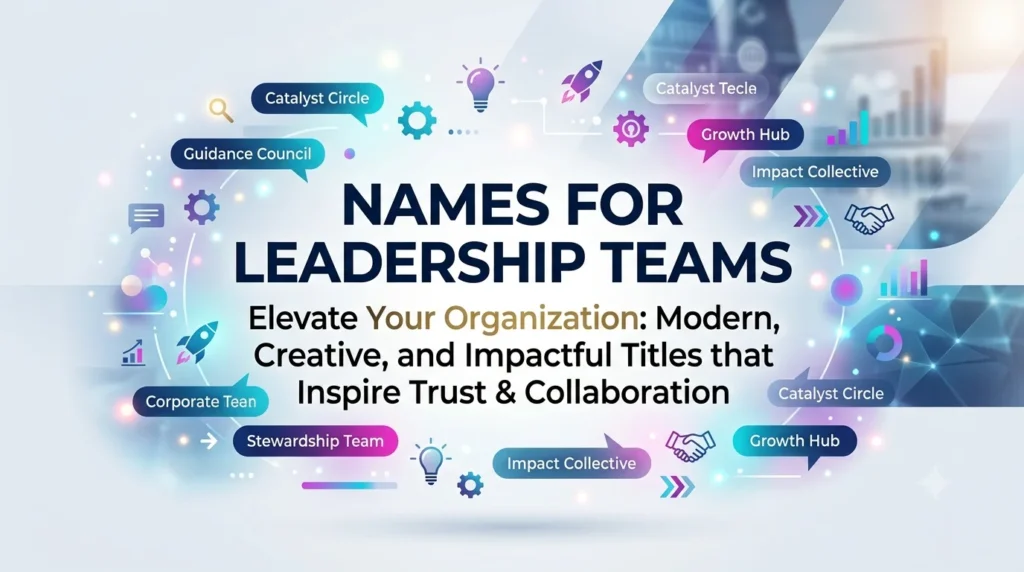
Depending on your industry, mission, and company culture, here are several distinct categories of names for leadership teams to consider.
Strategic and Visionary Names
- The Vision Circle: Focused on long-term goals and future planning.
- Strategy Hub: A dynamic center where core business plans are crafted.
- The Horizon Group: Looking ahead to the next industry shifts and opportunities.
Collaborative and Supportive Names
- The Guidance Council: Emphasizes mentorship and supporting the wider workforce.
- Stewardship Team: Focused on protecting and nurturing company resources and culture.
- The Alliance: Highlights unity and partnership across different business units.
Action and Innovation Names
- The Catalyst Group: Designed to spark change and accelerate business growth.
- Vanguard Team: Positioned at the absolute forefront of industry innovation.
- The Momentum Collective: Dedicated to keeping projects moving forward smoothly.
Functional and Operational Names
- Operations Core: The central engine keeping daily business functions aligned.
- The Nexus: The central connection point where all departments intersect.
- Growth Council: Focused entirely on scaling operations and expanding market reach.
How to Respond When Someone Uses It
Navigating these names in daily office conversations requires a bit of social awareness. Here is how to respond naturally depending on the context.
Casual Responses
- “Sounds like the Guidance Council has a solid plan for the upcoming quarter.”
- “Let’s run this past the Strategy Hub to see what they think.”
Funny Responses
- “Time to see if the Vision Circle can predict when the office coffee machine will be fixed!”
- “Let’s hope the Catalyst Group can catalyze a shorter Friday meeting.”
Mature Responses
- “I appreciate how transparent the Stewardship Team has been during this transition.”
- “Let’s align our goals with the priorities set by the Leadership Nexus.”
Respectful Responses
- “Thank you for sharing that feedback from the Executive Council.”
- “We will ensure our department deliverables align with the Vanguard Team’s expectations.”
Regional & Cultural Usage
The impact of a leadership name varies wildly depending on where your team is located and the generational makeup of your workforce.
Western vs. Eastern Corporate Culture
In Western corporate environments, there is a strong push toward flat structures, making creative, egalitarian names highly popular. In contrast, many Asian and Middle Eastern cultures value clear hierarchies and traditional titles as a sign of respect, stability, and established order.
Global Internet and Remote Culture
Remote companies operating entirely online tend to adopt the most casual and innovative names for leadership teams. This helps build a unified digital culture across borders where physical office dynamics do not exist.
Generational Differences
- Gen Z: Values authenticity, transparency, and flat structures; prefers collaborative or purpose-driven names.
- Millennials: Appreciate mission-oriented titles but still look for clear career progression and structural definitions.
- Gen X and Boomers: Often prefer traditional clarity, ensuring that a creative name does not obscure who holds final accountability.
Is It Safe for Kids?
From an educational and community standpoint, understanding leadership terminology is entirely safe and highly beneficial for younger generations. Introducing concepts of collaborative leadership in schools, clubs, and youth sports teams helps children reframe authority. Instead of viewing leadership as an exercise in giving orders, they learn to see it as a form of community stewardship and supportive guidance.
Frequently Asked Questions
What are good alternative names for leadership teams?
Good alternatives include terms like Guidance Council, Strategy Hub, Catalyst Group, or Stewardship Team. The best choice depends entirely on whether your company culture prioritizes innovation, collaboration, or operational structure.
How do you choose a name for an executive team?
Analyze your core company values and the emotional tone you want to set. Gather input from different levels of the organization to ensure the chosen title resonates across the entire company.
Can a creative leadership name replace official titles?
Internal culture names complement official titles rather than replacing them entirely. Your legal documents can still use traditional terms like “Board of Directors,” while daily internal communications use your chosen cultural name.
Why are companies moving away from terms like “C-Suite”?
Many organizations find terms like “C-Suite” or “Management” too distant and intimidating. Moving away from these titles helps create a more collaborative atmosphere and fosters psychological safety.
Do modern leadership names work in traditional industries?
Yes, but they require careful implementation. In traditional fields, leaning toward balanced terms like “Strategic Council” or “Advisory Group” works better than overly casual or trendy slang.
Conclusion
The names we assign to our leadership teams are far more than mere corporate branding exercise. They are a reflection of an organization’s heart, its values, and its approach to human collaboration. By stepping away from rigid, clinical hierarchy and embracing language that inspires trust, you pave the way for a more open, connected, and driven workforce. Choose a name that honors your structure while celebrating the human beings who bring that structure to life.
Meta Title: Modern Names for Leadership Teams: Creative Corporate Titles
Meta Description: Discover creative and impactful names for leadership teams. Learn how modern titles build workplace trust, improve company culture, and boost collaboration.
Meta Keywords: names for leadership teams, corporate leadership titles, executive team names, modern management vocabulary, company culture branding