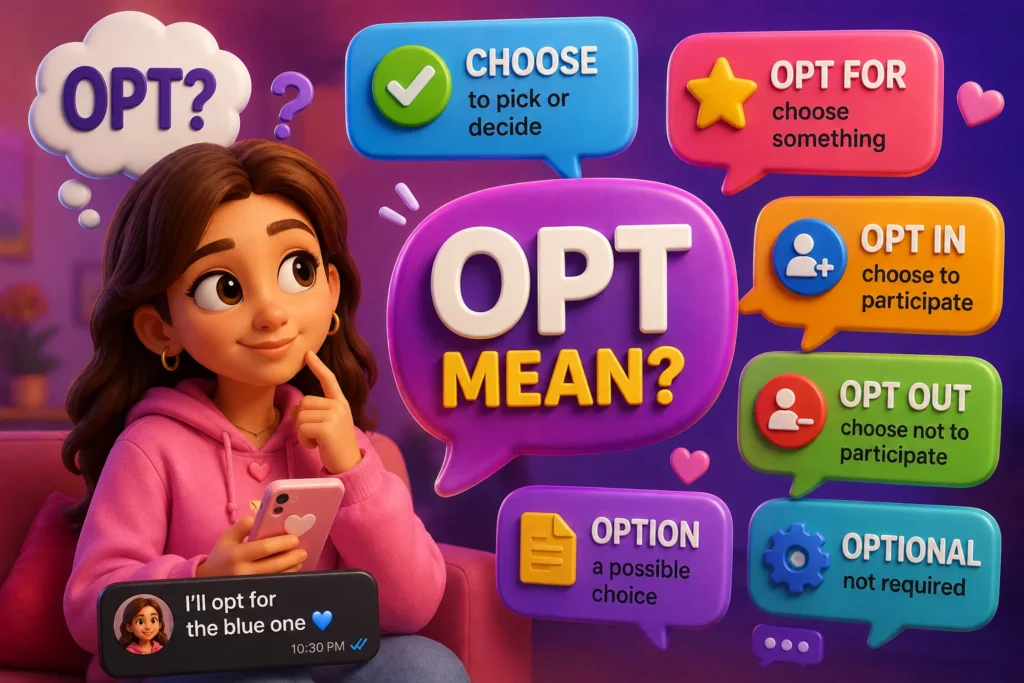
If a girl says “opt” in a text, she usually means “choose,” “decide,” or “go with.” It is not a secret female texting code. The exact meaning depends on the sentence, especially whether she writes “opt for,” “opt to,” “opt in,” or “opt out.”
What Does OPT Mean in Text From a Girl?
The most reliable meaning of opt is the normal English verb “to choose.”
For example:
“I’ll opt for the blue one.”
means:
“I’ll choose the blue one.”
Likewise:
“I opted to stay home.”
means:
“I chose to stay home.”
Cambridge defines opt as making a choice, particularly choosing one possibility instead of another. Merriam-Webster likewise defines it as “to make a choice,” especially deciding in favor of something.
So if a girl uses “opt” while texting you, you generally should not assume there is a hidden romantic or emotional meaning simply because she is a girl. The word itself does not change meaning based on the sender’s gender.
Simple examples
“I’ll opt for pizza.”
= “I’ll choose pizza.”
“I might opt to stay home.”
= “I might choose to stay home.”
“You can opt in.”
= “You can choose to participate.”
“I’m opting out.”
= “I’m choosing not to participate.”
The sentence around “opt” is much more important than who sent it.
Is OPT Slang, an Acronym, or an Abbreviation?
Usually, opt is not slang.
It is a standard English verb that has been shortened compared with phrases such as “choose to” or “decide to.” In casual messaging, people may use it because it is concise, but that does not automatically make it internet slang.
Merriam-Webster also lists opt. as an abbreviation for words such as “option” and “optional,” so the abbreviation can occur in some contexts.
That creates an important distinction:
| Form | Likely meaning |
|---|---|
| opt | choose or decide |
| opt for | choose something |
| opt to | choose to do something |
| opt in | choose to participate |
| opt out | choose not to participate |
| opt. | abbreviation that can mean “option” or “optional” |
Therefore, if you see “opt” in a normal sentence, the safest interpretation is usually the verb choose.
If you see “opt.” on a form, schedule, menu, document, or list, it could instead be an abbreviation for optional or option.
What Does “Opt” Mean When a Girl Texts You?
There is no established special meaning of “opt” that applies specifically when a girl sends it.
This matters because searches such as “what does opt mean in text from a girl” can make it sound as though the word contains a hidden relationship signal. There is no reliable evidence for that.
For example, suppose she says:
“I’ll opt for Friday.”
She is simply saying she chooses Friday.
If she says:
“You can opt out if you want.”
She is saying you can choose not to participate.
If she says:
“I’m going to opt to stay home tonight.”
She means she has decided to stay home.
The relationship between you and her can affect the overall message, but “opt” itself does not become romantic, flirty, rude, or cold merely because a girl uses it.
A Common Misunderstanding: “OPT” Does Not Automatically Mean “Option”
One reason “opt” can be confusing is that opt, option, and optional are related words but are not interchangeable in every sentence.
Opt is normally a verb:
“I’ll opt for the cheaper one.”
Option is normally a noun:
“The cheaper one is an option.”
Optional is an adjective:
“The extra class is optional.”
Merriam-Webster lists “option” and “optional” as abbreviations of opt., but ordinary lowercase “opt” is also a complete verb meaning to choose.
So if someone texts:
“I’ll opt.”
you should not automatically translate that into “I’ll option.”
Instead, look at what she is choosing.
What Does “Opt For” Mean in Text?
“Opt for” means “choose.”
This is one of the most common grammatical patterns for the word.
Examples:
“I’ll opt for the black dress.”
means:
“I’ll choose the black dress.”
“She opted for coffee instead.”
means:
“She chose coffee instead.”
Cambridge specifically gives “opt for something” as a structure meaning to choose one thing or possibility rather than another.
In texting, it can sound slightly more formal than simply saying “pick” or “choose,” but it is completely normal English.
What Does “Opt To” Mean?
“Opt to” means “choose to do something.”
For example:
“I opted to leave early.”
means:
“I chose to leave early.”
Another example:
“She opted to study tonight.”
means:
“She chose to study tonight.”
Cambridge recognizes both opt for + noun and opt to + verb constructions.
This can help you decode the sentence quickly.
Opt for + thing
“I opted for tea.”
Opt to + action
“I opted to stay.”
What Does “Opt In” Mean?
Opt in means choosing to participate in something.
Cambridge defines “opt in” as choosing to become part of an activity or arrangement.
For example:
“Do you want to opt in?”
could mean:
“Do you want to participate?”
This phrase is particularly common in subscriptions, notifications, group programs, promotions, privacy settings, and messaging systems.
For example:
“I opted in to the notifications.”
means the person chose to receive them.
What Does “Opt Out” Mean?
Opt out means choosing not to participate or choosing to withdraw.
For example:
“I’m going to opt out.”
means:
“I’m choosing not to take part.”
This is the opposite direction from opting in.
The distinction is important because “opt” alone does not tell you whether someone is accepting or rejecting something.
You need the surrounding word.
Opt in = participate
Opt out = don’t participate
This terminology is also used formally in text-message systems. For example, messaging providers describe an opt-in as consent to receive messages and an opt-out as a request to stop receiving them.
Which Apps Is “OPT” Used On?
There is not strong evidence that opt has a special meaning unique to TikTok, Snapchat, Instagram, WhatsApp, or X.
It is an ordinary English word, so it can naturally appear in many forms of digital communication, including text messages, DMs, group chats, comments, and online conversations.
Some slang-focused websites specifically claim that “opt” appears on platforms such as TikTok and Snapchat, but these claims do not establish a platform-specific slang definition. The more reliable interpretation is still the ordinary English meaning of choose.
So if you see:
“I’ll opt for this”
on Instagram, WhatsApp, Snapchat, TikTok, or another platform, there is no reason to assign it a different meaning simply because of the app.
Grammar: What Part of Speech Is “Opt”?
Opt is a verb.
It describes a choice or decision.
Common forms include:
- opt — present/base form
- opts — third-person singular
- opted — past tense
- opting — present participle
Examples:
“I opt for the first one.”
“She opts for coffee.”
“He opted for the earlier train.”
“They are opting to stay.”
Merriam-Webster gives the same basic verb forms and defines the word as making a choice.
Can “opt” be a complete reply?
Sometimes, but it can sound incomplete.
For example:
“Which one should I choose?”
“Opt blue.”
This is understandable in some informal contexts, but “I’d opt for blue” sounds much more natural.
If someone simply sends:
“opt”
without any surrounding words, there is not enough information to confidently determine what she means.
That is an important point: a standalone “opt” is ambiguous.
Where Did the Word “Opt” Come From?
The word has a genuine historical origin rather than being a modern internet invention.
Merriam-Webster traces the English verb opt to French opter, from Latin optare, and gives its first known English use as 1853.
Dictionary.com similarly traces it through French to Latin and connects the older root with ideas such as wishing, choosing, or selecting.
That means “opt” is much older than texting, social media, TikTok, or Gen Z slang.
It is therefore misleading to describe it as a word that was created by modern internet culture.
4 Short Conversations Showing Different Tones
1. Funny
Girl: “What are you eating tonight?”
You: “Probably cereal.”
Girl: “You had cereal yesterday 😭”
You: “Fine, I’ll opt for something that requires actual cooking.”
Here, “opt for” simply means choose.
2. Sarcastic
Girl: “You could answer your phone sometimes.”
You: “I was busy.”
Girl: “You opted to ignore me.”
You: “That sounds much more intentional than it was.”
Here, “opted” means chose.
3. Playful
Girl: “Beach or movie tonight?”
You: “I’ll opt for beach.”
Girl: “Good answer 😂”
You: “I knew you’d approve.”
Again, there is no hidden meaning in “opt.”
4. Serious
Girl: “Are you still going to the event?”
You: “No, I opted out.”
Girl: “Everything okay?”
You: “Yeah, I just need some time to myself.”
“Opted out” means chose not to participate.
10 More Realistic Texting Examples
1. Friends
Friend: “Pizza or burgers?”
You: “I’ll opt for burgers tonight.”
Friend: “Done. I’m ordering now.”
2. Dating
Girl: “Do you want to meet Saturday or Sunday?”
You: “I’d opt for Saturday.”
Girl: “Saturday works for me.”
The word does not make the message more or less romantic by itself.
3. Family
Mom: “Are you coming to dinner?”
You: “I might opt to eat at home tonight.”
Mom: “Okay, just let me know.”
4. Coworkers
Coworker: “Which meeting time works?”
You: “I’d opt for the 2 p.m. slot.”
Coworker: “Same here.”
5. Group Chat
Friend 1: “Movie tonight?”
Friend 2: “I’m opting in 😂”
Friend 3: “Same.”
Here, “opting in” means joining.
6. Snapchat
Friend: “You coming out?”
You: “Nah, I’m opting out tonight.”
Friend: “Fair enough.”
7. Instagram DM
Girl: “Which outfit should I wear?”
You: “I’d opt for the black one.”
Girl: “That was my first choice too.”
8. WhatsApp
Friend: “Are you joining the trip?”
You: “I opted out this time.”
Friend: “Maybe next time.”
9. School
Student: “Are you taking the extra class?”
Friend: “No, I opted out.”
Student: “Same.”
10. Plans
Girl: “Want to stay in or go out?”
You: “I’ll opt to stay in.”
Girl: “Honestly, same.”
11. Online Group
Admin: “Anyone want to join the tournament?”
Member: “I’m opting in.”
Admin: “Great, I’ll add you.”
12. Casual Decision
Friend: “Which phone are you getting?”
You: “I’m opting for the cheaper model.”
Friend: “Probably the smarter choice.”
How Should You Reply When a Girl Says “Opt”?
Your response should depend on what she actually means.
Funny reply
If she says:
“I’ll opt for pizza.”
You could reply:
“Excellent choice. Your decision-making skills have been approved.”
Serious reply
If she says:
“I opted out.”
A good response is:
“No problem. I respect your decision.”
Flirty reply
If the conversation is already romantic, you could say:
“Good choice. I was hoping you’d choose that one.”
The flirtiness comes from the context, not from the word “opt.”
Neutral reply
If you’re unsure:
“Sure, which option do you mean?”
That is often better than trying to decode a hidden message.
“Opt” vs Similar Words
| Term | Meaning | Tone | Popularity | Confusion Risk |
|---|---|---|---|---|
| opt | choose or decide | Neutral | Common | Low |
| choose | select something | Neutral | Very common | Low |
| pick | choose something | Casual | Very common | Low |
| option | a possible choice | Neutral | Very common | Medium |
| optional | not required | Neutral/formal | Common | Medium |
| opt out | choose not to participate | Neutral | Common | Medium |
| reject | refuse or decline | Stronger | Common | Medium |
One particularly useful distinction is between opt out and reject.
If someone says:
“I opted out.”
they are describing a choice not to participate.
If someone says:
“I rejected it.”
the wording is stronger and can imply refusal of an offer, proposal, person, or idea.
Who Uses “Opt”?
There is no reliable evidence that girls, boys, Gen Z, or Millennials have a completely different slang definition of “opt.”
The word is standard English and can be used by people of different ages and backgrounds.
You may encounter it in casual texting, but it can also appear in formal writing, business communication, education, websites, forms, and technical contexts.
That is actually one reason it can feel unusual in a casual message: “opt” can sound slightly more deliberate or formal than “pick.”
For example:
“I’ll pick the blue one.”
sounds very casual.
“I’ll opt for the blue one.”
sounds a little more polished.
But the basic meaning is still the same.
Is “OPT” Rude or Safe?
Opt is generally safe and non-offensive.
It is not profanity, a slur, or inherently sexual slang.
You can use it in ordinary conversation, although choose, pick, or go with may sound more natural in very casual texting.
It is also appropriate in professional contexts when used correctly.
For example:
“We opted for the second proposal.”
is perfectly normal professional English.
The only important distinction is that opt in and opt out can sometimes involve consent, subscriptions, privacy, or communications. In those situations, the direction matters: opting in means choosing to participate, while opting out means choosing not to.
Why Does “Opt” Work So Well in Conversation?
“Opt” is useful because it compresses an entire decision into a short verb. Instead of saying “I decided to choose,” someone can simply say “I opted for.” It also carries a slightly more deliberate feel than “pick,” which makes it useful when someone wants to describe a considered choice without sounding overly formal. Its long history and connection to words such as “option” also make its meaning intuitive once the pattern becomes familiar.
What If She Just Texted “OPT”?
This is where you should be careful.
If her entire message was simply:
“opt”
there is not enough context to identify one definite meaning.
It could be:
- a shortened use of the verb “opt”
- an abbreviation for “optional”
- an abbreviation related to “option”
- a typo
- part of an incomplete message
- shorthand understood from the previous conversation
Some online sources also claim additional meanings for OPT, but those claims are inconsistent and are not strong enough to treat as universal texting definitions.
The safest response is to look at the previous message or simply ask:
“What do you mean by opt?”
That is much more reliable than assuming she is sending you a hidden romantic signal.
FAQ
Does “opt” mean “choose” in texting?
Yes. The most reliable meaning is choose or decide. Cambridge and Merriam-Webster both define “opt” as making a choice, particularly choosing one possibility instead of another.
What does “opt for” mean in a text?
“Opt for” means choose something. For example, “I’ll opt for coffee” means “I’ll choose coffee.”
What does “opt out” mean from a girl?
It means she is choosing not to participate or continue with something. It does not automatically mean she is rejecting you personally; the object of “opt out” matters.
What does “opt in” mean?
“Opt in” means choose to participate in something. It is commonly used for memberships, notifications, programs, subscriptions, and other arrangements.
Does “opt” have a romantic meaning from a girl?
Not by itself. There is no established romantic definition of “opt” that applies specifically when a girl uses it. Any romantic meaning would come from the surrounding conversation, not from the word itself.
Is “opt” an acronym?
Usually, no. Opt is primarily a normal English verb. “Opt.” can also be used as an abbreviation for words such as “option” or “optional.”
Is “opt” Gen Z slang?
Not really. It is an established English word with a recorded English history going back to the 19th century. Modern texting may use it casually, but the word itself was not created by Gen Z.
What should I do if I don’t understand “opt” in her text?
Read the words immediately before and after it first. If the message is still unclear, ask her what she means rather than assigning a hidden meaning to it. Context is especially important when “opt” appears by itself.
Conclusion
So, what does “opt” mean in text from a girl? Most often, it simply means choose, decide, or select. It is a standard English verb rather than a special female texting code.
The most useful patterns to remember are:
- opt for = choose something
- opt to = choose to do something
- opt in = choose to participate
- opt out = choose not to participate
Don’t assume that “opt” has a secret romantic meaning because a girl used it. If she wrote something like “I’ll opt for this,” she is simply talking about a choice. If she sent only “opt,” the message is too incomplete to interpret confidently without more context.