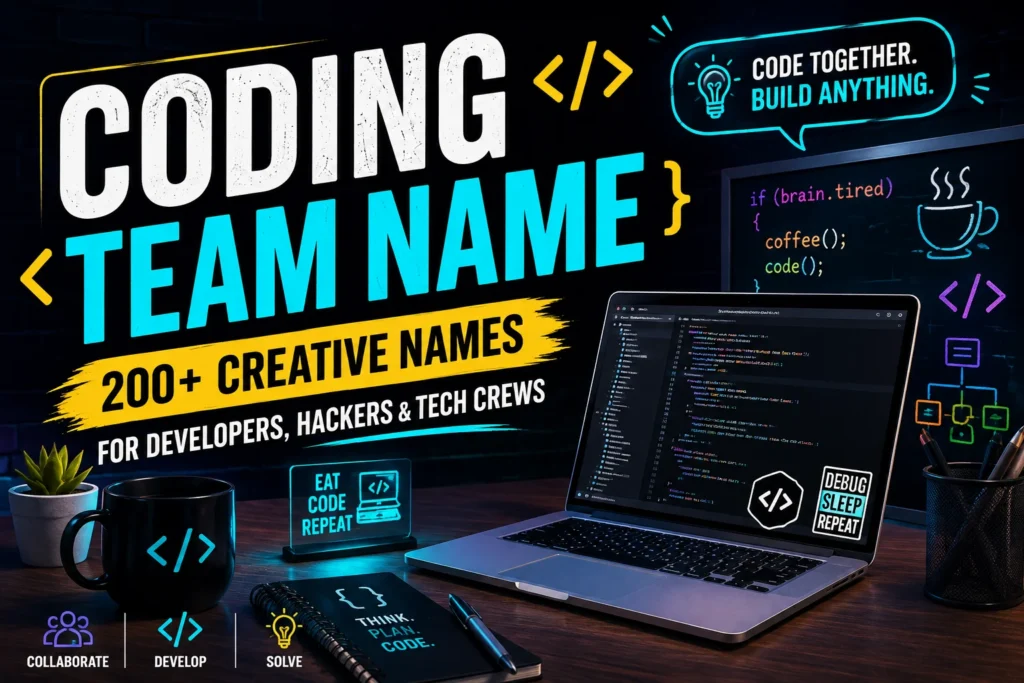
Finding the right coding team name can turn a group of developers into something that feels like an actual crew. Below are 200 coding team names divided into practical categories, from clever developer references and debugging humor to clean, modern names that work for hackathons, coding clubs, projects, competitions, and workplace teams.
A strong name also makes your team easier to recognize in a crowded coding event or project space while giving everyone a shared identity beyond the code itself.
How These Coding Team Names Were Curated
This list was built around names that sound usable in real developer environments rather than simply combining random technology words. I focused on names that can work across different experience levels, programming interests, team sizes, and settings without depending too heavily on one programming language or a short-lived tech trend.
I also avoided relying on the same predictable combinations throughout the list. Some names are playful, some technical, and others deliberately simple so you can choose something that matches your team’s personality rather than forcing every group into the same style.
How to Choose a Good Coding Team Name
Match the Name to Your Team’s Personality
Start by deciding what your group actually feels like. A serious software engineering team may want something polished, while a hackathon group might prefer a clever programming joke.
Think about whether your team is competitive, relaxed, experimental, academic, startup-focused, or simply a group of friends who enjoy building things together.
A useful approach is to choose one dominant personality trait and build around it.
For example:
- Technical + confident: Code Command
- Playful + developer-focused: Bug Buffet
- Creative + modern: Pixel Foundry
The best names usually communicate a feeling quickly instead of requiring a paragraph of explanation.
Use a Simple Naming Formula
A reliable formula is Coding Concept + Team Identity.
Examples include:
- Syntax Syndicate
- Runtime Crew
- Debug Collective
Another useful formula is Tech Object + Action Word.
Examples include:
- Binary Builders
- Pixel Forge
- Server Shapers
These formulas give you a starting point without making every name sound identical.
Think About Where the Name Will Appear
A coding team might use its name on a hackathon leaderboard, presentation slide, project repository, event badge, group chat, classroom board, or internal company page.
Short names are generally easier to display and remember. If your team will use the name across several places, check how it looks without extra context.
A name that sounds excellent when spoken may look awkward when squeezed into a small interface, so visual simplicity is worth considering.
Avoid Names That Are Too Narrow
A team built around one project today may work on something completely different six months from now.
For example, a name based entirely on one framework could become limiting if the team moves to another stack. A broader name such as Logic Foundry or Code Current can remain relevant as your interests change.
If the team is specifically dedicated to one language, framework, or technology, however, a more focused reference can be exactly what makes the name memorable.
Make Sure Everyone Can Say It Easily
A clever name is less useful if teammates constantly have to explain how to pronounce it.
Say your shortlist aloud. Imagine someone introducing the group during a presentation: “Next up is…” If the name flows naturally after that sentence, it is probably a strong candidate.
Also watch for unintended meanings, especially if the team will represent a school, company, community, or public project.
Check Uniqueness Before Finalizing
Once you have a favorite, search for the exact phrase before adopting it. Check your event, organization, project, repository, social profile, or team directory where relevant.
A name does not have to be completely unique across the internet to be usable, but avoiding a direct collision with another active team makes recognition much easier.
Clever Coding Team Names
These names lean into programming concepts without becoming overly technical. They are useful when you want something that sounds smart, memorable, and unmistakably connected to development.
| Name | Style/Tone |
|---|---|
| Syntax Syndicate | Clever and confident |
| Logic Loop | Minimal and technical |
| Code Current | Modern and energetic |
| Runtime Rebels | Playful and bold |
| Binary Builders | Technical and collaborative |
| Function Junction | Lighthearted |
| Compile Crew | Short and practical |
| Stack Theory | Intelligent and polished |
| Code Circuit | Futuristic |
| Algorithm Avenue | Creative and technical |
| Logic Foundry | Strong and professional |
| Variable Vision | Modern and inventive |
| Source Squad | Casual developer style |
| Byte Brigade | Energetic and memorable |
| Program Pulse | Sleek and modern |
| Debug Dynasty | Competitive and playful |
| Script Society | Community-oriented |
| Code Cartel | Edgy and confident |
| Loop Legends | Fun and competitive |
| Digital Draft | Creative and flexible |
Funny Coding Team Names
If your group enjoys inside jokes, late-night debugging, and laughing at problems that somehow disappear after restarting the program, these names fit a lighter atmosphere.
| Name | Style/Tone |
|---|---|
| Bug Buffet | Silly and memorable |
| Ctrl Alt Defeat | Classic computer humor |
| Commit Me Maybe | Music-inspired coding joke |
| The Missing Semicolons | Self-aware humor |
| Cache Me Outside | Pun-heavy |
| Code Before Coffee | Relatable developer humor |
| It Works Locally | Developer inside joke |
| Have You Tried Restarting? | Casual and humorous |
| The Null Squad | Technical comedy |
| Bug Whisperers | Playful |
| Syntax Errorists | Clever wordplay |
| Merge Happens | Relaxed and witty |
| Rubber Duck Club | Developer culture reference |
| Keyboard Warriors | Energetic and humorous |
| Git Happens | Short and punny |
| The Sleep-Deprived Devs | Hackathon humor |
| Undefined Behavior | Nerdy and funny |
| Exceptionally Funny | Technical wordplay |
| Ctrl Freaks | Short and cheeky |
| Works On My Machine | Classic developer humor |
Short Coding Team Names
Short names are easy to remember and work particularly well when your team needs something that looks clean on badges, slides, project pages, or competition boards.
| Name | Style/Tone |
|---|---|
| CodeLab | Clean and modern |
| ByteLab | Technical and compact |
| DevCore | Professional |
| CodeNest | Friendly |
| BitForge | Strong and modern |
| DevGrid | Structured |
| CodeMint | Fresh and brandable |
| LoopLab | Technical |
| ByteCrew | Casual |
| DevPulse | Energetic |
| CodeArc | Sleek |
| BitShift | Developer-focused |
| DevSpark | Creative |
| CodeWave | Modern |
| LogicLab | Academic and technical |
| ByteWorks | Professional |
| DevHive | Collaborative |
| CodePeak | Competitive |
| BitCraft | Creative |
| ScriptX | Futuristic |
Programming Language-Inspired Team Names
These names draw from the broader world of programming languages without making the team dependent on one specific technology. They can be especially fitting for coding clubs, classroom groups, or mixed-language development teams.
| Name | Style/Tone |
|---|---|
| Syntax Masters | Confident |
| Python Pioneers | Exploratory |
| Java Junction | Friendly |
| Ruby Rhythm | Creative |
| Rust Runners | Strong |
| Swift Sparks | Fast and modern |
| JavaScript Junction | Playful |
| TypeScript Titans | Competitive |
| Coded in C | Minimal and witty |
| The Polymorphs | Technical |
| Functional Force | Advanced and polished |
| Object Oriented Crew | Technical humor |
| Lambda League | Clever |
| Script Shifters | Modern |
| Compiler Collective | Professional |
| Language Loop | Simple |
| Code Polyglots | Versatile |
| Syntax Explorers | Curious |
| Runtime Riders | Energetic |
| The Type Casters | Punny and technical |
Debugging & Problem-Solving Team Names
Every developer eventually encounters a problem that makes perfect sense only after three hours of staring at it. These names celebrate the investigative side of programming and work especially well for competitive teams.
| Name | Style/Tone |
|---|---|
| Debug Detectives | Clever and practical |
| Bug Hunters | Direct and energetic |
| Stack Sleuths | Technical mystery |
| Error Eliminators | Competitive |
| Logic Investigators | Professional |
| Trace Trackers | Technical |
| Fix Factory | Short and strong |
| Patch Patrol | Playful |
| Exception Hunters | Developer-focused |
| Debug Division | Organized |
| Root Cause Crew | Professional |
| Fault Finders | Direct |
| Error Analysts | Serious and technical |
| Code Mechanics | Hands-on |
| The Fixers | Simple |
| Logic Locksmiths | Creative |
| Bug Breakers | Energetic |
| Trace Masters | Technical |
| Repair Runtime | Clever |
| Solution Stack | Polished |
Keyboard & Computer-Themed Coding Team Names
For teams that want a recognizable computer theme without using complicated programming terminology, these names borrow inspiration from keyboards, screens, files, terminals, and everyday developer hardware.
| Name | Style/Tone |
|---|---|
| Keyboard Kings | Bold and playful |
| Terminal Tribe | Technical and social |
| Screen Squad | Casual |
| Command Crew | Confident |
| Pixel Pilots | Creative |
| Cursor Collective | Modern |
| File Force | Simple |
| Mouse Mavericks | Fun |
| Desktop Dynamos | Energetic |
| Command Line Club | Technical |
| Keyframe Crew | Creative |
| Screen Shapers | Design-oriented |
| Input Output | Minimal |
| Terminal Titans | Competitive |
| Pixel Mechanics | Technical |
| Shortcut Society | Clever |
| Codeboard Crew | Playful |
| Digital Keys | Sleek |
| Cursor Chasers | Fun |
| Machine Minds | Intelligent |
Data & Algorithm Coding Team Names
These names are suited to groups that enjoy algorithms, data structures, optimization, logic puzzles, or technical competitions. They have a more analytical feel without becoming difficult to understand.
| Name | Style/Tone |
|---|---|
| Algorithm Architects | Professional |
| Data Drivers | Modern |
| Logic Layers | Technical |
| Graph Gurus | Clever |
| Array Alliance | Collaborative |
| Binary Minds | Smart and compact |
| Queue Command | Technical |
| Stack Strategists | Competitive |
| Data Crafters | Creative |
| Algorithm Atlas | Sophisticated |
| Recursive Minds | Technical |
| Hash Heroes | Playful |
| Logic Matrix | Futuristic |
| Query Quest | Creative |
| Data Dynamics | Energetic |
| Sorting Society | Clever |
| Node Navigators | Technical |
| Structure Squad | Straightforward |
| Pattern Processors | Analytical |
| Algorithm Forge | Strong and technical |
Cloud, DevOps & Infrastructure Team Names
For teams working with deployment, infrastructure, cloud systems, automation, servers, or large-scale applications, these names bring a more engineering-focused personality.
| Name | Style/Tone |
|---|---|
| Cloud Command | Strong and modern |
| Server Smiths | Creative |
| Deploy Division | Professional |
| Pipeline Crew | DevOps-focused |
| Container Collective | Technical |
| Infrastructure Minds | Serious |
| Uptime Union | Clever |
| Build Pipeline | Minimal |
| Release Rangers | Energetic |
| Cloud Crafters | Friendly |
| Server Surge | Powerful |
| Deployment Desk | Professional |
| Runtime Infrastructure | Technical |
| Scale Squad | Short and confident |
| System Shapers | Engineering-focused |
| Cluster Crew | Compact |
| Build Operators | Modern |
| Cloud Circuit | Futuristic |
| Version Vanguard | Competitive |
| Platform Pilots | Modern and versatile |
Creative & Product-Building Coding Team Names
Not every development team wants to sound intensely technical. These names work well for hackathons, startup projects, app-building groups, student teams, and developers who see coding as a creative craft.
| Name | Style/Tone |
|---|---|
| Product Forge | Builder-focused |
| Digital Makers | Friendly |
| Idea Engine | Creative |
| Pixel Foundry | Modern |
| Build Bloom | Fresh |
| App Architects | Professional |
| Creative Compile | Clever |
| Launch Logic | Startup-inspired |
| Product Pulse | Modern |
| Innovation Loop | Energetic |
| Maker Matrix | Technical and creative |
| Build Brigade | Collaborative |
| Digital Workshop | Approachable |
| Concept Coders | Clear and practical |
| Prototype People | Friendly |
| Feature Foundry | Product-focused |
| App Alchemists | Imaginative |
| Creation Circuit | Futuristic |
| Build Theory | Sophisticated |
| Launch Lab | Short and brandable |
Nerdy & Tech-Culture Coding Team Names
These names are ideal for groups that want their technical interests to be obvious while keeping the overall tone playful. They work especially well among friends, coding clubs, gaming communities, and informal developer groups.
| Name | Style/Tone |
|---|---|
| Nerd Node | Short and playful |
| Geek Stack | Casual |
| Silicon Souls | Futuristic |
| Tech Tinkerers | Friendly |
| Code Geeks United | Community-focused |
| Circuit Nerds | Playful |
| Digital Braintrust | Smart and polished |
| Pixel Nerds | Casual |
| The Logic Geeks | Friendly |
| Binary Buffs | Technical |
| Geek Mode | Minimal |
| Tech Think Tank | Professional |
| Code Curiosity | Creative |
| The Nerd Network | Social |
| Digital Brainwaves | Inventive |
| Circuit Scholars | Academic |
| Syntax Nerds | Developer-focused |
| Byte Brains | Short and catchy |
| Tech Brainbox | Quirky |
| The Code Collective | Community-oriented |
Professional Coding Team Names
If the team represents a company, university, development department, consultancy, or serious project, a polished name can feel more appropriate than a heavy programming joke.
| Name | Style/Tone |
|---|---|
| Code Vanguard | Professional and strong |
| Digital Strategy | Corporate |
| Logic Partners | Polished |
| Software Collective | Professional |
| Engineering Edge | Modern |
| Code Authority | Confident |
| Technical Core | Serious |
| Digital Architects | Professional |
| Software Frontier | Forward-looking |
| Development Guild | Established |
| Code Framework | Structured |
| Logic Partners | Collaborative |
| Engineering Nexus | Technical |
| Software Works | Simple |
| Digital Foundry | Strong |
| Development Point | Professional |
| Code Standard | Clean |
| Technology Circle | Community-focused |
| Software Vision | Strategic |
| Engineering Union | Collaborative |
Unique & Brandable Coding Team Names
These names move away from obvious developer terminology and aim for something that could work as a recognizable team identity. They are useful when you want a name that feels less like a joke and more like a brand.
| Name | Style/Tone |
|---|---|
| Codevera | Modern and invented |
| Bitora | Short and brandable |
| Devora | Sleek and developer-focused |
| Logivex | Futuristic |
| Codexa | Technical and polished |
| Bytevia | Modern |
| Nexocode | Technology-inspired |
| Devanta | Professional |
| Logiqra | Distinctive |
| Codelith | Strong and memorable |
| Bitnova | Futuristic |
| Devnix | Compact |
| Codentia | Professional |
| Algorise | Algorithm-inspired |
| Techvora | Modern |
| Codezenith | Ambitious |
| Devsphere | Broad and contemporary |
| Bitcrafta | Creative |
| Logicore | Technical and brandable |
| Codemesh | Modern and collaborative |
How to Narrow 200 Coding Team Names Down to One
Having a large list is useful, but the final decision should be much simpler. Start by selecting five names that fit your team’s personality instead of choosing five names that merely sound clever.
Next, say each one aloud as though you are introducing your team at a coding event. This quickly exposes names that look better on a screen than they sound in conversation.
Consider the Team’s Main Activity
A hackathon team, software engineering department, coding club, programming class, and open-source group can all have very different naming needs.
A hackathon team might benefit from something energetic such as Launch Logic, while a professional development department may prefer Digital Architects.
If the group changes projects frequently, choose a name that remains relevant across different technologies.
Think About Longevity
Programming trends change quickly. A name tied to a very specific tool may feel perfect today but dated later.
If longevity matters, concepts such as logic, building, systems, data, development, and creativity can give you more room to evolve.
On the other hand, an inside joke or technology reference may be exactly right for a short-term competition where personality matters more than permanence.
Make the Name Easy to Recognize
Avoid unnecessary punctuation, confusing spellings, or names that are difficult to distinguish when spoken.
A good team name should be recognizable after hearing it once or twice. This becomes particularly valuable when several teams are being announced during a competition.
Get a Quick Team Vote
Instead of asking everyone to invent names indefinitely, give the group a shortlist of five to ten finalists.
Ask each person to choose their top three. This keeps the process moving while giving everyone a voice.
You can also use simple criteria such as memorable, relevant, easy to say, visually clean, and team-appropriate.
Frequently Asked Questions
What is a good name for a coding team?
A good coding team name should be easy to remember, relevant to programming, and appropriate for the team’s personality. Names such as Syntax Syndicate, Logic Foundry, and Code Current work because they connect naturally to development without being overly complicated.
What are some funny coding team names?
Funny options include It Works Locally, Bug Buffet, Commit Me Maybe, Cache Me Outside, and Works On My Machine. These work particularly well for informal coding clubs, hackathons, friend groups, and developer competitions where humor is welcome.
What is a good coding team name for a hackathon?
Hackathon teams often benefit from names that suggest building, experimentation, speed, or creativity. Launch Logic, Product Forge, Idea Engine, Build Brigade, and Prototype People are good choices when the team wants a name connected to creating something quickly.
Should a coding team name include a programming language?
It can, but it does not have to. A language-specific name can be fun when your team specializes in Python, JavaScript, Rust, or another language, while a broader name is usually more flexible if your technology stack changes.
What are good coding team names for beginners?
Beginner-friendly names do not need advanced programming references. Digital Makers, CodeNest, LogicLab, Concept Coders, and Tech Tinkerers are approachable choices that still make the group’s coding focus clear.
How do I make my coding team name unique?
Start with a familiar coding concept and combine it with an unexpected word rather than copying a common technology phrase. After creating a shortlist, search the exact names in your event, school, workplace, project environment, and relevant online spaces to identify obvious conflicts.
What are some professional coding team names?
For a workplace or formal project, consider names such as Digital Architects, Code Vanguard, Engineering Edge, Software Collective, or Technical Core. These names communicate a development focus while avoiding overly casual jokes.
Final Tips
The best coding team name is not necessarily the most complicated or technical one. Choose a name that your teammates can say easily, remember quickly, and feel comfortable putting on a project, presentation, competition entry, or team profile.
Before making the final choice, narrow the list to three to five favorites, ask the whole team for feedback, check the spelling, and verify that the name is available where you plan to use it. A simple name with genuine team personality will usually age better than a forced reference to whatever technology happens to be popular right now.
Quick Final Checklist
- Pick a name that matches your team’s personality.
- Keep pronunciation and spelling straightforward.
- Avoid locking the team into a technology you may stop using.
- Search the final name for obvious conflicts before adopting it.