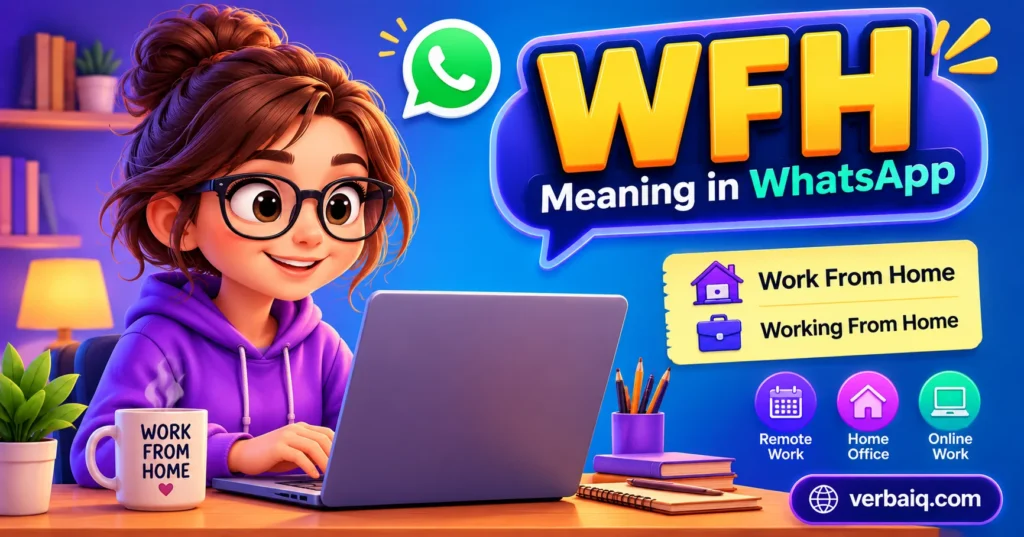
WFH in WhatsApp means “Work From Home” or “Working From Home.” It tells you that someone is doing their job from home instead of traveling to an office or another physical workplace.
What Does WFH Mean in WhatsApp?
When someone writes “WFH” in a WhatsApp message, they are normally talking about their work location or work arrangement.
For example:
“I’m WFH today.”
This simply means:
“I’m working from home today.”
WFH is an abbreviation/initialism, rather than a secret code or a separate slang word. Dictionaries including Cambridge, Merriam-Webster, Oxford, and Collins recognize WFH as an abbreviation for work from home or working from home.
On WhatsApp, the abbreviation is especially useful because people can communicate a work status in just three letters. A coworker might write “WFH today,” a friend might say “Can’t meet, I’m WFH,” or a family member might mention “Dad’s WFH this week.”
The meaning remains essentially the same in each case: the person is working from home rather than working at their usual physical workplace.
WFH Meaning: Work From Home or Working From Home?
You may see WFH expanded in two slightly different ways:
- Work From Home
- Working From Home
Both are legitimate and refer to the same general idea.
The difference is mainly grammatical.
“I WFH on Fridays” uses WFH as a verb-like abbreviation for “I work from home on Fridays.” Cambridge specifically lists WFH as a verb in this use.
“My WFH schedule changed” treats WFH more like a noun/modifier referring to working from home.
So if you see:
“I’m WFH today.”
The natural expansion is:
“I’m working from home today.”
If you see:
“I have a WFH job.”
It means:
“I have a job that I can do from home.”
There is no important difference in the underlying meaning.
Is WFH Slang or an Abbreviation?
WFH is best described as an abbreviation or initialism, although it has become common enough in casual internet communication that people sometimes call it workplace slang.
It is formed from the initial letters of Work From Home:
W = Work
F = From
H = Home
Unlike many internet slang terms, WFH does not depend on humor, irony, profanity, or a particular youth subculture. It is a practical shorthand used in both professional and casual communication.
Merriam-Webster lists WFH as an abbreviation for “work from home” and “working from home.”
A Common Misunderstanding About WFH
One of the easiest mistakes is assuming that WFH means someone is free because they are at home.
It doesn’t.
If someone says:
“I’m WFH today.”
They are telling you that they are working, not taking a day off.
For example, if your friend says:
“Want to go shopping at 2?”
And you answer:
“Can’t, I’m WFH.”
You are explaining that you’re at home but still occupied with your job.
Likewise, a coworker who says “WFH today” may still be attending meetings, answering messages, making calls, and completing normal duties.
WFH Does Not Automatically Mean “Available”
This is an important piece of context that short definitions often leave out.
Someone working from home may actually be less available for personal conversations during certain hours than you expect.
Consider these two messages:
“I’m home today.”
and
“I’m WFH today.”
They are not equivalent.
“I’m home today” tells you where the person is.
“I’m WFH today” tells you both where they are and why they may be busy.
That makes WFH useful as a quick expectation-setting phrase in WhatsApp conversations.
Where Is WFH Used?
WFH is not limited to WhatsApp. Its established meaning is connected to workplace and digital communication more broadly.
On WhatsApp, WFH can appear in:
- One-to-one chats
- Family groups
- Friend groups
- Coworker chats
- Business-related conversations
- Status updates
Examples include:
“WFH today, call me if anything comes up.”
“I’ll be WFH tomorrow.”
“Can’t meet at lunch, WFH.”
WhatsApp gives WFH a particularly flexible tone because the same abbreviation can appear in professional and completely casual conversations.
Text Messages
WFH can also be used in ordinary SMS or private messaging.
For example:
“I’m WFH today so I can’t come into town.”
Here, the abbreviation simply explains the person’s schedule.
Workplace Chat
WFH is particularly natural in workplace communication.
For example:
“WFH today. Available on Teams.”
In this setting, WFH functions almost like a status update.
Social Media
WFH is also used in online posts and captions related to remote work, home-office setups, productivity, and work routines. Social-media dictionary sources describe it as an abbreviation used in online conversations and social media.
However, the meaning does not change just because the platform changes.
The platform may affect the tone, but WFH still normally refers to working from home.
What Does WFH Mean on WhatsApp Specifically?
The WhatsApp meaning is straightforward:
WFH = Work From Home / Working From Home.
But the exact message around it can tell you what the sender wants you to understand.
“I’m WFH.”
Usually means:
“I’m working from home.”
“WFH today.”
Usually means:
“I’m working from home today instead of going into the office.”
“Can we call? I’m WFH.”
The person is probably working from home and wants to communicate remotely.
“WFH, might reply late.”
The person is working and is warning you that they may not respond immediately.
“WFH tomorrow?”
This could be asking whether the other person will be working from home tomorrow.
Context determines whether WFH is describing someone’s current status, asking about their schedule, or referring to a general work arrangement.
Grammar: How Is WFH Used in a Sentence?
WFH is flexible in digital writing.
It can function as a verb-like abbreviation:
“I WFH three days a week.”
Meaning:
“I work from home three days a week.”
It can also act as a noun or modifier:
“My WFH schedule changed.”
“I need a better WFH setup.”
It can even stand alone as a short status:
“WFH today.”
That is common in messaging because chat communication often removes words that would normally be necessary in formal writing.
You generally would not write:
“I am WFH-ing today”
in careful professional prose. Although informal forms such as “WFHing” can appear, the simpler “I’m WFH today” is much more natural.
Where Did WFH Come From?
WFH did not originate with WhatsApp or social media.
The concept of working from home existed long before modern messaging apps, and the abbreviation itself predates the COVID-19 pandemic. Dictionary.com gives its first recorded period as 1990–95.
What changed dramatically was its visibility.
The expansion of remote work during the COVID-19 pandemic made terms such as WFH, remote work, hybrid work, and work-from-home job much more familiar to the general public.
So it would be inaccurate to say that COVID-19 invented WFH. A better description is that the pandemic helped push an existing abbreviation into everyday mainstream communication.
Modern dictionaries now treat WFH as an established English abbreviation rather than merely an obscure internet expression.
There is no strong evidence that WFH originated in AAVE or another particular cultural slang tradition. Its structure is straightforward workplace shorthand, so there is no reason to attribute its origin to a specific cultural dialect without evidence.
WFH vs Remote Work vs Hybrid Work
These terms are related, but they are not identical.
| Term | Meaning | Tone | Popularity | Confusion Risk |
|---|---|---|---|---|
| WFH | Work/Working From Home | Casual to professional | Very high | Low |
| Remote work | Working away from a traditional workplace | Professional | Very high | Medium |
| Hybrid work | Combination of remote and in-office work | Professional | High | Medium |
| Work from home | Performing work from home | Neutral | Very high | Very low |
| WFH job | A job that allows working from home | Casual/professional | High | Low |
| In-office | Working physically at the workplace | Neutral | High | Low |
The most important distinction is between WFH and remote work.
Someone who works remotely does not necessarily work from home. A remote worker might work from a home office, coworking space, library, hotel, or another permitted location.
WFH specifically points to home.
WFH vs Hybrid: Why the Difference Matters
Suppose someone says:
“My job is hybrid.”
That doesn’t necessarily mean they are WFH every day.
They might work:
- Monday and Tuesday at home
- Wednesday through Friday in the office
If they message you on Tuesday:
“WFH today.”
That describes their location that day.
So WFH can describe a particular day’s arrangement even when the person’s overall employment arrangement is hybrid.
This distinction is useful when interpreting WhatsApp messages because “WFH” often refers to today’s work location, not necessarily someone’s permanent work arrangement.
4 WFH Conversations in Different Tones
1. Funny
Alex: “Lunch today?”
Sam: “Can’t. WFH.”
Alex: “So you’re working in pajamas?”
Sam: “That information is classified.”
Here WFH is being used normally, while the rest of the conversation adds humor.
2. Sarcastic
Mia: “Are you coming to the office today?”
Jake: “Nope. WFH.”
Mia: “Another very difficult commute from your bed to your laptop?”
Jake: “Exactly. Traffic was terrible.”
The abbreviation itself is neutral; the sarcasm comes from the surrounding conversation.
3. Playful
Lena: “Movie later?”
Chris: “Maybe. I’m WFH today.”
Lena: “Then your office needs a snack delivery.”
Chris: “Finally, someone understands remote-work productivity.”
4. Serious
Manager: “Will you be in the office tomorrow?”
Employee: “No, I’ll be WFH.”
Manager: “Okay. Please join the 10 a.m. meeting online.”
Employee: “Absolutely.”
Here WFH is simply a practical work-status abbreviation.
12 More Realistic WFH Text Examples
1. Friends
Friend 1: “Coffee after work?”
Friend 2: “Sure. I’m WFH today, so I’ll finish around 5.”
2. Family
Mom: “Are you coming for lunch?”
Son: “Can’t today. I’m WFH and have meetings.”
3. Coworkers
Nina: “Are you in the office?”
Mark: “No, WFH today. Send me the document here.”
4. Group Chat
Sam: “Anyone free for breakfast?”
Riya: “Not me 😭 WFH until noon.”
5. Dating
Alex: “Want to grab coffee this afternoon?”
Jordan: “I’m WFH today, but I could meet after 6.”
6. Manager and Employee
Manager: “Will you be joining us onsite?”
Employee: “No, I’m WFH today. I’ll attend remotely.”
7. Instagram DM
Friend: “Your home office looks serious 😂”
You: “WFH setup finally upgraded.”
8. WhatsApp Family Group
Sister: “Why are you still at home?”
Brother: “WFH today. I have calls all morning.”
9. Friend Asking About Availability
Taylor: “Can I call?”
Morgan: “Give me 20 minutes. I’m WFH and on a meeting.”
10. Group Project
Student: “Can everyone meet at the library?”
Member: “I can’t. I’m WFH today.”
Student: “No worries, we’ll send the notes.”
11. Casual Status
Friend: “What are you doing?”
You: “WFH ☕💻”
12. Scheduling
Colleague: “Are you WFH Friday?”
You: “Yep. I’ll be online all day.”
These examples show an important pattern: WFH usually communicates work status, not simply physical location.
How to Reply to WFH on WhatsApp
The best response depends on why the person mentioned it.
Neutral Reply
“Got it. Message me when you’re free.”
This works in almost any casual conversation.
Serious or Professional Reply
“No problem. I’ll send everything online.”
This works well with coworkers.
Funny Reply
“The shortest commute wins 😂”
This is appropriate when you’re joking with someone you know well.
Flirty Reply
If the conversation is already romantic, you could say:
“WFH today? Maybe I’ll steal you for coffee after work 😉”
The flirtiness comes from the message around WFH, not from WFH itself.
Who Uses WFH?
WFH is not limited to one age group.
Its widespread use is strongly connected to modern workplace communication and the growth of remote and hybrid work. It appears in professional settings as well as casual digital conversations.
Because it is an established workplace abbreviation, Millennials, Gen X, Gen Z, and other working-age adults may all encounter or use it. There is not strong evidence supporting a meaningful gender-specific usage pattern.
Regional differences are also less important here than workplace and language context. WFH is used in English-speaking environments, and dictionaries such as Cambridge and Collins recognize it in both American and British English.
The biggest factor is usually whether the person communicates in a work environment where remote work is relevant.
Is WFH Rude or Safe?
WFH is not offensive, profane, or inherently rude.
It is generally safe in:
- WhatsApp chats
- Text messages
- Workplace messaging
- Internal emails
- Social media
- Casual conversations
The main consideration is formality.
For a casual WhatsApp message:
“WFH today.”
is perfectly natural.
For a highly formal document, it may be better to write:
“I will be working from home today.”
The issue isn’t that WFH is inappropriate. It is simply that abbreviations may not suit every formal writing situation.
Is WFH the Same as Being Off Work?
No.
This deserves special attention because it is one of the most practical differences between WFH and ordinary “at home” language.
WFH = working.
Day off = not working.
For example:
“I’m home today.”
could mean many things.
But:
“I’m WFH today.”
specifically indicates that work is taking place from home.
If someone says “I’m WFH,” you should generally assume they have work responsibilities unless the surrounding context says otherwise.
Can WFH Mean Something Else?
In ordinary WhatsApp conversations about jobs, schedules, meetings, or work, Work From Home / Working From Home is overwhelmingly the relevant interpretation.
There are other expansions of the letters WFH in specialized contexts. For example, Wiktionary records WFH as an initialism for work for hire in U.S. copyright law and World Federation of Hemophilia in a medical/organizational context.
Those meanings are not what someone normally means when they text:
“I’m WFH today.”
Context is therefore essential. If the conversation is about employment and daily schedules, read WFH as work from home. If it appears in a specialized legal or organizational context, the surrounding subject may point to another expansion.
Why WFH Works So Well in WhatsApp Conversations
WFH survives because it solves a very specific communication problem in only three letters: it tells people both what you’re doing and why your availability may be different. “I’m home” doesn’t explain your schedule, while “I’m working from home today” is unnecessarily long when everyone in the conversation already understands the workplace shorthand.
WFH therefore sits comfortably between professional terminology and everyday texting—it is short enough for casual chat but established enough to be understood in workplace communication.
Frequently Asked Questions
What does WFH mean in WhatsApp?
WFH usually means “Work From Home” or “Working From Home.” It tells you that someone is doing their job from home rather than traveling to a traditional workplace. The abbreviation can be used casually or professionally.
Does WFH mean someone is free?
No. WFH means the person is working from home, not taking the day off. They may still have meetings, deadlines, calls, and other responsibilities. Being physically at home does not necessarily mean they are available.
Is WFH slang?
WFH is more accurately an abbreviation or initialism than traditional slang. However, it is common in casual messaging, so people sometimes describe it as workplace slang. Major dictionaries recognize it as an established abbreviation.
What does “I’m WFH today” mean?
It means “I’m working from home today.” The person is likely doing their normal job remotely instead of physically going to their office or workplace. It can also explain why they are not available for an in-person meeting or social plan.
Is WFH the same as remote work?
Not exactly. WFH specifically means working from home, while remote work can take place from various locations outside a traditional workplace. Someone can therefore be a remote worker without literally working from home every day.
Can WFH be used in professional messages?
Yes. WFH is widely used in workplace communication, particularly in informal or internal messages. For highly formal writing, spelling out “working from home” may be preferable depending on the audience.
Did WFH start during COVID-19?
No. The abbreviation existed before the pandemic; Dictionary.com records WFH as dating to the 1990–95 period. The pandemic greatly increased the visibility and everyday use of remote-work terminology.
Can WFH be used as a verb?
Yes. Cambridge lists WFH as a verb in usage such as “I WFH five days a week.” In that construction, it means “I work from home.”
Conclusion
If you see WFH in a WhatsApp message, the safest interpretation is “Work From Home” or “Working From Home.”
It is an abbreviation rather than offensive or secret slang, and it can be used in both casual and professional conversations.
Remember these key points:
- WFH = Work From Home / Working From Home
- It normally means someone is working from their home.
- It does not mean they are automatically free.
- It is commonly used in workplace and digital communication.
- It can describe a single day’s arrangement or a broader work routine.
- Remote work is broader than WFH because remote work does not always happen at home.
- The abbreviation existed before COVID-19 but became far more visible as remote work expanded.
- On WhatsApp, context determines whether WFH is simply a status update, an explanation for someone’s availability, or part of a work-related conversation.
So, if a coworker messages “WFH today”, there is usually nothing mysterious behind it: they’re working, just from home.