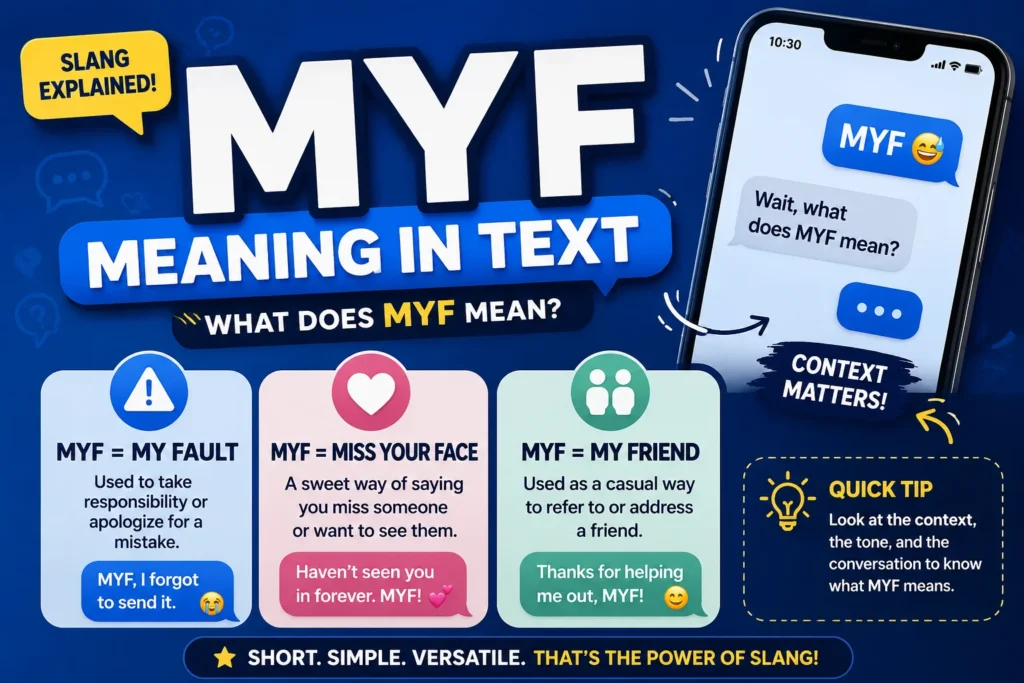
MYF most commonly appears as a short form for “My Fault” or “Miss Your Face,” depending on context. It can also be used as “My Friend” in some casual online conversations, so the surrounding message is important before deciding what the sender meant.
What Does MYF Mean in Text?
MYF is a texting abbreviation rather than a standard English word. Two meanings have particularly useful evidence behind them: “My Fault” and “Miss Your Face.” A third expansion, “My Friend,” appears in current slang references, but it is less consistently documented than the first two.
When MYF means “My Fault,” it is an informal way to accept responsibility for a mistake. It works similarly to “my bad” or “that was on me.”
“MYF, I forgot to send the file.”
Here, the sender is essentially saying, “My fault, I forgot to send it.”
When MYF means “Miss Your Face,” it has an affectionate meaning. It tells someone that the sender misses seeing them or being around them.
“It’s been forever. MYF!”
In this case, the abbreviation is warm rather than apologetic.
MYF = My Fault
“My Fault” is particularly well documented as a texting meaning. Urban Dictionary has entries dating from 2021 describing MYF as an abbreviated apology, while a 2024 Dexerto article specifically reported MYF being used on TikTok to mean “My Fault.”
The expression is useful when the mistake is relatively small:
- “MYF, wrong group chat.”
- “MYF, I thought you said Friday.”
- “MYF, I completely forgot.”
- “MYF 😭 I sent the old version.”
The tone can range from genuinely apologetic to very casual.
MYF = Miss Your Face
“Miss Your Face” is another established texting use. An Urban Dictionary entry for this meaning dates to 2009, which is useful evidence that the expression was already being used as text/SMS slang by then.
It usually communicates affection, nostalgia, or a desire to see someone again.
For example:
“MYF! When are you coming back?”
This does not literally mean the sender is concerned only about the person’s face. It is a playful way of saying that they miss seeing or spending time with that person.
MYF = My Friend
“My Friend” also appears in several current slang references as an interpretation of MYF. It makes sense grammatically when used as a form of address, such as “Thanks, MYF,” but the available evidence is less consistent than it is for “My Fault” and “Miss Your Face.”
For that reason, it is better to treat “My Friend” as a context-dependent use rather than a universal definition.
The Most Important Difference: Apology or Affection?
The fastest way to interpret MYF is to look at what comes immediately before and after it.
If someone has just admitted a mistake, “My Fault” is the natural interpretation.
“Oops, I sent that to the wrong person. MYF.”
If the conversation is about missing someone, a reunion, an old photo, or seeing someone again, “Miss Your Face” becomes much more plausible.
“Found our old graduation pics. MYF 🥹”
If MYF appears directly after a person’s name or as a form of address, “My Friend” may be intended.
“Thanks for helping me, MYF.”
This context-first approach is more reliable than assuming every three-letter abbreviation has one fixed definition.
Is MYF an Acronym, Abbreviation, or Slang?
MYF is best described as a texting abbreviation or initialism when the letters represent a phrase such as “My Fault” or “Miss Your Face.”
It is not a conventional English word. People generally encounter it in informal digital communication rather than formal writing.
The capitalization is also flexible. You may see:
- MYF
- myf
- Myf
Capitalization normally does not settle the meaning. The surrounding conversation does.
Where Is MYF Used?
MYF has been documented in text messaging and social-media communication, but its meanings are not standardized by platform.
A 2024 report on TikTok specifically identified “My Fault” as a MYF meaning and noted that the abbreviation can also appear on other social platforms.
Current slang references also describe MYF in contexts including Instagram, Snapchat, WhatsApp, TikTok, and other casual chats, although those sources do not establish reliable platform-wide usage statistics.
So it is safer to say MYF can appear in casual messaging and social-media conversations than to claim that one particular app owns the abbreviation.
How MYF Works Grammatically
MYF does not behave exactly like an ordinary noun or verb because its grammatical role depends on which phrase it represents.
When MYF Means “My Fault”
It generally functions as a short standalone apology:
“MYF. I misunderstood.”
It can also appear at the beginning or end of a message:
“MYF, I should’ve checked first.”
“I sent the wrong link, MYF.”
When MYF Means “Miss Your Face”
It can function as a compact emotional statement:
“MYF ❤️”
It may also appear alongside a longer sentence:
“MYF already. Come back soon.”
When MYF Means “My Friend”
It can function like a form of address:
“What’s up, MYF?”
Because the abbreviation is informal, its sentence position is flexible.
Where Did MYF Come From?
There is no reliable evidence identifying one creator, launch date, or single platform where MYF was invented.
The available evidence suggests that different meanings developed in informal online communication rather than coming from one clearly documented source.
One useful historical clue is an Urban Dictionary entry for “Miss Your Face” dated February 18, 2009. Separate entries for “My Fault” appear later, including entries from 2021.
That does not prove that 2009 was the first-ever use of MYF. It only establishes an early publicly indexed example that can currently be found.
Likewise, claims that MYF definitely originated from a particular generation, city, app, or texting platform should be treated cautiously unless supported by stronger historical evidence.
A Common Misunderstanding About MYF
The biggest misunderstanding is assuming that MYF has one universal definition.
Some current websites confidently call “Miss Your Face” the most common meaning, while others identify “My Fault” or even “My Friend” as the primary meaning.
The disagreement itself is useful evidence: MYF is not standardized enough for a single definition to work in every conversation.
A better approach is to ask what the message is doing.
Mistake → My Fault.
Missing someone → Miss Your Face.
Direct address → possibly My Friend.
That three-part check can solve most examples without guessing.
MYF Example Conversations: Four Different Tones
Funny
Alex: MYF 😂 I just realized I was replying to the wrong chat.
Sam: You wrote all that to your cousin?
Alex: Unfortunately.
Sam: I’m never letting you forget this.
Here, MYF clearly means “My Fault” because Alex has made a mistake.
Sarcastic
Mia: You said the meeting was at 3.
Jordan: It was at 2.
Mia: MYF 😭 I read the calendar wrong.
Jordan: At least you made it before it ended.
Again, MYF works as a quick admission of fault.
Playful
Lena: Look what I found from our beach trip.
Nora: Stoppp 😂
Lena: We looked so happy.
Nora: MYF already.
Here, the affectionate context points toward “Miss Your Face.”
Serious
Chris: I shouldn’t have blamed you for that.
Taylor: It’s okay.
Chris: No, MYF. I should’ve asked first.
Taylor: I appreciate you saying that.
In this context, MYF means “My Fault” and functions as a direct acknowledgment of responsibility.
10 More MYF Conversations in Realistic Situations
Friends — Text Message
A: MYF, I completely forgot our plans.
B: I figured something came up.
A: Nothing came up. My brain just failed me.
B: 😂 Let’s reschedule.
Family — WhatsApp
Mom: You left your keys here again.
Son: MYF 😭
Mom: I’ll keep them safe.
Son: Thank you. I’m coming back now.
Dating — Private Chat
A: Haven’t seen you all week.
B: I know. It’s been way too long.
A: MYF ❤️
B: Then let’s fix that this weekend.
Here the context strongly favors “Miss Your Face.”
Coworkers — Team Chat
A: MYF, I uploaded the wrong spreadsheet.
B: No problem.
A: The corrected one is in the folder now.
B: Got it. Thanks for fixing it.
Instagram DM
A: That throwback just appeared on my feed.
B: 😂 We looked so young.
A: Seriously. MYF.
B: Same. We need another trip.
The nostalgic context supports the affectionate meaning.
Snapchat
A: MYF 😭
B: You saw me yesterday.
A: And?
B: Fair enough 😂
This is playful use of the “Miss Your Face” interpretation.
TikTok Comment
A: MYF, I should’ve checked the caption first.
B: 😂 At least you corrected it.
A: Lesson learned.
B: Happens to everyone.
The mistake makes “My Fault” the obvious interpretation.
Group Chat
A: MYF everyone, I gave you the wrong address.
B: We’re already here.
C: It’s okay, we found it.
A: I owe everyone coffee.
Old Friend
A: Saw our old school photo today.
B: Wow, that’s ancient 😂
A: Seriously. MYF.
B: We should catch up soon.
The memory and reunion context suggest “Miss Your Face.”
Online Gaming Chat
A: MYF, I missed the timing.
B: All good.
A: Next round I’ll be ready.
B: Let’s run it again.
Here it works naturally as “My Fault.”
How to Reply When Someone Says MYF
Your response depends almost entirely on which meaning is intended.
If MYF Means “My Fault”
Funny reply:
“Accepted 😂 Try not to do it twice.”
Serious reply:
“No worries. Thanks for owning it.”
Neutral reply:
“All good.”
If MYF Means “Miss Your Face”
Flirty reply:
“Maybe you should come see me then 😉”
Friendly reply:
“MYF too! It’s been too long.”
Neutral reply:
“Same here. Hope we can catch up soon.”
If you’re genuinely unsure, simply ask:
“MYF as in my fault or miss your face? 😂”
That’s often better than responding to the wrong emotional meaning.
MYF vs Similar Texting Terms
| Term | Meaning | Tone | Popularity | Confusion Risk |
|---|---|---|---|---|
| MYF | My Fault / Miss Your Face / context-dependent | Casual | Less standardized | High |
| MB | My Bad | Casual apology | Common | Low |
| IMY | I Miss You | Affectionate | Common | Low |
| ILY | I Love You | Affectionate | Common | Low |
| TY | Thank You | Friendly/neutral | Very common | Low |
| MY FRIEND | Direct reference to a friend | Friendly | Standard phrase | Low |
| Sorry | Apology | Neutral to serious | Universal | Very low |
The most useful comparison is MYF vs MB when the context involves a mistake. “MB” almost unambiguously means “my bad,” while MYF requires more interpretation.
Similarly, IMY is much clearer when someone wants to say they miss another person. If someone sends “MYF,” the emotional context needs to do more of the work.
Who Uses MYF?
There is not enough reliable demographic evidence to say that MYF belongs specifically to Gen Z, Millennials, teenagers, men, women, Americans, or another demographic group.
Current web sources show MYF appearing in general texting and social-media contexts, while one source specifically reports “My Fault” usage on TikTok.
There is also a user-generated Urban Dictionary entry claiming a Philadelphia connection for the “My Fault” meaning. Because that is a user-submitted slang definition rather than a linguistic study, it should be treated as a reported regional association, not proof that MYF is uniquely or broadly Philadelphia slang.
In practical terms, MYF is best understood as informal online shorthand whose meaning can vary by community and conversation.
Is MYF Rude or Safe?
It depends on the meaning.
When MYF means “My Fault,” it is generally harmless and informal. When it means “Miss Your Face,” it is affectionate and can be friendly or romantic depending on the relationship.
The abbreviation itself is not inherently profane.
However, because MYF has multiple interpretations, it is not ideal for formal school or workplace writing. In a professional email, writing “My fault” or “I apologize” is clearer.
The safest rule is simple: use MYF with people who already understand your casual texting style.
Why Does MYF Work in Conversation?
MYF survives because it compresses a surprisingly large amount of social meaning into three letters. “My Fault” can signal accountability without requiring a formal apology, while “Miss Your Face” can communicate affection without sounding as direct or emotionally heavy as “I miss you.” That flexibility is useful in fast-moving chats, but it is also exactly what creates ambiguity: the same three letters can point in opposite emotional directions—one admits a mistake, while another expresses closeness. The surrounding conversation therefore acts almost like punctuation, telling the reader which interpretation makes sense.
Frequently Asked Questions
What does MYF mean in text from a girl?
There is no reliable gender-specific meaning for MYF. A girl using MYF could mean “My Fault,” “Miss Your Face,” or another context-dependent expansion. Look at the sentence and the relationship rather than assuming the sender’s gender determines the definition.
What does MYF mean from a guy?
The same principle applies when a guy sends MYF. It does not have a fixed male-specific meaning. If he is apologizing, “My Fault” is likely; if he is talking about missing you, “Miss Your Face” may fit better.
Does MYF mean “my fault”?
Yes. “My Fault” is a documented texting use of MYF, including examples in user-generated slang records and reporting about TikTok usage.
Does MYF mean “miss your face”?
Yes. “Miss Your Face” is another documented texting meaning, with a user-generated slang entry dating back to 2009.
Is MYF the same as IMY?
Not necessarily. IMY conventionally expands to “I Miss You,” while MYF can mean “Miss Your Face” but can also mean “My Fault” or other context-specific phrases. If someone sends MYF, the surrounding conversation matters much more.
Is MYF a romantic abbreviation?
It can be when it means “Miss Your Face,” but it is not inherently romantic. Friends and family can use affectionate language like this too, so the relationship and conversation determine whether the message is romantic.
Can MYF mean “my friend”?
Some current slang references use MYF for “My Friend,” particularly when it functions as a casual form of address. However, this meaning is less consistently documented than “My Fault” and “Miss Your Face,” so context is especially important.
What should I do if I don’t know what MYF means?
Look at the sentence immediately before it. If there is a mistake or apology, “My Fault” is likely; if there is nostalgia or missing someone, “Miss Your Face” is more plausible. If neither fits, ask the sender directly instead of guessing.
Final Takeaway
MYF does not have one universally fixed meaning in texting. The strongest documented uses are “My Fault” and “Miss Your Face,” while “My Friend” appears as a less consistently established interpretation.
Use the context as your first clue: mistakes point toward “My Fault,” affectionate or nostalgic messages point toward “Miss Your Face,” and direct-address wording may indicate “My Friend.” When the context is ambiguous, asking is better than confidently choosing the wrong meaning.
For casual chats, MYF can be perfectly natural. For school, work, or other situations where clarity matters, write the full phrase instead.
Meta Title
MYF Meaning in Text: The 3 Meanings You Need to Know
Meta Description
What does MYF mean in text? Discover its real meanings, including “My Fault” and “Miss Your Face,” plus examples, replies, and context clues.