
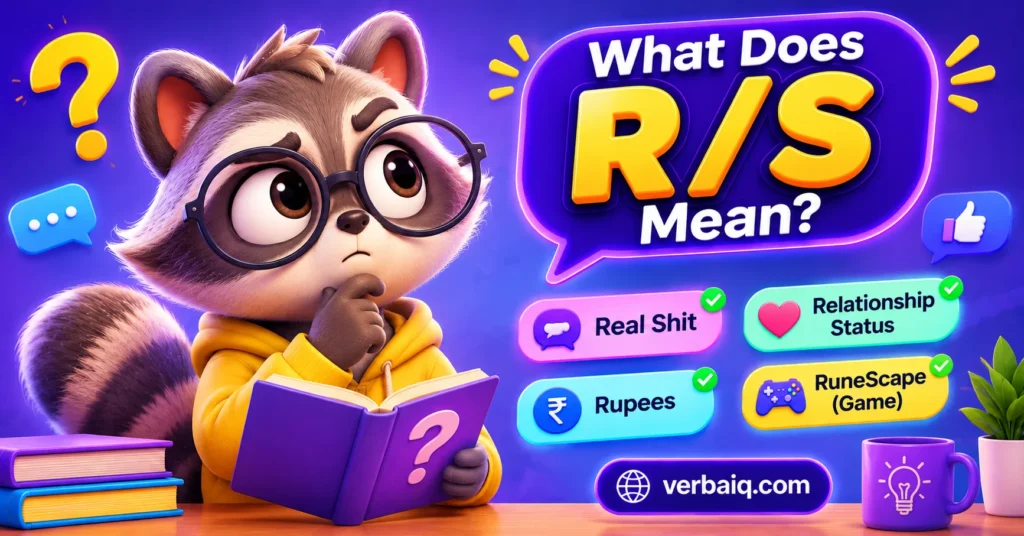
R/S or RS most commonly means “real shit” in modern casual texting, meaning “for real,” “seriously,” or “I strongly agree.” However, the exact meaning depends on the conversation, because RS can also refer to things such as relationship status, rupees, or RuneScape.
If someone sends you “rs” after you make a relatable statement, they are usually emphasizing that they agree or that what you said is genuinely true.
For example:
“I need a vacation so bad.”
“rs.”
Here, rs essentially means “for real” or “seriously.”
The important detail is that R/S is not a single-purpose abbreviation. Context matters. The same two letters can mean something completely different when they appear next to a price, in a gaming conversation, or in a discussion about dating.
What Does RS Mean in Text Slang?
In current online slang, RS most commonly stands for “real shit.” It is used to emphasize honesty, agreement, seriousness, or authenticity.
Someone might write:
- “That exam was brutal rs.”
- “rs, I was thinking the same thing.”
- “You need to leave that situation rs.”
- “RS.”
- “That’s rs.”
In each case, the expression adds weight to the message.
It can be understood as:
- For real
- Seriously
- Honestly
- That’s true
- I agree
- No joke
The expression comes with a somewhat stronger and more informal tone than simply saying “yes.” Current slang references consistently describe RS in this way, particularly in texting and social-media conversations.
Is RS an Acronym or an Abbreviation?
RS is best described as an initialism or text abbreviation when it represents the first letters of “real shit.”
People normally pronounce the letters individually: “R-S.”
It is not a conventional English word. Its meaning comes from the phrase it abbreviates and from the context in which people use it.
The lowercase form “rs” is especially common in informal chats, while “RS” may be used for emphasis or simply because the sender prefers capital letters.
Other Real Meanings of R/S and RS
Although “real shit” is the leading modern slang interpretation, RS has several other established or context-specific meanings.
RS Meaning “Relationship Status”
In conversations about dating or social profiles, RS can mean “relationship status” or, more loosely, “relationship.”
For example:
“What’s your RS?”
Depending on the person and context, this could mean:
“What’s your relationship status?”
This usage is considerably more context-dependent than the slang meaning.
If someone says:
“RS, that movie was amazing.”
they probably are not talking about relationship status.
But:
“What’s your RS with him?”
makes a relationship-related interpretation much more plausible.
RS Meaning “Rupees”
Rs. is also widely used as an abbreviation for rupees, particularly in South Asian contexts.
For example:
“The shoes cost Rs. 4,500.”
Here, RS has nothing to do with internet slang. It refers to money.
A useful shortcut is to look for a number.
If you see:
“Rs 2,000”
the financial meaning is overwhelmingly more likely than “real shit.”
This distinction is especially important in countries and communities where rupees are commonly discussed.
RS Meaning “RuneScape”
In gaming communities, RS can refer to RuneScape, the long-running online role-playing game.
For example:
“Do you still play RS?”
If the conversation is about levels, quests, characters, combat, or online games, RuneScape is a much more sensible interpretation than “real shit.”
This is one reason you should never interpret a two-letter abbreviation without looking at the surrounding message.
Other Context-Specific Meanings
RS can represent other words or names in specialized settings. For example, automotive terminology can use RS in model names, while particular communities may create their own abbreviations.
These meanings should not automatically be treated as slang.
The safest rule is simple:
If the surrounding conversation clearly points toward another subject, follow the subject rather than forcing the slang definition.
A Common Misunderstanding About R/S
A common mistake is assuming that every “RS” in a text means “real shit.”
That is not true.
Consider these three messages:
“That was crazy rs.”
Likely meaning: real shit / seriously
“How much was it? Rs 5,000.”
Likely meaning: rupees
“You still play RS?”
Likely meaning: RuneScape, if the conversation is about gaming
The letters are identical, but the surrounding information changes the interpretation completely.
There is another subtle misunderstanding: some people assume that RS always means agreement. In practice, it can also reinforce the speaker’s own statement.
For example:
“I’m done with this drama, rs.”
Here, RS is not necessarily responding to another person’s opinion. It strengthens the speaker’s own statement.
What Does R/S Mean on Social Media?
When rs appears in casual comments, captions, DMs, or replies, the slang interpretation is often the relevant one.
Current search results consistently show RS appearing in casual social-media communication as a marker of agreement, seriousness, or authenticity.
RS on TikTok
On TikTok, rs can appear in comments or replies to relatable statements.
Example:
“Nobody talks about how exhausting group projects are.”
“rs.”
The commenter means:
“Seriously. That is so true.”
RS on Instagram
On Instagram, it can appear in comments, DMs, or replies.
“I could sleep for 14 hours.”
“rs 😭”
The expression reinforces agreement.
RS on Snapchat
The same casual slang interpretation can occur in Snapchat conversations.
However, Snapchat users also use many platform-specific abbreviations, so context remains important.
RS on WhatsApp
In private WhatsApp chats, rs may simply function as a quick agreement marker.
Because WhatsApp is used for everything from family conversations to business communication, the surrounding topic is especially important.
RS on X
On X, short replies such as “rs” can be used to agree with a post or emphasize that a statement feels truthful or relatable.
The meaning is not created by the platform itself; it comes from the slang usage.
How RS Works Grammatically
RS does not behave like a normal noun or verb. In its slang sense, it works more like a discourse marker or emphasis marker.
It can appear in several positions.
At the Beginning
“RS, people need to stop doing that.”
Here it introduces the speaker’s strong agreement or serious opinion.
At the End
“That was the longest meeting ever rs.”
Here it reinforces the statement.
As a Standalone Reply
“I’m so tired of pretending I like Monday mornings.”
“rs.”
This is one of the clearest uses because the response essentially means:
“For real.”
Inside a Sentence
“I’m rs about quitting.”
This type of construction is more dependent on the speaker’s personal slang style and can be less natural than using RS as an emphasis marker.
For clarity, the standalone or sentence-edge use is generally easier to interpret.
Where Did RS Come From?
There is no well-documented single inventor, launch date, or platform that can confidently be identified as the origin of the modern slang abbreviation RS.
The phrase “real shit” existed in informal speech before its shortened texting form, and digital communication naturally encourages people to compress frequently used expressions.
Older online records show RS used as “real shit” in texting at least by the 2010s, including a 2017 Urban Dictionary entry describing it as a texting expression for strong agreement.
That establishes documented online usage, but it does not prove that the abbreviation was invented in 2017. Slang normally circulates informally before its earliest searchable online records.
It is therefore more accurate to say that the exact origin of RS as texting slang is unclear, while its documented online use goes back at least to the 2010s.
There is also no strong evidence that the abbreviation itself can be confidently attributed to one particular ethnic group, platform, or social-media trend. Claims assigning a single cultural origin should therefore be treated cautiously.
Four Short R/S Conversations by Tone
Funny
Alex: I ate the whole pizza by myself.
Mia: Again??
Alex: I was hungry 😭
Mia: rs, you have no self-control.
Here, RS adds humorous agreement.
Sarcastic
Sam: Another meeting that could’ve been an email.
Jordan: rs.
Sam: And they scheduled a follow-up.
Jordan: Amazing. Truly living the dream.
The RS reinforces the sarcastic complaint.
Playful
Lena: You still owe me ice cream.
Chris: rs?
Lena: Don’t act confused 😂
Chris: Fine, fine. I remember.
Here, the expression can help create a playful back-and-forth.
Serious
Nora: I think you should stop letting them treat you like that.
Ava: rs?
Nora: Yes. I mean it. You deserve better than that.
Ava: Okay. I needed to hear that.
In a serious conversation, RS can reinforce sincerity, although the surrounding message carries most of the emotional meaning.
12 More Realistic R/S Examples
1. Between Friends
Friend 1: I need a break from everyone.
Friend 2: rs.
Friend 1: Like a whole week offline.
Friend 2: Honestly, same.
2. Group Chat
A: Why does everyone become busy exactly when you need help?
B: rs 😭
C: That part.
A: Glad I’m not the only one noticing.
3. Dating
A: I don’t want mixed signals anymore.
B: rs.
A: Either you’re interested or you’re not.
B: Exactly.
4. Family
Sister: Mom really does know everything.
Brother: rs 😂
Sister: I don’t even know how she finds out.
Brother: She has sources.
5. Coworkers
Alex: Three meetings before lunch should be illegal.
Taylor: rs.
Alex: I’m already exhausted.
Taylor: And it’s only 11:30.
6. Instagram Comment
User 1: This song never gets old.
User 2: rs 🔥
User 1: Exactly!
User 2: Still on repeat.
7. Snapchat
A: I stayed up until 3 watching one episode.
B: rs 😭
A: Then I realized there were six more.
B: That’s how they get you.
8. WhatsApp
A: This weather makes me want to sleep all day.
B: rs.
A: Finally someone understands.
B: Same struggle.
9. School Friends
A: That test was nothing like the revision sheet.
B: rs.
A: I studied the wrong chapters.
B: We all did.
10. Gaming Chat
A: I finally reached the next level.
B: RS!
A: Took me forever.
B: Worth it though.
Here, the meaning should be determined from the surrounding gaming context. RS could also refer to RuneScape in a different gaming conversation.
11. Money Conversation
A: How much did the phone cost?
B: Rs 85,000.
A: That’s expensive.
B: I know.
Here, Rs clearly refers to rupees, not slang.
12. Relationship Conversation
A: Are they officially together?
B: I don’t know their RS.
A: I’ll just ask them.
Here, the context makes relationship status the intended interpretation.
How to Reply When Someone Says “RS”
Your response should depend on what the person means.
Funny Reply
“Finally, someone speaking facts 😂”
Serious Reply
“Exactly. I completely agree.”
Flirty Reply
If the conversation is already romantic:
“RS? So you admit I’m right? 😏”
Neutral Reply
“For real.”
If you’re unsure what the sender means, simply ask:
“RS as in real shit?”
That is much better than confidently responding to the wrong meaning.
RS vs Similar Texting Terms
| Term | Meaning | Tone | Popularity | Confusion Risk |
|---|---|---|---|---|
| RS | Usually “real shit” | Strong, casual | High in slang contexts | High |
| FR | For real | Casual, emphatic | Very high | Low |
| NGL | Not gonna lie | Honest, conversational | High | Low |
| TBH | To be honest | Direct, honest | High | Low |
| IKR | I know, right? | Agreeing, conversational | High | Medium |
| Cap | A lie or false claim | Casual, skeptical | High | Medium |
| Facts | Strong agreement / truth | Direct, emphatic | High | Low |
RS vs FR
RS and FR are probably the closest comparisons.
“That movie was terrible fr.”
and:
“That movie was terrible rs.”
Both can communicate strong agreement or sincerity.
The difference is mostly tone and intensity. FR (“for real”) is more flexible and can even be used as a question:
“Fr?”
RS generally feels more like a firm statement.
Read More:
A Useful Way to Decode RS
When you encounter RS, don’t immediately expand the letters. Instead, use this three-step test.
Step 1: Look at What Comes Before It
If someone says:
“That was the best concert ever rs.”
the slang interpretation is likely.
Step 2: Look for Numbers
If you see:
“Rs 2,500”
you are almost certainly looking at the abbreviation for rupees.
Step 3: Identify the Topic
Gaming conversation?
RS could refer to RuneScape.
Dating conversation?
RS may refer to relationship status.
Casual reaction to a relatable statement?
RS most likely means real shit.
This approach is more reliable than memorizing one definition.
Who Uses RS?
There is evidence of RS being used in modern online slang and casual texting, but it would be an overstatement to claim that all Gen Z users use it or that it belongs exclusively to one age group.
Younger internet users may encounter it frequently in slang-heavy environments, while older users may recognize it without necessarily using it themselves.
There is also no reliable basis for saying that one gender uses RS more than another.
Regional context matters more when RS is being used as something other than slang. For example, Rs. is naturally understood as a currency abbreviation in places where rupees are commonly discussed.
Is R/S Rude or Safe?
If RS means “real shit,” it contains a word that is considered profanity or crude language in many settings.
That does not necessarily make the abbreviation aggressive or insulting. Among friends, it can be completely ordinary.
However, it is better to avoid it in:
- Formal school assignments
- Professional emails
- Job applications
- Official documents
- Messages to clients
- Formal workplace communication
If you want the same general idea without profanity, alternatives such as “for real,” “seriously,” “honestly,” or “facts” are safer.
The abbreviation itself is not inherently offensive. Its tone depends heavily on the context and the meaning intended.
Why Does RS Work So Well in Text?
RS works because written messages lack many of the signals people use in face-to-face conversation. You cannot hear someone’s voice or see whether they are being sincere, sarcastic, frustrated, or completely serious.
A tiny expression such as rs gives the reader an extra signal: I mean this; I agree; this is genuinely true. That makes it more than simple typing shorthand. It functions almost like digital punctuation for sincerity. Its continued use is therefore less about saving two or three keystrokes and more about quickly communicating an attitude.
Frequently Asked Questions
What does R/S mean in text?
In modern casual slang, RS most commonly means “real shit.” It is used to express strong agreement, honesty, seriousness, or the idea that something is genuinely true. The intended meaning can change when the surrounding topic points to something else.
Does RS mean “real shit”?
Yes. “Real shit” is the leading slang interpretation of RS in casual texting and social-media conversations. It often works like “for real,” “seriously,” or “that’s true.” Current slang references consistently identify this as a major modern use.
What does RS mean on Snapchat?
On Snapchat, rs can mean “real shit” when it appears as a reaction to something relatable or serious. For example, replying “rs” to “I need a vacation” means something like “for real.” However, the topic of the conversation should always be checked before deciding on the meaning.
Is RS the same as FR?
They are similar but not identical. FR means “for real,” while RS most commonly represents “real shit.” Both can express agreement or sincerity, but RS can carry a slightly stronger or more intense informal tone.
Can RS mean relationship status?
Yes, RS can refer to relationship status in relationship-related conversations. For example, “What’s your RS?” may be asking about someone’s relationship status. This meaning is much more dependent on context than the slang meaning.
Does RS mean rupees?
Rs. can be an abbreviation for rupees, especially when it appears next to a price. “Rs 5,000” means 5,000 rupees, not “real shit.” Numbers and financial context are the easiest clues for recognizing this meaning.
Can RS mean RuneScape?
Yes. In gaming conversations, RS is commonly used as shorthand for RuneScape. A message such as “Do you still play RS?” can therefore refer to the game rather than slang. Look for gaming-related words around the abbreviation.
Is RS appropriate for school or work?
If RS means “real shit,” it is best treated as casual slang and avoided in formal communication because the expanded phrase contains profanity. In professional or academic settings, use clearer alternatives such as “seriously,” “for real,” or “I agree.”
Conclusion
So, what does R/S mean? In modern casual texting, RS most commonly means “real shit,” a slang expression used to show strong agreement, honesty, seriousness, or authenticity.
But RS is highly context-dependent. It can also refer to relationship status, rupees, RuneScape, or other specialized meanings.
The easiest way to decode it is to examine the message around the abbreviation:
- “That’s so true rs” → real shit
- “Rs 5,000” → rupees
- “Do you play RS?” in a gaming chat → likely RuneScape
- “What’s your RS?” in a dating conversation → likely relationship status
Use rs naturally with people who understand casual internet slang, but avoid it in formal writing. And if the context is genuinely ambiguous, asking the sender what they mean is always better than guessing.