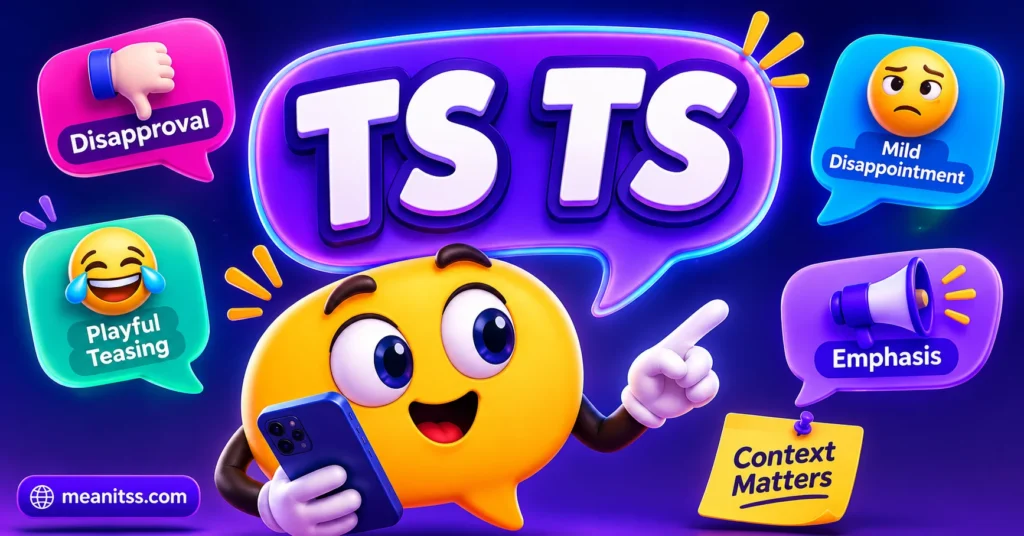
“TS TS” in text most likely represents “tsk tsk,” a written sound used to show mild disapproval, disappointment, teasing, or playful criticism. It is not a standard acronym with one fixed full form.
If someone sends you “ts ts”, the surrounding conversation matters. In the most defensible interpretation, it is a casual text version of “tsk tsk,” similar to saying “oh, you shouldn’t have done that” or “for shame” in a teasing way. Dictionaries describe tsk and tsk tsk as expressions of disapproval, and Cambridge specifically notes that repeating the sound can be humorous.
There is an important caveat, though: “TS TS” is not a well-established abbreviation in the same way as “LOL,” “BRB,” or “BTW.” One recent slang article directly interprets “TS TS” as “tsk tsk,” but broader dictionary evidence supports the underlying expression tsk tsk, not a separate standardized slang term called “TS TS.”
What Does TS TS Mean in Text?
In casual messaging, TS TS = “tsk tsk” is best understood as a written representation of a little tongue-clicking sound associated with disapproval.
It can communicate:
- Mild disappointment
- Playful disapproval
- “For shame”
- Light teasing
- A gentle scolding
- Mock annoyance
- “You really did that?”
- “You know better than that.”
For example:
Friend: I ate the last slice and didn’t tell you.
You: ts ts 😭
The sender probably isn’t genuinely angry. They are playfully pretending to scold you.
The same expression can become more serious depending on the conversation:
Friend: I lied to my parents about where I was.
You: tsk tsk… that’s not a good idea.
The meaning comes less from the letters themselves and more from the social reaction they represent.
Oxford defines tsk tsk as an expression written to represent the sound someone makes with their tongue when they disapprove of something.
Is TS TS an Acronym or Slang?
Not really.
Unlike abbreviations such as “IDK” = “I don’t know” or “TY” = “thank you,” tsk tsk is an onomatopoeic or sound-representing expression. In other words, the written form imitates a sound or gesture rather than shortening a conventional phrase.
“TS TS” appears to be an informal spelling of the already-established “tsk tsk.”
That distinction matters because you shouldn’t automatically try to expand every pair of letters into a phrase. Here, the letters are representing a sound.
Merriam-Webster classifies tsk as an interjection and describes it as a dental click used to express disapproval. It records the first known use of tsk in 1937 and tsk-tsk in 1930.
A Common Misunderstanding: Is TS TS the Same as Modern “TS” Slang?
Not necessarily.
This is where things get confusing.
Online, “ts” has developed other uses. Recent internet-slang discussions commonly associate lowercase ts with expressions such as “this shit,” particularly in phrases like “ts pmo.” There has also been discussion around people using ts to mean simply “this.”
But “ts ts” is a different pattern when it is being used as tsk tsk.
Compare:
- “ts is crazy” → potentially modern “this/this shit” slang, depending on context.
- “ts pmo” → commonly interpreted in current slang discussions as “this shit pisses me off.”
- “ts ts 😭” → potentially a stylized “tsk tsk,” expressing playful disapproval.
- “tsk tsk” → the established written expression for disapproval.
So don’t automatically interpret every appearance of ts or TS the same way.
How TS TS Is Used in a Conversation
The easiest way to understand it is to imagine the person making a small tongue-clicking sound while shaking their head.
Playful disapproval
“You really forgot my birthday? ts ts 😂”
Meaning:
“Come on, you should know better!”
Mild disappointment
“You didn’t save me any cake? ts ts”
Meaning:
“I’m disappointed in you.”
Teasing
“You said you’d be here at 7 and showed up at 8:30. ts ts 👀”
Meaning:
“Look at you being late again.”
Mock judgment
“You watched the entire season without me? TS TS.”
Meaning:
“Wow, that’s bad behavior.”
The expression doesn’t necessarily indicate serious anger. In fact, repeated tsk sounds are often used humorously or theatrically. Cambridge explicitly notes that tsk can be repeated in a humorous way to suggest disapproval.
Which Apps Is TS TS Used On?
There is not enough reliable evidence to claim that “TS TS” belongs specifically to TikTok, Snapchat, Instagram, WhatsApp, or X.
The underlying expression “tsk tsk” is a general English writing convention, so it can naturally appear anywhere people communicate informally through text.
You may encounter a spelling such as “ts ts” in casual:
- Text messages
- Direct messages
- Online chats
- Comment sections
- Group conversations
However, I would avoid saying that TikTok, Snapchat, Instagram, WhatsApp, or X has a distinct, established “TS TS” slang meaning. The evidence doesn’t support that level of platform-specific certainty.
This is especially important because “ts” by itself has newer internet-slang meanings, while “ts ts” can simply be a casual representation of tsk tsk.
Grammar: What Part of Speech Is TS TS?
“Tsk tsk” functions primarily as an interjection or expressive reaction.
It doesn’t behave like an ordinary noun or verb.
You can put it at the beginning of a response:
Tsk tsk, you shouldn’t have done that.
It can also stand by itself:
“Tsk tsk 😏”
Or appear after a sentence:
“You ate the whole pizza? Tsk tsk.”
The expression can even be turned into a verb in English:
“She tsked when she heard the news.”
Merriam-Webster recognizes tsk-tsk as both a verb and an expression of disapproval, while Dictionary.com also lists tsk as an interjection, noun, and verb.
In texting, however, “ts ts” is most naturally interpreted as a reaction rather than a grammatical sentence.
Where Did Tsk Tsk Come From?
The exact origin is imitative, meaning the written expression represents a sound rather than coming from a particular acronym or named phrase.
Oxford gives the word origin as 1940s and imitative. Merriam-Webster records tsk from the 1930s and tsk-tsk shortly afterward. Dictionary.com likewise describes tsk as expressive in origin and records it from the late 1930s.
So there is no good evidence that “TS TS” originated as a Gen Z acronym.
Instead, the more accurate history is:
spoken tongue-click → written “tsk” → repeated “tsk tsk” → informal digital spellings such as “ts ts.”
There is also no solid basis for claiming that the expression originated in AAVE. The dictionary evidence instead treats tsk as an imitative English expression. That distinction is worth making because modern internet slang sometimes overlaps with AAVE, but this particular expression should not automatically be assigned an AAVE origin.
4 Tone Examples for TS TS
1. Funny
Alex: I finished the entire pizza by myself.
Mia: The entire thing?!
Alex: There was one slice left.
Mia: ts ts 😭 you have no self-control.
Here, the expression is clearly playful.
2. Sarcastic
Sam: I told you I wouldn’t be late.
Jordan: You arrived 45 minutes late.
Sam: Traffic.
Jordan: ts ts… very convincing.
The repetition creates mock disapproval.
3. Playful
Lena: I may have looked at your birthday present.
Chris: You WHAT?
Lena: Just a tiny peek 😂
Chris: ts ts, now you ruined the surprise.
This is teasing rather than genuinely angry.
4. Serious
Mark: I ignored the warning and drove anyway.
Ryan: That’s dangerous.
Mark: I know. I shouldn’t have done it.
Ryan: Tsk tsk. Please don’t do that again.
Here, the same expression sounds more genuinely disapproving.
Realistic TS TS Examples
1. Between friends
A: I forgot to bring the tickets.
B: You had ONE job.
A: I know 😭
B: ts ts.
The response is a humorous scolding.
2. Dating
A: I saw your message and didn’t answer for three hours.
B: I noticed 😂
A: Sorryyy.
B: ts ts, don’t make it a habit.
This is teasing with a slightly affectionate tone.
3. Family
Mom: You left the kitchen light on again.
Son: My bad.
Mom: How many times have I told you?
Son: ts ts 😭
Here the child could even be using the phrase jokingly to imitate the parent’s reaction.
4. Group chat
Friend 1: He said he could cook.
Friend 2: He burned the noodles.
Friend 3: 😭
Friend 1: ts ts.
The group is playfully judging the cooking attempt.
5. Coworkers
Coworker A: I accidentally sent the draft to the wrong person.
Coworker B: Oh no.
Coworker A: They replied “Thanks!”
Coworker B: ts ts 😭
The tone is sympathetic but amused.
6. Snapchat-style conversation
A: I posted the embarrassing picture.
B: WHY WOULD YOU DO THAT
A: It was funny!
B: ts ts 😂
The reaction is mock disapproval.
7. Comment-style reaction
A: “I watched the finale before everyone else.”
B: “ts ts 👀”
The short response acts almost like an emoji reaction.
8. Teasing a friend
A: I said I wasn’t hungry.
B: Then you ate half my fries.
A: They looked good.
B: ts ts.
The phrase means something like “I see what you’re doing.”
9. Mild disagreement
A: I think skipping breakfast is a great idea.
B: That’s terrible advice.
A: I’m doing it anyway.
B: tsk tsk.
The expression communicates disapproval without becoming a full argument.
10. Sibling conversation
A: Did you use my headphones again?
B: Maybe.
A: Without asking?
B: …
A: ts ts.
This gives the message a playful “caught you” feeling.
11. Friendly teasing
A: I said I wasn’t going to buy anything today.
B: And?
A: I bought three things.
B: ts ts 😂
The reaction is affectionate judgment.
12. Lightly dramatic
A: I forgot the password again.
B: Again?!
A: Don’t judge me.
B: Too late. ts ts.
Here, the expression adds theatrical humor.
How Should You Reply to TS TS?
Your best reply depends on whether the sender is genuinely criticizing you or simply teasing.
Funny reply
“I knowww 😭 I have disappointed the entire family.”
Serious reply
“Yeah, you’re right. I shouldn’t have done that.”
Flirty reply
If the conversation is already flirtatious:
“Tsk tsk all you want, you still like me 😏”
Neutral reply
“Haha, fair enough.”
If you’re unsure what the sender means, asking is perfectly reasonable:
“Wait, do you mean tsk tsk? 😂”
That is better than confidently interpreting an ambiguous abbreviation incorrectly.
TS TS vs Similar Expressions
| Term | Meaning | Tone | Popularity | Confusion Risk |
|---|---|---|---|---|
| TS TS | Likely informal “tsk tsk” | Playful/disapproving | Low/uncertain | High |
| Tsk tsk | Expresses disapproval or disappointment | Disapproving, teasing | Established | Low |
| Tut tut | Similar expression of disapproval | Mild, often humorous | Established | Low |
| SMH | “Shaking my head” | Disbelief/disapproval | High | Medium |
| OMG | “Oh my God” | Surprise/shock | High | Low |
| TS | Several possible meanings depending on context | Highly variable | High online | Very high |
| 👍 | Approval/acknowledgment | Positive or neutral | Very high | Low |
The important distinction is that “tsk tsk” has a dictionary-established meaning, while “TS TS” does not appear to have a universally standardized definition of its own.
Who Uses TS TS?
There isn’t reliable evidence showing that “TS TS” belongs specifically to Gen Z, Millennials, teenagers, men, women, or one geographic region.
The underlying expression tsk tsk is much older than current internet slang. It appears in established English dictionaries and has been used in writing for decades.
The newer lowercase spelling “ts ts” is better treated as an informal digital variation rather than a clearly age-specific slang term.
So if someone uses it, don’t try to determine their age or personality from the abbreviation alone. The surrounding message gives you much more information.
Is TS TS Rude or Safe?
Usually, “ts ts” is not profanity and is not inherently offensive.
Its effect depends heavily on tone.
It can be:
- Playful
- Teasing
- Mildly critical
- Sarcastic
- Genuinely disapproving
For example:
“ts ts 😂”
is likely playful.
But:
“Tsk tsk. You should know better.”
can sound judgmental or patronizing.
It is generally fine among friends and in casual conversations. However, because it communicates disapproval, it isn’t necessarily appropriate in every professional situation.
For a workplace message, instead of:
“ts ts”
you would normally communicate the actual point:
“I think we should reconsider that.”
The expression can also sound childish or sarcastic if used in a serious professional conversation.
The Bigger Clue: Repetition Changes the Tone
One useful detail that many explanations miss is that repetition itself carries meaning.
Compare:
tsk
with:
tsk tsk
and:
tsk tsk tsk 😭
The first can be a quick reaction.
The second feels more deliberate and often resembles a playful reprimand.
The third can become exaggerated or theatrical.
This is similar to how people stretch words in texting:
“no”
versus:
“nooo”
The literal content has barely changed, but the emotional performance has.
That is one reason a text spelling such as “ts ts” can feel different from simply writing “I disapprove.”
Why Does TS TS Work in Conversation?
The appeal of “ts ts” comes from its ability to communicate an attitude without explaining the attitude. Instead of writing “I think that was a bad decision, but I’m not seriously angry with you,” two tiny repeated sounds can perform the entire reaction. It is especially useful when the sender wants to tease, lightly judge, or exaggerate disappointment without turning the conversation into a serious confrontation. The expression also works because readers already recognize the imagined tongue-click and head-shake behind it.
FAQ About TS TS in Text
What does TS TS mean in text?
TS TS most likely represents “tsk tsk.” It is used to express mild disapproval, disappointment, teasing, or playful criticism. The exact tone depends on the surrounding conversation.
Is TS TS the same as tsk tsk?
Usually, that is the most reasonable interpretation when someone writes “ts ts” as a reaction. Tsk tsk is an established English expression used to represent a tongue-click associated with disapproval. The spelling “ts ts” is much less standardized.
Does TS TS mean “this shit”?
Not necessarily. “ts” can have a newer internet-slang meaning related to “this shit,” particularly in expressions such as “ts pmo,” but that doesn’t automatically make “ts ts” mean the same thing. Context is essential.
Is TS TS rude?
It can be, but it doesn’t have to be. Between friends, it may be nothing more than playful teasing. In a serious conversation, however, “tsk tsk” can sound dismissive, judgmental, or patronizing.
Can TS TS be a complete reply?
Yes. Because tsk is an interjection, it can function as a standalone reaction. A message such as “ts ts 😭” can communicate an entire emotional response without a full sentence.
Is TS TS a Gen Z word?
It would be misleading to call the underlying expression specifically Gen Z. “Tsk tsk” predates modern social media by many decades. The informal spelling “ts ts” may appear in contemporary online communication, but there is not enough evidence to establish it as an exclusively Gen Z expression.
Where did tsk tsk come from?
The expression is considered imitative, meaning the spelling represents a tongue-clicking sound. Dictionary sources date tsk to the 1930s and tsk-tsk to around the 1930s–1940s, although individual dictionaries give slightly different first-use dates.
How should I respond if someone texts TS TS?
Look at the tone first. If they’re teasing you, a humorous response such as “I know 😭” works well; if they’re genuinely disappointed, acknowledge what happened. If you cannot tell what they mean, simply asking “Do you mean tsk tsk?” avoids guessing.
Conclusion
“TS TS” in text is best understood as an informal spelling of “tsk tsk,” a reaction that expresses mild disapproval, disappointment, teasing, or playful judgment. The underlying expression is well established in English, while the exact spelling “TS TS” is much less standardized, so context matters.
Don’t confuse it automatically with the newer internet-slang uses of “ts.” If the message looks like a playful reaction to something you did, “tsk tsk” is probably the intended idea. If “ts” appears inside a phrase such as “ts pmo,” a different modern slang meaning is likely.
The safest rule is simple: read the whole message, not just the two letters. “Ts ts 😂” from a friend may be harmless teasing, while “tsk tsk” during a serious conversation can communicate genuine disapproval. And because the phrase is informal, it’s best kept to casual conversations rather than formal school, workplace, or professional writing.