
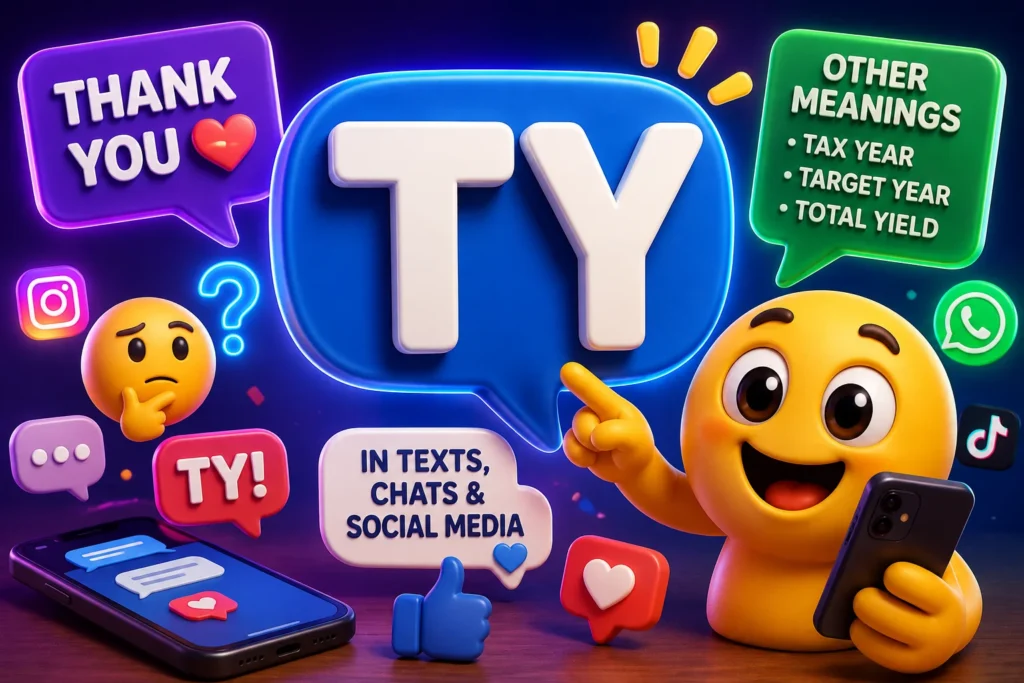
TY most commonly means “Thank You.” It’s a widely used internet abbreviation in text messages, social media, gaming chats, and online conversations. People often search for “what does TY mean” because it’s short, appears in many apps, and can occasionally have different meanings outside casual texting.
Is TY an Acronym, an Abbreviation, or Slang?
TY is best described as an abbreviation (or initialism) rather than true slang.
Unlike expressions such as WTH, ASF, or FR, TY simply shortens an existing phrase:
TY = Thank You
It serves the same purpose as writing “thanks,” but in an even shorter form. Because of its simplicity, TY has remained popular for decades despite the constant evolution of internet slang.
Although some people casually call it “text slang,” linguistically it’s more accurate to describe TY as an internet abbreviation used in digital communication.
The Main Meaning of TY
Nearly every time you see TY in a text message or social media conversation, it means:
Thank You
It’s used to quickly express appreciation without typing the full phrase.
Examples:
TY for helping me yesterday.
TY! I really appreciate it.
TY for the recommendation.
TY, that solved my problem.
The abbreviation saves time while still communicating gratitude.
Unlike many internet abbreviations that confuse new users, TY is one of the easiest because its meaning rarely changes in casual conversations.
Other Real Meanings of TY
Although “Thank You” dominates online conversations, TY does have several legitimate meanings in specific industries and professional settings.
These include:
- Tax Year (finance and accounting)
- Target Year (education and investing)
- Total Yield (engineering and manufacturing)
- Company names or internal abbreviations
However, these meanings almost never appear in ordinary text messages.
For example:
TY for the birthday gift!
obviously means:
Thank You.
Whereas:
TY 2026 tax filing
clearly refers to Tax Year rather than gratitude.
For most people searching this keyword, the texting meaning is the one they’re looking for.
A Common Misunderstanding
Some people assume TY is another version of TYSM.
That’s not quite correct.
Compare the two:
TY
Thank You
TYSM
Thank You So Much
TYSM expresses stronger appreciation.
Likewise, TY is sometimes confused with:
- THX
- TYVM
- TQ (used in some countries)
These abbreviations all express gratitude, but they aren’t identical.
Choosing one over another slightly changes the tone of your message.
Where Is TY Actually Used?
Unlike some slang terms that belong mainly to TikTok or Snapchat, TY appears almost everywhere people communicate online.
Text Messages
SMS remains one of the most common places to see TY.
Examples:
TY for picking me up.
TY! See you tomorrow.
Because text messages often encourage quick replies, TY feels natural and efficient.
WhatsApp conversations regularly include TY between friends, classmates, coworkers, and family members.
Examples:
TY for sending the notes.
TY 😊
Many users alternate between writing TY, Thanks, and Thank you, depending on how formal they want to sound.
Snapchat
On Snapchat, TY usually appears after:
- receiving a Snap
- getting advice
- receiving compliments
- sharing photos
- helping with homework
Examples:
TY for the filter recommendation.
TY 😂
Instagram users commonly write TY in:
- direct messages
- comments
- story replies
Examples:
TY for following!
TY for the support ❤️
Creators often respond with TY when followers compliment their content.
TikTok
TikTok comments frequently include TY.
Examples:
TY for posting this tutorial.
TY! I’ve been looking for this recipe.
Although TikTok constantly introduces new slang, TY remains one of the platform’s timeless abbreviations because gratitude never goes out of style.
X (Formerly Twitter)
Because character limits historically encouraged shorter writing, TY became especially common on X.
Examples:
TY everyone for the birthday wishes.
TY for sharing this article.
Even though today’s character limit is larger than before, many users still prefer TY because it’s quick and familiar.
Discord and Gaming Chats
Gaming communities frequently use TY after:
- receiving help
- winning matches
- getting equipment
- joining teams
Examples:
TY for the revive.
TY everyone, GG!
Gamers often combine TY with other abbreviations such as GG, GLHF, or NP.
Grammar: How Does TY Function?
One detail many articles overlook is that TY behaves differently from many internet abbreviations.
Part of Speech
TY functions as an interjection.
Its purpose is to express appreciation rather than describe an action.
For example:
TY!
works exactly like saying:
Thanks!
or
Thank you!
Can TY Stand Alone?
Yes.
Unlike abbreviations such as IMO, TBH, or PMO, TY can easily be an entire reply.
Example:
A: I emailed the file.
B: TY!
The conversation still feels complete.
Can TY Begin a Sentence?
Absolutely.
Examples:
TY for everything.
TY again for your help.
Here, TY replaces the complete phrase “Thank you.”
Can TY End a Sentence?
It can also appear at the end.
Examples:
I got your package, TY.
That was really thoughtful—TY.
This flexibility is one reason TY remains one of the easiest abbreviations to understand.
Where Did TY Come From?
Unlike many modern slang expressions that began on TikTok, TY is much older.
The abbreviation developed naturally during the early days of online communication in the 1990s, when internet users relied on:
- IRC chat rooms
- AOL Instant Messenger
- MSN Messenger
- Yahoo Messenger
- SMS text messaging
Typing on physical mobile phone keypads required multiple button presses for each letter, so shortening common phrases became a practical habit.
Instead of writing:
Thank you.
people simply typed:
TY
There is no verified evidence that a single person invented TY. Like many internet abbreviations, it spread organically as millions of users independently adopted the shortcut.
Unlike trendy slang that rises and disappears within a few years, TY has survived multiple generations of technology because expressing gratitude is something people do every day.
Why TY Has Stayed Popular for So Long
Many internet abbreviations fade once trends change, but TY has remained remarkably stable for one simple reason: it solves a universal communication need.
People thank each other constantly—whether they’re replying to a friend, acknowledging help, or responding to a compliment. TY offers a fast, recognizable way to do that without sacrificing clarity.
Another reason for its longevity is that it rarely causes confusion. While abbreviations like RS, PMO, or ASF can have multiple meanings depending on context, TY almost always means “Thank You” in casual digital conversations. That consistency has helped it remain relevant across generations of internet users.
Finally, small formatting choices can subtly affect tone. For example:
- ty often feels relaxed and casual.
- TY can appear slightly more emphatic or noticeable.
- Ty may look like a name if used alone, so it’s less common.
- TY! adds enthusiasm and warmth.
These subtle differences allow users to adjust the tone of their gratitude without changing the meaning, making TY one of the most enduring abbreviations in online communication.
TY in Different Conversation Tones
Although TY always means “Thank You,” the feeling behind it changes depending on the conversation. Here are four realistic examples.
Funny
A: I brought you coffee before you turned into a zombie.
B: TY 😂 You probably saved everyone’s morning.
A: I expect a lifetime supply of snacks now.
B: Deal… maybe.
Sarcastic
A: Thanks for telling me the meeting started five minutes ago.
B: You’re welcome?
A: TY… I guess. 😒
B: I’ll text you earlier next time.
Playful
A: I finally beat your high score.
B: Lucky win.
A: TY for motivating me.
B: Keep dreaming.
Serious
A: TY for checking in after everything happened.
B: Of course.
A: It meant a lot to me.
B: Anytime.
Real Chat Examples
The following conversations show how TY naturally appears across different relationships and platforms.
1. Friends Texting
A: I dropped your charger at your house.
B: TY! I couldn’t find mine anywhere.
A: No problem.
B: You’re the best.
2. Family Group Chat
A: Dinner will be ready at 7.
B: TY! I’ll be there.
A: Drive safely.
B: Will do.
3. Snapchat
A: That filter looks amazing.
B: It’s the new one everyone is using.
A: TY! I’m trying it now.
B: You’ll love it.
4. Instagram DM
A: TY for following back!
B: Happy to support.
A: Your content is great.
B: I appreciate that.
5. TikTok Comments
A: TY for sharing this recipe.
B: Glad it helped.
A: I’m making it tonight.
B: Hope you enjoy it!
6. Gaming Chat
A: TY for the revive.
B: Anytime.
A: We almost lost that round.
B: Teamwork saved us.
7. Coworkers
A: I emailed the report.
B: TY. I’ll review it this afternoon.
A: Let me know if anything needs changing.
B: Will do.
8. Dating Conversation
A: TY for dinner tonight.
B: You’re welcome.
A: I had a really nice time.
B: Me too.
9. College Friends
A: TY for sending your notes.
B: No problem.
A: That’ll help me study tonight.
B: Good luck on the exam!
10. Online Shopping
A: Your order has been delivered.
B: TY!
A: Hope everything arrived safely.
B: It did.
11. Discord Server
A: TY for inviting me.
B: Glad you joined.
A: Looking forward to hanging out.
B: Same here.
12. Community Forum
A: TY for answering my question.
B: Happy to help.
A: That fixed the issue immediately.
B: Great to hear.
How to Reply to TY
Since TY expresses gratitude, the best reply depends on your relationship with the sender and the tone of the conversation.
Funny Reply
If someone says:
TY!
You could reply:
“I’ll accept payment in pizza. 🍕”
Serious Reply
If someone writes:
TY for helping today.
A thoughtful response is:
“You’re very welcome. I’m glad I could help.”
Flirty Reply
If someone texts:
TY for today ❤️
You could answer:
“Anytime. I’d happily do it again. 😊”
This works only when the conversation is already friendly or romantic.
Neutral Reply
Simple responses include:
- You’re welcome!
- No problem.
- Anytime.
- Happy to help.
- Of course.
TY Compared with Similar Abbreviations
| Term | Meaning | Tone | Popularity | Confusion Risk |
|---|---|---|---|---|
| TY | Thank You | Friendly | Very High | Very Low |
| THX | Thanks | Casual | Very High | Very Low |
| TYSM | Thank You So Much | Warm, enthusiastic | High | Low |
| TYVM | Thank You Very Much | Polite | Medium | Low |
| Thanks | Standard expression of gratitude | Neutral | Very High | None |
| NP (common reply) | No Problem | Casual response | High | Very Low |
One useful difference is that TY is the shortest and most neutral option. TYSM adds stronger appreciation, while TYVM often feels slightly more formal. THX is equally casual but can sound a bit less personal than TY in some conversations.
Who Uses TY?
Age Groups
TY is one of the few internet abbreviations used across almost every age group.
Common users include:
- Teenagers
- College students
- Young professionals
- Parents
- Online gamers
- Long-time internet users
Unlike trend-driven slang, TY isn’t tied to a single generation.
Gen Z vs Millennials
Gen Z often mixes TY with emojis, GIFs, or other abbreviations.
Examples:
TY 😂
tysm ❤️
ty!!
Millennials also use TY regularly but may alternate between Thanks, TY, and THX depending on the situation.
Overall, both generations understand TY immediately.
Regional Usage
TY is widely recognized throughout English-speaking countries, including:
- United States
- Canada
- United Kingdom
- Australia
- New Zealand
Because it’s based on the universally understood phrase “Thank You,” there are very few regional differences in meaning. The abbreviation is also recognized by many non-native English speakers who communicate online.
Is TY Rude or Safe?
Is TY Offensive?
No.
TY contains no profanity, insults, or offensive language.
Its only purpose is expressing appreciation.
Is TY Appropriate for School?
Yes—in informal conversations with classmates, TY is generally acceptable.
However, teachers usually expect complete words in assignments and formal emails.
Instead of:
TY for your feedback.
Write:
Thank you for your feedback.
Is TY Appropriate at Work?
TY is common in workplace messaging apps such as Slack, Microsoft Teams, and internal chats.
However, in client emails or formal business communication, writing the complete phrase “Thank you” appears more professional and polished.
Can TY Ever Feel Impersonal?
Sometimes.
One practical detail many articles overlook is that very short acknowledgments can occasionally seem less sincere, especially after someone has invested significant time or effort. For example, replying with only “TY” after receiving a detailed recommendation or a heartfelt gift may feel brief to some people.
In those situations, writing “Thank you so much,” “I really appreciate it,” or “Thanks, that means a lot” often conveys warmer appreciation.
A Real-World Observation
TY has survived decades of changing internet trends because it fulfills one of the most common needs in everyday communication: expressing gratitude quickly. Unlike many abbreviations that become outdated as slang evolves, TY remains useful because people thank each other countless times every day. Its simplicity, clarity, and nearly universal recognition mean it rarely causes confusion. Whether it’s sent in a gaming chat, a family group, a workplace message, or a social media comment, TY communicates appreciation instantly while fitting naturally into fast-paced digital conversations.
Frequently Asked Questions About TY
Does TY always mean “Thank You”?
In almost every casual online conversation, TY means “Thank You.” Whether you’re texting a friend, replying to a social media comment, or chatting in a game, this is the meaning people expect. Although TY has other definitions in fields like finance or business (such as Tax Year), those meanings depend entirely on context and are rarely intended in everyday messaging.
Is TY considered slang?
Not exactly. TY is an internet abbreviation (or initialism), not traditional slang. Slang usually introduces a new word or phrase with a unique meaning, while TY simply shortens the existing phrase “Thank You.” Even so, many people casually refer to it as texting slang because it’s commonly used in informal digital conversations.
What’s the difference between TY and TYSM?
Both abbreviations express gratitude, but TYSM means “Thank You So Much,” making it stronger and more enthusiastic. TY works well for everyday appreciation, while TYSM is better when someone has done something especially thoughtful or helpful. Choosing between them depends on how much emphasis you want to give your thanks.
Is TY polite enough for work emails?
For quick workplace chats on platforms like Slack or Microsoft Teams, TY is generally acceptable if your organization has a casual communication style. However, for client emails, job applications, academic messages, or formal business correspondence, it’s better to write “Thank you” in full. The complete phrase looks more professional and sincere.
Can TY be used as a complete reply?
Yes. TY often works perfectly as a standalone response. For example, if someone sends you a file, answers your question, or shares useful information, replying with “TY!” is a complete and natural acknowledgment. Many people also add an emoji or exclamation mark to make it feel warmer.
Is TY still popular, or is it outdated?
TY remains one of the most widely recognized internet abbreviations. While newer slang terms come and go, TY has stayed relevant because expressing gratitude is a constant part of online communication. It continues to appear in text messages, gaming chats, social media comments, and messaging apps across different age groups.
Why do some people write “ty” instead of “TY”?
The meaning is exactly the same. Writing “ty” in lowercase often feels more casual and conversational, especially in fast-paced chats. Using “TY” in uppercase can add slight emphasis, while “TY!” sounds more enthusiastic and appreciative.
Can TY sound rude or insincere?
Usually not. However, context matters. If someone spends a long time helping you or gives you a meaningful gift, replying with only “TY” may feel a little brief to some people. In those situations, writing “Thank you so much,” “I really appreciate it,” or adding a short personal message often communicates greater sincerity.
What does TY mean in texting?
TY is a common abbreviation for “Thank You.” It’s used to quickly express appreciation in text messages, online chats, and social media conversations.
What does TY mean on Snapchat?
On Snapchat, TY almost always means “Thank You.” People use it after receiving a Snap, compliment, recommendation, or helpful reply.
What does TY mean on TikTok?
TikTok users typically use TY in comments and direct messages to thank creators for videos, tutorials, recipes, or recommendations. The meaning remains “Thank You.”
Is TY the same as THX?
Both express gratitude, but they aren’t identical. TY directly abbreviates “Thank You,” while THX is a shortened spelling of “Thanks.” Both are casual, though some people feel TY sounds slightly more personal.
Is TY an acronym?
Technically, TY is an initialism, a type of abbreviation where each letter represents the first letter of a word. Because people pronounce it as the individual letters “T-Y” rather than as a word, it’s more accurately described as an initialism than an acronym.
What does TY mean in gaming?
In gaming chats, TY simply means “Thank You.” Players often use it after receiving assistance, being revived, sharing resources, or winning as a team.
Conclusion
If you’ve been wondering “What does TY mean?”, the answer is straightforward: TY almost always means “Thank You.” It’s one of the oldest and most widely understood internet abbreviations, appearing across text messages, WhatsApp, Snapchat, Instagram, TikTok, X, Discord, and online gaming communities. Although TY has other specialized meanings in finance and business, the texting definition is overwhelmingly the one people intend in everyday conversations.
Because it’s short, clear, and universally recognized, TY has remained useful for decades despite changing internet trends. Whether you’re thanking a friend, coworker, family member, or online creator, it’s a quick and friendly way to show appreciation.
Usage Tips
- Use TY in casual texts, social media, and online chats.
- Write “Thank you” in full for formal emails, schoolwork, and professional communication.
- Add an emoji or exclamation mark if you want your appreciation to feel warmer.
- Choose TYSM instead of TY when you want to express extra gratitude.
Common Mistakes
- Assuming TY has multiple slang meanings in texting—it almost always means “Thank You.”
- Using TY in highly formal business or academic writing.
- Confusing TY with TYSM or THX, which carry slightly different levels of emphasis.
- Thinking uppercase and lowercase change the meaning—they only affect tone slightly.
When to Use TY
Use TY when:
- You’re chatting with friends or family.
- You’re responding quickly on social media.
- You’re thanking teammates in games.
- You’re acknowledging help in casual workplace chats.
Avoid TY when:
- Writing formal emails.
- Sending cover letters or resumes.
- Communicating in academic assignments.
- Writing to clients or people in very formal settings.