
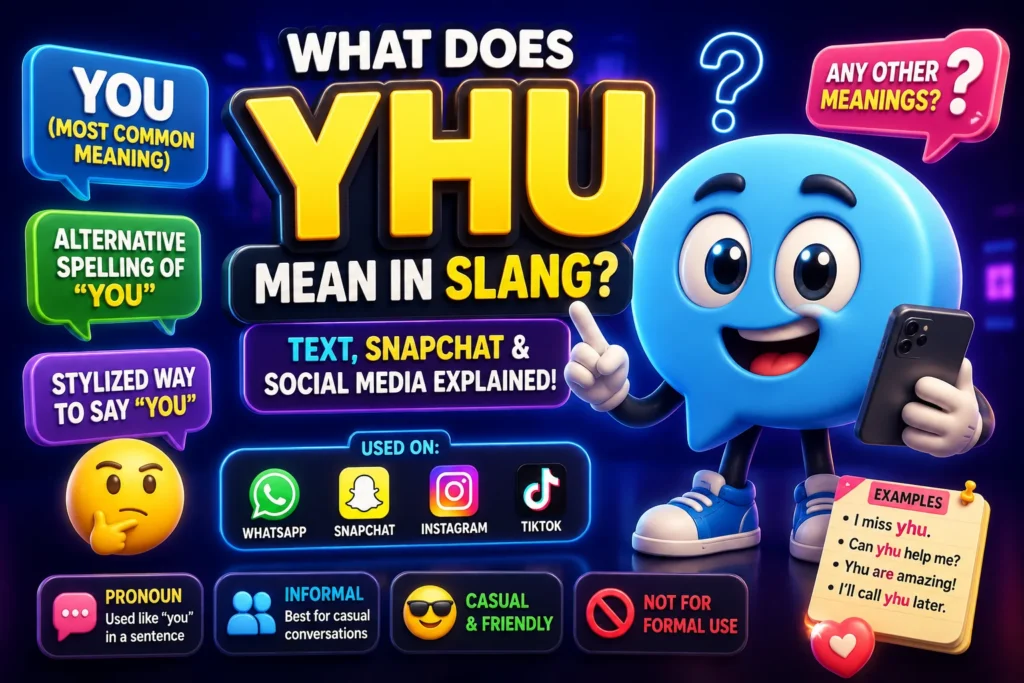
YHU means “you.” It’s an alternative spelling of the word you that’s commonly used in casual text messages and social media conversations. Many people mistake it for an acronym, but it’s actually just a stylized way of writing the same word.
What Does YHU Mean?
In almost every online conversation, YHU simply means “you.”
Instead of using the standard spelling, some people deliberately write yhu to make their messages feel more personal, expressive, or unique. Although it looks unusual at first, it carries exactly the same meaning as the ordinary word you.
For example:
- “I miss yhu.”
- “Can yhu help me?”
- “Yhu always know how to make me laugh.”
- “I’ll call yhu after work.”
If you replace yhu with you, every sentence still means the same thing.
Unlike abbreviations such as LOL (Laugh Out Loud) or BRB (Be Right Back), YHU does not stand for multiple words. It is simply another spelling of the pronoun you.
Is YHU an Acronym, Abbreviation, or Slang?
This question causes a lot of confusion because different websites describe YHU differently.
Technically, YHU is not an acronym because each letter doesn’t represent a separate word.
It also isn’t a traditional abbreviation like ASAP or ETA.
The most accurate description is that YHU is a stylized slang spelling of the word “you.” It’s an informal writing choice that developed through internet culture rather than a coded abbreviation.
Many online slang dictionaries list it alongside abbreviations because they catalog all forms of internet language together, but linguistically it functions as an alternative spelling instead of an acronym.
All Real Meanings of YHU
1. You (Most Common Meaning)
The overwhelming majority of people use YHU to mean “you.”
Whether someone writes:
- “I appreciate yhu.”
- “Miss yhu already.”
- “Where are yhu?”
they simply mean you.
This is the meaning behind nearly every search for “YHU meaning.”
2. Other Context-Specific Meanings
Outside online conversations, the letters YHU may appear as initials for organizations, businesses, universities, or location codes.
These meanings are entirely unrelated to internet slang and depend on the context in which the letters appear. If you receive a message saying “I miss yhu,” it’s referring to you, not an organization or code.
Why Do People Type “YHU” Instead of “You”?
Unlike many early texting shortcuts, YHU wasn’t created to save typing time.
In fact, it contains one extra letter compared to the standard spelling.
People usually choose yhu because they prefer its appearance or because it reflects the informal style used by their friends or online communities.
Common reasons include:
- making messages feel friendlier
- adding personality to conversations
- following casual texting habits
- matching the writing style of friends
- creating a distinctive online identity
For many users, it’s simply a stylistic choice rather than a different word.
A Common Misunderstanding
Many people assume YHU must stand for something because it looks like an acronym.
Searches such as:
- What does YHU stand for?
- Is YHU an abbreviation?
- Does YHU have a hidden meaning?
are very common.
However, there is no widely accepted expanded form behind the slang usage.
Occasionally, you’ll find websites suggesting phrases that fit the letters, but there is little evidence that people actually use YHU that way in everyday online conversations. When someone writes yhu in a text message, they almost always mean you.
Which Apps Is YHU Actually Used On?
Because YHU is simply another way of writing you, it isn’t tied to one specific platform. Instead, it appears anywhere people have casual conversations.
Instagram comments and direct messages frequently contain creative spellings, including yhu.
Examples include:
- “Yhu look amazing!”
- “Love yhu so much.”
Snapchat
Snapchat conversations are naturally informal, making it another place where people sometimes replace you with yhu.
Typical examples include:
- “Where yhu?”
- “Text yhu later.”
Friends chatting on WhatsApp occasionally use yhu, although modern keyboards often autocorrect it back to you, making the standard spelling more common today.
TikTok
On TikTok, yhu appears occasionally in comments, captions, and replies, especially in casual conversations between users.
X (Formerly Twitter)
There isn’t strong evidence that YHU is widely associated with X.
Although individual users may write it, the spelling isn’t considered a defining part of communication on the platform. Its use there is occasional rather than widespread.
Grammar: How Does YHU Work in a Sentence?
Since yhu simply replaces you, it follows the same grammar rules.
Part of Speech
YHU functions as a pronoun.
Examples:
- Yhu are amazing.
- I appreciate yhu.
- Can yhu help me?
Sentence Position
It can appear almost anywhere the word you normally appears.
Beginning of a sentence:
Yhu always know what to say.
Middle of a sentence:
I think yhu should come with us.
End of a sentence:
This gift is for yhu.
Can It Be a Complete Reply?
Not usually.
Unlike expressions such as LOL, Bet, Fr, or W, YHU doesn’t express an emotion or reaction by itself. It normally forms part of a complete sentence.
Formal or Informal?
YHU is strictly informal.
Avoid using it in:
- business emails
- academic assignments
- professional reports
- workplace communication
- formal applications
In any professional or academic setting, the standard spelling you is always the better choice.
Where Did YHU Come From?
There is no verified single origin for YHU.
Unlike slang terms that can be traced to a specific community or internet trend, YHU appears to have developed naturally as online messaging became more popular during the late 2000s and early 2010s.
As texting culture evolved, people experimented with alternative spellings of common words, producing variations such as:
- U
- Yu
- Yoo
- Yhu
These spellings weren’t created to save characters. Instead, they reflected personal style and the informal nature of digital conversations.
Although some people associate YHU with particular online communities, there is no reliable evidence connecting it exclusively to one culture, region, or social group. Any claims about a precise origin should therefore be treated with caution.
YHU vs. You vs. U vs. Yu
Although these spellings all refer to the same word, they don’t create exactly the same impression.
| Spelling | Typical Impression | Formality |
|---|---|---|
| You | Standard English | Formal & Informal |
| U | Classic texting shortcut | Informal |
| Yu | Phonetic spelling | Informal |
| YHU | Stylized and expressive | Informal |
| Yoo | Playful and friendly | Informal |
Someone writing:
“Miss yhu ❤️”
isn’t changing the meaning. They’re simply choosing a spelling that feels more expressive than the standard “Miss you.”
Why Has YHU Remained Popular?
Many early texting shortcuts disappeared as smartphones introduced predictive text, autocorrect, and faster keyboards. YHU, however, continues to appear because it serves a different purpose.
Rather than saving time, it helps some users create a recognizable online writing style.
That said, its popularity isn’t as widespread as it once was. Many younger users now prefer standard spelling because modern keyboards make typing you just as quick, while others still enjoy using yhu as part of their personal texting style.
This balance between familiarity and individuality is one reason YHU continues to appear in casual online conversations, even though it has never become part of standard English.
YHU in Different Conversation Tones
The meaning of YHU doesn’t change with tone—it still means “you.” What changes is the emotion or intention behind the message. Below are four realistic conversations showing how people naturally use yhu in different situations.
Funny
A: Yhu seriously finished the whole pizza by yourself?
B: I was protecting it from getting cold.
A: That’s the worst excuse I’ve ever heard.
B: And yhu know I’d use it again.
Sarcastic
A: Yhu finally replied after two days.
B: Better late than never.
A: Wow, thanks for making time for me.
B: You’re welcome… I guess.
Playful
A: Guess who just beat yhu in the game again?
B: Lucky win.
A: That’s what yhu said last time.
B: Rematch tonight?
Serious
A: I really appreciate everything yhu did for me.
B: I’m glad I could help.
A: I honestly couldn’t have managed without yhu.
B: That means a lot to hear.
Real Chat Examples
The following conversations show how yhu appears naturally in different relationships, platforms, and everyday situations.
1. Friends (WhatsApp)
A: Yhu coming over later?
B: Yeah, probably around seven.
A: Cool, I’ll order food.
B: Save me some fries.
2. Instagram DM
A: Yhu looked amazing in those vacation photos.
B: Thank yhu!
A: That beach looked incredible.
B: It was even better in person.
3. Snapchat
A: Where yhu at?
B: Still at school.
A: Hurry up.
B: Five more minutes.
4. Family Group Chat
Mom: Yhu forgot your jacket again.
Son: I know.
Mom: You’ll need it tonight.
Son: I’ll grab it before I leave.
5. Dating Conversation
A: I miss yhu already.
B: We literally saw each other this morning.
A: Doesn’t matter.
B: That’s actually kind of sweet.
6. Gaming Chat
A: Yhu carried the whole team.
B: Finally someone noticed.
A: MVP today.
B: I’ll take it.
7. Coworkers (Casual Team Chat)
A: Can yhu send me yesterday’s notes?
B: Sure.
A: Appreciate it.
B: I’ll email them now.
8. College Friends
A: Yhu ready for tomorrow’s exam?
B: Not even close.
A: Same here.
B: Guess we’re studying all night.
9. Group Chat
A: Who’s bringing snacks?
B: Not me.
C: Yhu always say that.
B: Because someone else always brings them.
10. Birthday Conversation
A: Happy Birthday! Hope yhu have an amazing day.
B: Thank yhu so much!
A: Any plans?
B: Dinner with the family tonight.
11. Travel Planning
A: Are yhu booking the hotel?
B: Already done.
A: Nice.
B: Just need to book the flights now.
12. Late-Night Text
A: Yhu still awake?
B: Barely.
A: Couldn’t sleep.
B: Same here.
How to Reply When Someone Uses “YHU”
Since yhu simply means you, your reply doesn’t need to acknowledge the spelling. Respond naturally based on the conversation.
Funny Reply
“Only because yhu keep texting me 😂”
Serious Reply
“Thanks, I appreciate that.”
Flirty Reply
“Maybe… but only if yhu keep smiling 😉”
A flirty reply only makes sense if the conversation is already flirtatious.
Neutral Reply
“Sounds good.”
or
“Okay, thanks.”
YHU vs. Similar Texting Terms
| Term | Meaning | Tone | Popularity | Confusion Risk |
|---|---|---|---|---|
| YHU | Alternative spelling of “you” | Casual | Medium | Medium |
| You | Standard English pronoun | Neutral | Very High | None |
| U | Shortened form of “you” | Casual | Very High | Low |
| Yu | Phonetic spelling of “you” | Casual | Medium | Low |
| Yoo | Playful spelling of “you” | Friendly | Medium | Low |
| Me (opposite reference) | Refers to the speaker rather than the listener | Neutral | Very High | Very Low |
Who Uses YHU?
Age Groups
YHU is most commonly seen among teenagers and young adults who enjoy informal texting styles. Older users generally prefer the standard spelling you, although some also use alternative spellings in casual chats.
Gen Z vs. Millennials
Many Gen Z users recognize yhu, but not everyone uses it regularly. Today’s messaging apps make typing you just as easy, so some younger users simply stick with the standard spelling.
Among Millennials, YHU is familiar because it became more noticeable during the early years of smartphone texting and social networking. However, usage varies widely from person to person.
Rather than belonging to one generation, YHU is best viewed as an informal writing preference.
Regional Usage
There is no reliable evidence showing that YHU belongs to one country or region.
It appears in English-language conversations across different countries, including:
- United States
- United Kingdom
- Canada
- Australia
- South Africa
- Other English-speaking communities
Because it spreads through social media and messaging apps, its use depends more on personal style than geographic location.
Is YHU Rude or Safe to Use?
Generally, YHU is completely harmless.
Is It Offensive?
No.
The word contains no offensive or insulting meaning. It simply replaces you with an alternative spelling.
Is It Profanity?
No.
There is no profanity or explicit language involved.
Is It Appropriate for School or Work?
Not usually.
Although it’s harmless, YHU is still considered very informal.
For professional communication, academic writing, business emails, and official documents, always use the standard spelling you.
For casual conversations with friends or family, YHU is perfectly acceptable.
A Real Insight: Why Does YHU Continue to Exist?
One interesting thing about YHU is that it survived for a different reason than many early texting shortcuts. Abbreviations like U became popular because they reduced typing. YHU, however, actually adds an extra letter. That suggests its purpose isn’t efficiency—it’s self-expression.
People often develop small writing habits that become part of their online identity. Just as someone might always use lowercase letters, extra emojis, or repeated punctuation, others choose spellings like yhu because they make their messages feel more personal or recognizable. Even if the meaning never changes, the style helps create a distinct voice in digital conversations.
Common Mistakes to Avoid
When using or interpreting YHU, avoid these common mistakes:
- Assuming it stands for multiple words.
- Thinking it has a hidden or secret meaning.
- Using it in formal writing or professional communication.
- Believing it’s exclusive to one social media platform.
- Treating it as a completely different word from you.
Understanding these points makes it much easier to recognize yhu whenever it appears in everyday online conversations.
Frequently Asked Questions About YHU
Does YHU always mean “you”?
Yes, in almost every casual online conversation, YHU simply means “you.” It isn’t an acronym or secret code. Instead, it’s an alternative spelling that some people use in text messages, social media comments, and direct messages. The meaning remains exactly the same as the standard English pronoun.
Is YHU still popular in 2026?
YHU is still recognized, but it isn’t as widespread as it was during the peak years of creative texting. Many people now type “you” because smartphones offer faster keyboards, predictive text, and autocorrect. However, you’ll still see yhu used by some people who enjoy expressive or stylized writing.
Is YHU used on TikTok?
Yes, but only occasionally. You may see yhu in TikTok comments, captions, or replies where users write casually. It isn’t a TikTok-exclusive term or trend, and its usage is simply another example of informal internet spelling rather than platform-specific slang.
Why do people spell “you” as “yhu”?
Most people use yhu for style rather than convenience. Since it actually contains one more letter than you, it doesn’t save typing time. Instead, it helps create a casual, personal, or distinctive writing style that reflects how some people like to communicate online.
Is YHU proper English?
No. YHU is not considered standard English. It’s an informal spelling that belongs to texting and social media culture. In professional emails, academic writing, business communication, or official documents, you should always use the standard spelling you.
Is YHU rude or offensive?
No. YHU has no offensive meaning and contains no profanity. It’s simply an alternative way of writing you. The only concern is appropriateness—because it’s informal, it may appear unprofessional in formal situations.
Is YHU an acronym?
No. Although many people assume it stands for several words, YHU is not an acronym. It doesn’t expand into a phrase. It’s simply a creative spelling of the word you.
Should I reply using “YHU” or “You”?
Either is acceptable in casual conversations. If the other person uses yhu, you can reply the same way if you want to match their style. However, using you is always the safer choice because it’s clear, universally understood, and appropriate in every situation.
People Also Ask
What does YHU mean in texting?
In texting, YHU means “you.” It’s an informal spelling variation rather than a separate word or abbreviation. The message’s meaning doesn’t change when you replace yhu with you.
What does YHU mean on Snapchat?
On Snapchat, yhu has the same meaning as in text messages—it simply means you. People sometimes use it because Snapchat conversations are usually informal and conversational.
What does YHU mean on Instagram?
On Instagram, yhu commonly appears in comments, captions, and direct messages as an alternative spelling of you. It isn’t an Instagram-specific term, but it occasionally appears in casual conversations on the platform.
Is YHU the same as “U”?
Both YHU and U represent the word you, but they create different impressions. U is a classic texting shortcut intended to save characters, while YHU is mainly a stylistic spelling that adds personality rather than saving time.
Should You Use “YHU” or “You”?
If you’re unsure which version to use, this simple guide can help.
Use YHU when:
- You’re chatting with close friends.
- You’re sending casual text messages.
- You’re commenting on social media.
- You want your writing to feel relaxed or expressive.
Use You when:
- Writing emails.
- Applying for jobs.
- Completing school assignments.
- Communicating with clients or coworkers.
- Posting professional content.
When in doubt, choose you. It always works, regardless of the audience.
Final Thoughts
YHU may look like an acronym at first glance, but it’s simply a creative spelling of you. While it appears in text messages, Instagram comments, Snapchat chats, WhatsApp conversations, and occasionally on TikTok, it isn’t tied to one platform or internet trend.
Unlike traditional texting abbreviations that were designed to save time, YHU exists mainly as a stylistic choice. Some people enjoy using it to make their messages feel more personal or distinctive, while others prefer the standard spelling. Neither changes the meaning of the conversation.
The most important thing to remember is that context matters. In casual chats, YHU is easy to understand. In professional or academic writing, however, the standard spelling you remains the better option.
Quick Usage Tips
- Use YHU only in informal conversations.
- Remember that it simply means “you.”
- Match the other person’s texting style if appropriate.
- Choose you whenever you’re writing professionally.
Common Mistakes
- Thinking YHU is an acronym with a hidden meaning.
- Assuming it’s exclusive to TikTok or Snapchat.
- Using it in business emails or school assignments.
- Believing it changes the meaning of the sentence.
When to Use YHU vs. When to Avoid It
Use YHU:
- Text messages
- Casual chats
- Social media comments
- Friendly conversations
Avoid YHU:
- Professional emails
- Academic writing
- Business reports
- Formal applications
- Official documents