
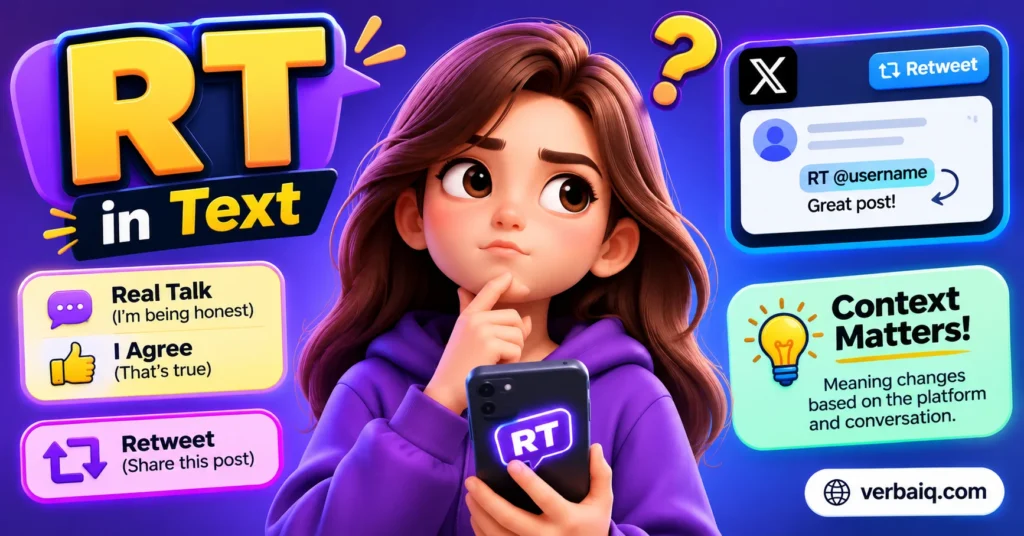
RT in text most commonly means “real talk” when used in a casual conversation, or “retweet” when it refers to sharing a post on X. The surrounding message and platform usually reveal which meaning is intended.
If someone sends you “RT” by itself, it can be surprisingly difficult to decode. On one screen, it may mean “I’m being serious” or “I completely agree.” On another, it may refer to the older social-media practice of reposting someone else’s message.
The important point is that RT is not one fixed piece of slang. Its meaning depends heavily on context.
What Does RT Mean in Text?
In casual texting, RT can mean “real talk.” In this use, it signals sincerity, honesty, or strong agreement.
For example:
“RT, you really need to stop overthinking this.”
Here, RT is essentially saying, “Seriously,” “Honestly,” or “I’m being real with you.”
A second major meaning is “retweet.” This is the original social-media meaning associated with Twitter, now called X. A person might write:
“RT this if you agree.”
In that context, they are asking people to share or repost the post. Cambridge lists RT as an abbreviation for retweet, meaning to publish again something that someone else posted on the platform formerly known as Twitter.
There is also an important overlap between the two meanings. Someone may type:
“RT, that is exactly how I feel.”
Although this can literally be read as “real talk,” it also carries the older social-media idea of “I would retweet this because I strongly agree.”
That overlap helps explain why RT can feel like both an abbreviation and a reaction.
The Two Main Meanings of RT
1. RT = Retweet
Retweet is the original and historically important meaning of RT in internet culture.
On Twitter/X, a retweet meant sharing another user’s post with your own audience. Before Twitter introduced a built-in retweet function, users manually copied another person’s post and placed “RT @username” before it to indicate the original source.
Examples include:
- “Please RT this announcement.”
- “Thanks for the RT!”
- “RT @username: Great news!”
- “RT if you agree.”
- “I just RT’d your post.”
Today, X uses “repost” terminology, but the older word “retweet” and abbreviation “RT” remain widely recognizable.
2. RT = Real Talk
In casual text conversations, RT can mean “real talk.”
This meaning introduces honesty, seriousness, or emphasis. It can be used before an opinion:
“RT, that was the best episode.”
It can also introduce something more personal:
“RT, I’ve actually been stressed about this.”
In short, real talk = I’m being honest / seriously / for real.
Some slang references also document RT as a way of expressing agreement, particularly when someone says something relatable or strongly true.
Does RT Mean “I Agree”?
It can.
When someone responds with only:
“RT”
they may effectively be saying:
- “Exactly.”
- “I agree.”
- “That’s so true.”
- “Same.”
- “Facts.”
This is especially likely when the message being answered contains an opinion rather than something that could literally be reposted.
For example:
Friend: “Why does Monday feel longer than the entire weekend?”
You: “RT 😭”
Here, the person is not asking you to repost anything. They are simply agreeing.
A Common Misunderstanding About RT
One common mistake is assuming that RT always means “retweet.”
That interpretation makes perfect sense on X, especially when you see something like:
“RT this post.”
But it becomes less convincing in an ordinary private conversation.
Consider:
“RT, you deserve better friends.”
There is no obvious post being shared. The person is probably using RT as a casual marker of sincerity or agreement.
The reverse mistake also happens: someone may assume RT means “real talk” when it actually refers to reposting.
A useful rule is:
If RT is connected to a post, username, link, or request to share, think “retweet.” If it appears as a reaction to someone’s statement, “real talk” or strong agreement is more plausible.
How to Tell Which RT Meaning Someone Intended
Instead of memorizing dozens of definitions, look at three clues.
Look at the platform
On X, the retweet meaning is the obvious starting point.
In a private text, DM, or casual group chat, “real talk” or agreement is more plausible. Current slang guides consistently make this platform/context distinction.
Look at what comes after RT
Compare:
“RT @alex…”
This strongly points toward retweet.
Now compare:
“RT, I’m actually worried about you.”
That naturally reads as real talk.
Look at what came immediately before it
If someone says:
“I hate how expensive everything is.”
and you answer:
“RT.”
you’re probably agreeing.
If someone says:
“Can you share this?”
and you answer:
“RT.”
they may be talking about reposting.
Where Is RT Used?
X
X is the clearest home for the retweet meaning. The abbreviation grew directly out of Twitter users’ practice of manually copying posts and adding “RT @username.” Research on the history of retweeting traces the convention to the platform’s early user community, before the official retweet feature appeared in 2009.
Because X renamed retweets as reposts after the Twitter-to-X rebrand, newer users may encounter “repost” more often in the interface, while RT remains part of the platform’s established vocabulary.
Text Messages and DMs
RT can appear in ordinary texting and private conversations with the real-talk/agreement meaning.
For example:
“RT, I can’t believe you actually did that.”
This is not necessarily asking anyone to repost anything.
Instagram, Snapchat, WhatsApp, and TikTok
RT may appear in casual online conversations on these platforms, but there is an important distinction: RT is not a native sharing command on these services in the same way the term historically functioned on Twitter.
When users write RT in these environments, it is more useful to interpret it from the surrounding conversation rather than automatically assuming it means a platform-specific feature. Contemporary slang references document RT in DMs, comments, group chats, and cross-platform conversations, but usage is not uniform.
So don’t tell yourself, “RT always means X on Snapchat.” Context matters more than the app.
Grammar: How Does RT Work in a Sentence?
RT is an initialism/abbreviation, rather than a conventional English word.
Its grammatical behavior changes with its meaning.
When it means real talk, it can work as an introductory expression:
“RT, you handled that really well.”
It can also stand alone:
“That was the funniest thing I’ve seen all week.”
“RT.”
When it means retweet, it can function more like a noun or verb-related shorthand:
“Thanks for the RT.”
“Can you RT this?”
“I RT’d your post.”
The abbreviation therefore behaves flexibly depending on the context.
Where Did RT Come From?
The retweet meaning has a much clearer documented history than the slang expansion “real talk.”
Retweeting developed organically among early Twitter users rather than beginning as an official Twitter feature. Research traces the term “ReTweet” to 2007, with users developing conventions for copying another person’s post and crediting the original author. The shortened “RT @username” format became a recognizable convention later.
Twitter did not initially have a native retweet button. Users had to manually copy and repost messages. Twitter eventually introduced an official retweet mechanism in 2009.
The abbreviation therefore had a practical purpose: saving characters while making attribution clear. This mattered particularly when Twitter imposed a 140-character limit.
The history of RT = “real talk” is less clearly documented. Modern slang references do record that meaning, but there isn’t a comparably well-established single origin point showing exactly when and where “real talk” was first shortened to RT. It is safer to describe this as a later internet/texting abbreviation whose precise origin is unclear, rather than inventing a specific person or date.
Four Short Conversations Showing Different Tones
Funny
Mia: I opened the fridge three times and still didn’t find anything new.
Jay: You expected a surprise meal to spawn?
Mia: RT 😂
Jay: The fridge is not a loot box.
Here, RT means “exactly” or “I agree.”
Sarcastic
Alex: Apparently replying “k” is considered rude now.
Sam: Society has collapsed.
Alex: RT 😭
Sam: Thoughts and prayers for the letter K.
Playful
Lena: You said you’d only buy one pair of shoes.
Nora: I showed incredible restraint.
Lena: You bought four.
Nora: RT, and all four were necessary.
Here RT reinforces the speaker’s playful claim.
Serious
Chris: I think I need to stop pretending everything is fine.
Jordan: You don’t have to handle everything alone.
Chris: RT. I probably needed to hear that.
Jordan: I’m here if you want to talk.
Here RT signals sincerity rather than reposting.
More Realistic Examples of RT in Conversation
1. Friends
A: That restaurant is seriously overrated.
B: RT.
A: Finally, someone said it.
B: The fries weren’t even good.
2. Family Group Chat
Mom: Everyone needs to remember Grandma’s birthday is Sunday.
Sara: RT, don’t forget this time 😂
Brother: I have it saved.
Sara: Good, because last year was embarrassing.
3. Dating
A: Communication matters more than expensive gifts.
B: RT.
A: Glad we’re on the same page.
B: Very much so.
4. Coworkers
A: That meeting could have been an email.
B: RT.
A: We were there for 90 minutes.
B: And somehow accomplished nothing.
5. Group Chat
A: We should leave before traffic gets worse.
B: RT.
C: Agreed.
D: I’m already putting my shoes on.
6. X
A: RT this announcement so everyone sees it.
B: Done.
A: Thanks!
B: Hope it reaches everyone who needs it.
Here RT clearly means retweet/repost, not real talk.
7. Snapchat
A: That test was brutal.
B: RT 😭
A: I guessed half of it.
B: Same.
This is an agreement reaction.
8. Instagram Comment
A: Nobody talks about how good this album is.
B: RT.
A: Exactly!
B: It’s been on repeat all week.
9. WhatsApp
A: I’m going to start going to bed earlier.
B: RT.
A: Why are you laughing?
B: Because you said that yesterday.
10. Dating Conversation
A: Honestly, consistency is attractive.
B: RT.
A: That’s what I like to hear.
B: Actions matter more than promises.
11. School Friends
A: Why does homework always take twice as long as expected?
B: RT 😩
A: I started at 7.
B: And somehow it’s midnight.
12. Online Discussion
A: People should read the entire article before arguing about the headline.
B: RT.
A: Seriously.
B: Context changes everything.
How Should You Reply to RT?
Your response depends on which meaning is intended.
If RT means “I agree”
You can say:
- “Exactly!”
- “Facts.”
- “That’s what I’m saying.”
- “Right??”
- “Same.”
If RT means “real talk”
A serious response might be:
“Yeah, honestly, I agree.”
Or:
“I appreciate you being honest.”
If RT means retweet
You might reply:
“Thanks for sharing!”
Or:
“Appreciate the RT!”
If You’re Not Sure
Don’t overthink it. Simply ask:
“RT as in real talk or retweet?”
That’s much safer than responding to the wrong meaning.
RT vs Similar Terms
| Term | Meaning | Tone | Popularity | Confusion Risk |
|---|---|---|---|---|
| RT | Retweet, or real talk/agreement depending on context | Casual | High recognition | High |
| Repost | Share someone else’s content again | Neutral/casual | High | Low |
| Real talk | Honest or serious statement | Casual/serious | High | Medium |
| Facts | Strong agreement with a statement | Casual | Very high | Low |
| Same | “I feel the same way” | Casual | Very high | Low |
| FR | “For real” / genuine agreement or emphasis | Casual | Very high | Medium |
| Disagree | Express the opposite position | Neutral to direct | Very high | None |
There isn’t a perfect one-word opposite of RT because RT can represent either reposting or agreement. If RT is being used to agree, “disagree” is the conceptual opposite, but it is not an antonym of the abbreviation itself.
Who Uses RT?
There is not strong evidence for assigning RT to one exact age group or gender. It is better understood as internet and messaging shorthand whose familiarity depends partly on someone’s exposure to Twitter/X culture and online slang.
The retweet sense is especially tied to people familiar with older Twitter conventions. The real-talk/agreement sense can appear in casual online conversations outside X as well.
Claims that RT is exclusively “Gen Z slang” would be too broad. The abbreviation predates Gen Z’s current internet culture and has been part of social-media language since the late 2000s.
There is also no reliable basis for saying that RT has a special meaning in one particular English-speaking country. Its most important distinction is context and platform, not US-versus-UK regional usage.
Is RT Rude or Safe?
RT is generally not offensive or profane.
As an agreement reaction, it is casual rather than insulting:
“RT, that’s exactly what happened.”
However, it can feel too informal in certain professional situations. A workplace email is usually clearer with:
“I agree.”
rather than:
“RT.”
On X, using RT to share something can also communicate endorsement or amplification, so users should understand what they are sharing before doing it.
In other words, the abbreviation itself isn’t dangerous or rude. The content attached to it is what matters.
Why Does RT Work So Well in Conversation?
RT survived because it compresses a surprisingly complicated social response into two letters. Saying “RT” can mean “I agree,” “you said exactly what I was thinking,” or “I’m willing to publicly amplify this,” depending on context. Its history also gives it a useful connection to social-media sharing: a person can simultaneously agree with an idea and signal that it deserves to be repeated. That combination of agreement, endorsement, and brevity makes RT more expressive than its tiny size suggests.
A Useful Trick: Read RT as an Action, Not Just an Abbreviation
One of the easiest ways to understand RT is to ask:
“What is the person doing by saying it?”
If they’re sharing something, RT probably relates to retweeting.
If they’re agreeing with you, it may mean “real talk,” “that’s true,” or “same.”
If they’re starting a serious statement, it probably signals honesty:
“RT, I don’t think this is working.”
This action-based approach is often more reliable than trying to memorize every possible expansion of two letters.
Frequently Asked Questions
What does RT mean in a text message?
In a casual text message, RT can mean “real talk” or serve as a short way of expressing strong agreement. If the conversation involves social-media content, it can instead refer to “retweet.” Context is the key to choosing between the meanings.
Does RT mean “real talk”?
Yes, RT can mean “real talk” in texting and casual online conversation. It is generally used to signal sincerity, honesty, seriousness, or agreement. However, this is not the only meaning of RT.
Does RT mean “retweet”?
Yes. RT is the established abbreviation for “retweet.” The abbreviation originated from Twitter users’ early practice of manually copying another person’s post and adding “RT” to identify it as a repost.
What does RT mean on X?
On X, RT is primarily associated with retweeting, meaning sharing another person’s post. Although X now uses “repost” terminology in its interface, the older RT abbreviation remains recognizable because it was central to Twitter’s original user-created sharing convention.
What does RT mean when someone replies to a message?
When someone simply replies “RT” to your statement, they may be expressing strong agreement. In that situation, it can be understood as “exactly,” “same,” “facts,” or “real talk.” The surrounding message should determine the precise interpretation.
Is RT the same as “facts”?
Not exactly, but they can perform a similar conversational function. “Facts” directly means that the speaker considers a statement true, while RT may signal agreement or reference the idea of reposting it. In casual chat, however, the two can sometimes be interchangeable.
Is RT still used now that Twitter is called X?
Yes. The platform has moved toward the term “repost,” but RT and “retweet” remain recognizable parts of established internet vocabulary. The abbreviation has also developed a life outside the platform, especially in casual online conversation.
Can I use RT in a professional message?
You can, but it is usually better to write the intended meaning explicitly in formal communication. “I agree,” “Please repost this,” or “I’m being serious” will be clearer than RT. The abbreviation works best when the people involved already understand the shorthand.
Conclusion
RT has two important meanings: “retweet” and “real talk.”
On X, especially when connected to another user’s post, RT points to retweeting or reposting. In casual texts, DMs, comments, and group chats, it can function as “real talk,” “exactly,” or strong agreement.
The biggest mistake is assuming that every RT means the same thing. Instead, check the platform, surrounding words, and what the person is actually doing.
If someone writes:
“RT this post”
think retweet.
If they write:
“RT, you’re absolutely right”
think real talk/agreement.
And if the meaning still isn’t obvious, simply ask. With a two-letter abbreviation like RT, context is often more informative than the letters themselves.