
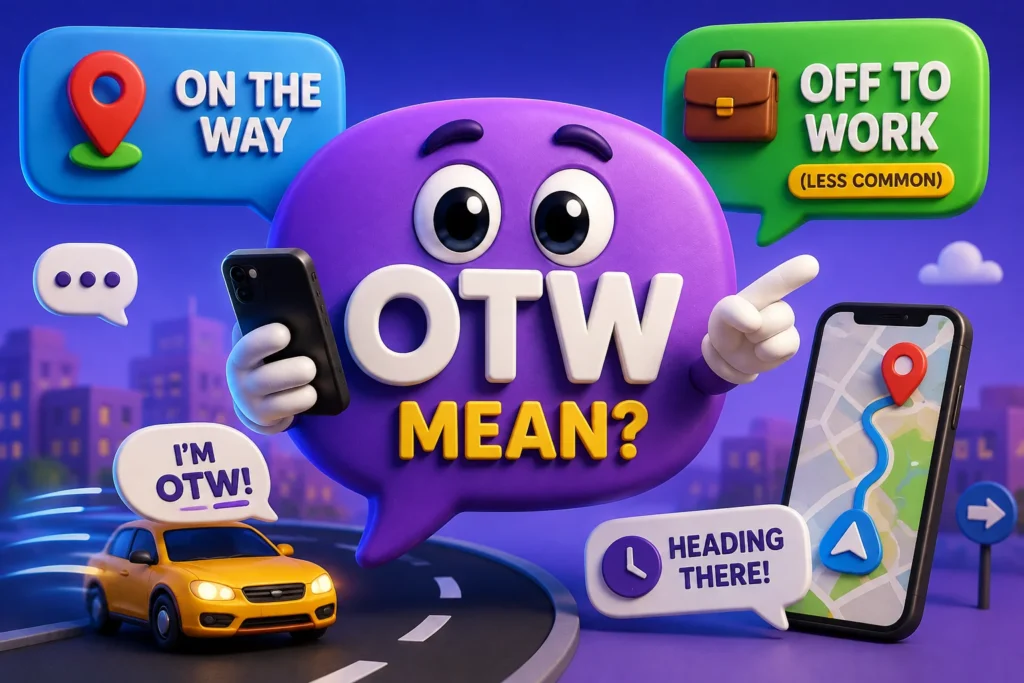
OTW usually means “on the way” in texting and online chat. It tells someone that you or something is currently traveling toward a destination. For example, “I’m OTW” generally means “I’m on my way” or “I’m coming.”
If someone sends you “OTW”, the safest interpretation is usually “on the way.” It is a texting abbreviation rather than a separate slang word, and it is especially useful when someone wants to give a quick update without typing the entire phrase.
What Does OTW Mean in Text?
In text messages, OTW means “on the way.” Someone can use it to say that they have started traveling, are heading toward a particular place, or expect to arrive soon.
For example:
“Where are you?”
“OTW.”
The second person is essentially saying, “I’m on my way.”
OTW can refer to a person, but it can also describe something being delivered or sent:
“Your pizza is OTW.”
Here, the pizza is “on the way” rather than the person speaking.
This is the main meaning consistently associated with OTW in texting references. Dictionary.com identifies OTW as a textspeak acronym for “on the way,” while Wiktionary lists it as an initialism of the same phrase.
OTW in Simple Words
Depending on the situation, OTW can mean:
- “I’m coming.”
- “I’m on my way.”
- “I’ve left and I’m heading there.”
- “It’s currently being delivered.”
- “I’m traveling there now.”
It does not necessarily mean that the person has already arrived nearby. It simply communicates movement toward the destination.
That distinction can matter.
If someone texts “OTW” while they are still getting ready, they may technically be using the abbreviation loosely. If they have already left and are traveling, the meaning is much more literal.
Is OTW an Acronym or an Abbreviation?
OTW is best described as an initialism or texting abbreviation for “on the way.”
Because each letter represents a word—O for “on,” T for “the,” and W for “way”—it is generally read as the individual letters rather than pronounced as a normal word.
You might see it written as:
- OTW
- otw
- Otw
The capitalization does not normally change the meaning.
In casual texting, lowercase “otw” is completely normal:
“otw rn”
That means:
“On the way right now.”
Wiktionary specifically categorizes OTW as an initialism, while Dictionary.com describes it as a textspeak acronym.
For everyday readers, the important point is simple: OTW is shorthand for “on the way.”
Other Meanings of OTW
Although “on the way” is by far the most relevant meaning in ordinary texting, OTW can have other meanings in particular contexts.
One texting reference also lists “off to work” as a possible interpretation. For example:
“OTW, talk later.”
If the surrounding conversation is about someone’s job, OTW could potentially mean “off to work.” However, this interpretation is much more ambiguous because most people encountering OTW in a casual message will think “on the way” first.
There are also specialized meanings outside ordinary texting. For example, Wiktionary lists OTW as an initialism for “overtime win” in sports contexts.
That does not mean you should automatically interpret every OTW as having one of these meanings. Context determines the meaning.
The Most Useful Rule
If you see:
“OTW to your house”
it almost certainly means:
“On the way to your house.”
If you see:
“OTW, gotta start my shift”
the meaning could be less obvious, especially if the person uses OTW to mean “off to work.”
When the context is unclear, asking “Do you mean on the way?” is better than guessing.
A Common Misunderstanding: OTW vs. OMW
One of the easiest abbreviations to confuse with OTW is OMW.
They are extremely similar, but their full phrases are slightly different:
- OTW = On The Way
- OMW = On My Way
In everyday conversation, however, the practical meaning is almost identical.
Compare:
“Where are you?”
“OTW.”
with:
“Where are you?”
“OMW.”
Both normally tell the other person that the sender is heading toward the destination.
The difference is grammatical rather than significant in most casual chats. OTW describes being “on the way,” while OMW explicitly says “on my way.”
Some people prefer OMW, while others use OTW. Community discussions also show that both forms are recognized in ordinary online communication.
OTW vs. OMW at a Glance
| Abbreviation | Full Meaning | Typical Use |
|---|---|---|
| OTW | On the way | “I’m heading there.” |
| OMW | On my way | “I’m heading there.” |
| BRB | Be right back | Temporarily leaving a chat |
| ETA | Estimated time of arrival | Asking or giving an arrival estimate |
| AFK | Away from keyboard | Temporarily unavailable online |
The most important distinction is between OTW/OMW and ETA.
If someone says:
“OTW.”
they are telling you about their status.
If they say:
“ETA 10 mins.”
they are giving you an estimated arrival time.
That makes “OTW” a status update rather than a precise promise about arrival time.
Which Apps Is OTW Used On?
OTW is primarily a general digital communication abbreviation, rather than slang belonging to one specific social-media platform.
It can naturally appear in:
- Text messages
- Instagram DMs
- Snapchat conversations
- WhatsApp chats
- TikTok messages
- X direct messages
- Group chats
- Gaming chats
The strongest evidence supports OTW as a general texting and online-chat abbreviation rather than something uniquely associated with TikTok, Snapchat, or Instagram. Sources describing its use consistently place it in casual texting and online communication.
So if someone writes “otw” in a WhatsApp message, there is no special WhatsApp-specific definition. It still normally means “on the way.”
The same applies to an Instagram DM or a regular SMS.
OTW in Group Chats
Group chats are particularly suited to abbreviations like OTW because people often need quick status updates.
For example:
Mia: “Are we all meeting at 7?”
Jay: “otw”
Sam: “Same, traffic is awful.”
Mia: “Okay, see you guys soon.”
Here, OTW functions almost like a tiny status indicator: the person is in transit.
What Does OTW Mean on Snapchat?
On Snapchat, OTW normally means “on the way” when it appears in a chat or message.
For example:
“u otw?”
means:
“Are you on the way?”
And:
“yeah otw”
means:
“Yes, I’m on my way.”
There is no reliable evidence that OTW has a unique Snapchat-only slang meaning. Its meaning remains dependent on the surrounding conversation.
That is useful to remember because social-media platforms often make ordinary abbreviations look like platform-specific slang when they are actually used across multiple messaging environments.
What Does OTW Mean on Instagram?
In Instagram DMs, OTW generally means “on the way.”
For example:
“We’re otw to the concert.”
means:
“We’re on the way to the concert.”
It can also refer to an object or delivery:
“Your hoodie is otw.”
In that case, the hoodie is being sent or delivered.
Again, context matters. There is no strong evidence that Instagram gives OTW a separate slang definition.
What Does OTW Mean on WhatsApp?
On WhatsApp, OTW normally has the same meaning: “on the way.”
A person might send:
“OTW now, save me a seat.”
They are telling the group that they are heading toward the meeting place.
Because WhatsApp is heavily used for everyday coordination, OTW can be especially practical in conversations about meetings, rides, family plans, shopping, food, and social events.
What Does OTW Mean in Gaming?
Gaming introduces another useful context.
If a teammate asks for help and another player responds:
“OTW”
the likely meaning is still “on the way,” but the destination may be a teammate’s location, an objective, or a particular area of the game.
For example:
Player 1: “Need backup at the east gate.”
Player 2: “OTW.”
That means the second player is heading toward the east gate.
A gaming slang reference also documents this use of OTW for indicating that assistance is traveling toward a player.
The important point is that gaming does not necessarily create a new definition here. It simply applies the ordinary meaning of “on the way” to a virtual environment.
Grammar: How Does OTW Work in a Sentence?
OTW is unusual because it can function as a complete message by itself.
For example:
“Where are you?”
“OTW.”
That one abbreviation communicates a complete idea.
It can also appear before or after additional information:
“OTW to your place.”
“I’m otw now.”
“Food is OTW.”
“We’re OTW to the airport.”
In grammatical terms, OTW is replacing the phrase “on the way” rather than behaving like a conventional noun or verb.
It can therefore be used as a compact status expression:
“OTW.”
or incorporated into a longer sentence:
“I’m OTW to the store.”
This flexibility is one reason the abbreviation works so well in fast-moving conversations.
Where Did OTW Come From?
The exact historical origin of the texting abbreviation OTW is not clearly documented.
It is reasonable to connect its development with the broader rise of texting shorthand and digital communication, where people began shortening common phrases to save time and characters. However, the available references do not establish a specific person, message, website, or exact date as the invention of OTW.
One useful historical data point is an entry for “On the Way” submitted to Abbreviations.com in December 2011, showing that the abbreviation was already documented in texting terminology by then. Dictionary.com also had a published OTW entry by 2018.
So it would be misleading to claim that a particular social-media platform “invented” OTW.
The safest conclusion is:
OTW developed as part of the broader tradition of shortening common phrases for digital communication, but its exact origin is unclear.
There is also no strong evidence that OTW originated specifically in AAVE or another particular cultural community. It is best understood as general English-language texting shorthand unless a particular community is clearly being discussed.
Why Does OTW Work So Well in Conversation?
OTW solves a very specific communication problem: someone wants to reassure you that movement has started without typing a full sentence.
Compare:
“I have left my house and I am currently traveling toward your location.”
with:
“OTW.”
The second message is dramatically shorter while still giving the recipient the information they actually need.
That makes OTW especially useful when someone is walking, driving, rushing to meet friends, coordinating a pickup, joining a game, or waiting for a delivery. It is not really about sounding trendy; its strength is efficiency.
At the same time, OTW has one limitation: it does not tell you how long the journey will take. Someone can truthfully say “OTW” while being 30 minutes away. That is why pairing it with an estimate is often clearer:
“OTW, about 15 mins.”
OTW in Different Tones and Situations
Although OTW has a straightforward definition, the situation around it can change how the message feels.
The abbreviation itself is usually neutral. The tone comes from the words, punctuation, emojis, timing, and relationship surrounding it.
For example:
“OTW.”
can sound purely informational.
But:
“OTW 😂”
can feel relaxed and playful.
And:
“OTW. Sorry, I’m running late.”
sounds more serious because the sender is addressing a delay.
OTW can therefore fit many kinds of conversations without changing its basic meaning.
Funny OTW
Friend 1: “Are you coming to the party?”
Friend 2: “OTW 😂”
Friend 1: “You said that 40 minutes ago.”
Friend 2: “This time I’m actually wearing shoes.”
Here, OTW is still “on the way,” but the surrounding conversation makes it humorous.
Sarcastic OTW
Alex: “You said you’d be here at 6.”
Jordan: “OTW.”
Alex: “It’s 6:47.”
Jordan: “Technically, I am on a way.”
The joke comes from stretching the meaning of “on the way,” not from OTW itself.
Playful OTW
Maya: “Did you bring snacks?”
Leo: “OTW 👀”
Maya: “That doesn’t answer my question.”
Leo: “The snacks are coming too.”
Here, OTW creates a quick, casual update.
Serious OTW
Dad: “Have you left yet?”
Son: “Yes, OTW.”
Dad: “Okay. Drive carefully.”
Son: “Will do.”
In this situation, OTW simply communicates that the person has started traveling.
12 Realistic OTW Texting Examples
The following examples show how OTW can appear naturally between different people. The wording is illustrative, while the underlying use reflects the ordinary “on the way” meaning.
1. Friends Meeting for Coffee
Emma: “We’re already at the café.”
Noah: “OTW.”
Emma: “How long?”
Noah: “About 10 mins.”
This is one of the most typical situations for OTW: someone asks or needs to know whether another person has started traveling.
2. Family Group Chat
Mom: “Dinner is ready.”
Sara: “OTW home.”
Mom: “Okay, I’ll keep your plate covered.”
Sara: “Thanks ❤️”
Here, the abbreviation gives the family a quick status update.
3. Dating Conversation
Mia: “Are you still coming?”
Ethan: “Yep, OTW.”
Mia: “Okay, I’ll meet you outside.”
Ethan: “Perfect.”
OTW does not automatically have a romantic meaning just because it appears between people who are dating. It still means “on the way.”
4. Running Late
Chris: “Where are you?”
Taylor: “OTW, sorry.”
Chris: “No worries. Just let me know when you’re close.”
Taylor: “Will do.”
Adding “sorry” changes the interpersonal tone, while OTW remains a simple travel update.
5. WhatsApp Family Chat
Brother: “Who’s picking Grandma up?”
Sister: “I am.”
Brother: “OTW?”
Sister: “Yep, leaving now.”
Notice that OTW can be used as a question as well as an answer.
“OTW?” effectively asks:
“Are you on the way?”
6. Instagram DM
Friend: “We’re heading to the concert.”
You: “OTW too.”
Friend: “Meet us by the entrance.”
You: “Got it.”
In a DM, OTW functions just like it would in a normal text message. There is no special Instagram-specific definition supported by the sources reviewed.
7. Gaming Chat
Player 1: “Need backup at the bridge.”
Player 2: “OTW.”
Player 1: “Perfect.”
Player 2: “30 seconds.”
In gaming, “on the way” simply refers to movement within the game. The abbreviation can therefore describe a virtual journey rather than physical travel.
8. Group Project
Aisha: “Are you joining the study session?”
Ben: “OTW.”
Aisha: “Okay, we’re starting the presentation slides.”
Ben: “I’ll help when I get there.”
This shows that OTW is not limited to purely social conversations.
9. Food Delivery
Customer: “Is my order coming soon?”
Friend: “Yeah, the driver is OTW.”
Customer: “Finally 😂”
Friend: “Should be there soon.”
Here, the phrase describes another person or object traveling toward a destination.
10. Coworkers
Manager: “Can you come to the conference room?”
Employee: “OTW.”
Manager: “Thanks.”
Employee: “Be there in two minutes.”
OTW can appear in workplace messaging, but the overall message is still informal shorthand.
For a formal email or official business communication, writing “I’m on my way” is generally clearer and more professional.
11. Group Chat Before a Movie
Liam: “Movie starts in 15.”
Zoe: “OTW!”
Liam: “Please tell me you have the tickets.”
Zoe: “On my phone 😂”
Here, OTW is being used as a quick reassurance that the person has started heading over.
12. Friend Picking Someone Up
Sam: “Can you pick me up?”
Alex: “Sure, OTW.”
Sam: “I’ll wait outside.”
Alex: “Okay.”
This is another common logistical use: confirming that transportation has started.
What Does “OTW” Mean From a Girl?
If a girl texts you “OTW,” it normally means exactly what it means when anyone else sends it: “on the way.”
For example:
You: “Are you coming?”
Her: “OTW.”
The natural interpretation is:
“I’m on my way.”
It does not automatically indicate flirting, romantic interest, excitement, annoyance, or any other hidden emotion.
If she writes:
“OTW ❤️”
the heart may add warmth or affection, but that interpretation comes from the heart emoji and the relationship, not from OTW itself.
Likewise:
“OTW lol”
sounds more casual because of “lol.”
The safest approach is to interpret OTW literally first and look at the rest of the conversation for additional meaning.
What Does “OTW” Mean From a Guy?
The same principle applies when a guy sends OTW.
You: “Where are you?”
Him: “OTW.”
Normally, he means:
“I’m on the way.”
There is no reliable basis for assuming that OTW has a different definition based on the sender’s gender.
If someone wants to communicate romantic interest, that usually comes from the broader conversation, not the abbreviation itself.
OTW vs. OMW: What’s the Difference?
OTW and OMW are close enough that they are sometimes used interchangeably in casual conversation.
OTW means:
“On the way.”
OMW means:
“On my way.”
The practical difference is small.
Compare:
“OTW to the mall.”
with:
“OMW to the mall.”
Both communicate that the sender is traveling toward the mall.
One useful distinction is that OMW explicitly identifies the sender as the person traveling, while OTW can describe a person, object, or delivery:
“I’m OMW.”
“The package is OTW.”
That makes OTW slightly more flexible in some contexts.
Slang.net specifically describes OTW as similar to OMW and notes that OMW is more common.
OTW vs. ETA
These two abbreviations are often confused because they can appear in the same conversation.
OTW = on the way
ETA = estimated time of arrival
Consider:
“Are you coming?”
“OTW.”
This tells you that the person has started heading there.
Now compare:
“When will you arrive?”
“ETA 15 minutes.”
That provides an estimated arrival time.
You can combine them:
“OTW, ETA 15 mins.”
That is arguably more useful than simply saying OTW because the recipient knows both your status and your expected arrival time.
OTW vs. BRB
OTW and BRB describe completely different situations.
OTW means on the way.
BRB means be right back.
For example:
“OTW to the store.”
means someone is traveling to the store.
But:
“BRB, getting some water.”
means someone is temporarily leaving the conversation and expects to return.
Confusing the two could make a message surprisingly unclear.
OTW vs. AFK
AFK stands for away from keyboard.
It is especially common in gaming and online communication.
“AFK for 5 mins.”
means the person is temporarily unavailable.
OTW, meanwhile, communicates movement toward a destination:
“OTW to the lobby.”
A gamer could even use both:
“AFK right now, OTW back in 5.”
The abbreviations describe different states.
OTW vs. “Almost There”
“Almost there” is not an exact synonym for OTW.
Someone who says OTW could still be quite far away.
Someone who says “almost there” normally suggests they are close to the destination.
For example:
“OTW, ETA 30 minutes.”
means the journey has started but the person is not necessarily close.
“Almost there, two minutes.”
suggests the person is nearly at the destination.
This distinction is useful when coordinating real-world plans.
Comparison Table: OTW and Similar Terms
| Term | Meaning | Tone | Popularity | Confusion Risk |
|---|---|---|---|---|
| OTW | On the way | Casual, neutral | Common | Low |
| OMW | On my way | Casual, neutral | Very common | Low |
| ETA | Estimated time of arrival | Neutral | Common | Medium |
| BRB | Be right back | Casual | Common | Low |
| AFK | Away from keyboard | Casual/gaming | Common online | Medium |
| Almost there | Nearly at destination | Casual | Very common | Low |
| Not coming | Will not attend/arrive | Direct, negative | Common | Low |
There is no true single-word opposite of OTW because “on the way” describes a state of movement rather than an attitude or quality.
Depending on the situation, phrases such as “not coming,” “staying here,” “turned around,” or “not leaving yet” can communicate the opposite situation.
How to Reply When Someone Says “OTW”
Your response should depend on what you actually need to know.
Neutral Reply
“Okay, see you soon.”
This works in almost any casual situation.
If You Need an Arrival Time
“Great. About how long?”
This is better than assuming OTW means the person will arrive immediately.
If You’re Waiting for Them
“Okay, I’ll wait here.”
Simple and clear.
Funny Reply
“OTW actually, or OTW in your imagination? 😂”
This works when you already have a joking relationship with the person.
If They’re Running Late
“No worries. Just send me your ETA when you know.”
This keeps the conversation practical without creating unnecessary tension.
Flirty Reply
A flirty reply can work if the conversation is already romantic:
“Good, I’ll be waiting for you 😉”
The flirtiness comes from the response, not from OTW itself.
Can OTW Be Used in School or Work?
OTW is generally harmless and does not contain profanity or offensive language.
However, context matters more than safety.
A casual message to a coworker might say:
“OTW to the meeting room.”
But a formal email would be better as:
“I’m on my way to the meeting room.”
The abbreviation is therefore best suited to informal digital communication.
For teachers, supervisors, clients, formal emails, applications, reports, or professional documents, spelling out the phrase is usually the safer choice.
Is OTW Rude?
No. OTW is not inherently rude, offensive, or profane.
A bare:
“OTW.”
can sometimes feel abrupt because it is so short, but that is a matter of communication style rather than the meaning of the abbreviation.
Compare:
“OTW.”
with:
“Yep, I’m OTW! See you soon 😊”
The second sounds warmer because it contains additional language and an emoji.
If someone sends you only “OTW,” there is usually no reason to interpret it as anger or hostility without other evidence.
When OTW Can Cause Confusion
The biggest problem with OTW is not its definition. It is how much information the abbreviation leaves out.
Suppose someone texts:
“OTW.”
You still might not know:
- Where they are coming from
- How far away they are
- How long they will take
- Whether they have actually left
- Whether traffic is delaying them
- Whether they mean “on the way” or the less common “off to work”
This is why adding an ETA can make the message much clearer:
“OTW, about 20 mins.”
That version gives the recipient something actionable.
There is also a humorous social reality around “on the way” messages: people sometimes use the phrase before they are literally traveling. Informal online discussions show that people interpret “on my way” differently, with some using it only after leaving and others using it while they are still getting ready.
So OTW communicates intention or travel status, but it should not automatically be treated as a precise arrival guarantee.
Does OTW Always Mean Someone Has Left?
No—not necessarily.
The conventional meaning is “on the way,” but everyday speakers do not always use the phrase with strict precision.
For example, someone might text:
“OTW!”
while putting on their shoes.
Another person might only send it after getting into their car.
Because the abbreviation is informal, the exact point at which someone considers themselves “on the way” varies from person to person.
If timing matters, the best solution is to give an ETA:
“OTW, leaving now. About 15 minutes.”
That removes most of the ambiguity.
A Useful Rule for Reading OTW
When you see OTW, use this order of interpretation:
First: Assume “on the way.”
Second: Look at what the person is talking about.
Third: Check whether they are referring to a person, package, delivery, event, or destination.
Fourth: If “on the way” does not make sense, consider the less common interpretation “off to work.”
This approach avoids overthinking a simple abbreviation while still leaving room for context.
Who Uses OTW?
There is no reliable evidence that OTW belongs exclusively to one age group, gender, or region.
It appears in general English-language texting and online communication, and references describe it as a casual abbreviation used in messages and chats.
It can therefore be used by:
- Teenagers
- Young adults
- Older adults who use texting
- Friends
- Family members
- Coworkers
- Gamers
- Online communities
It would be misleading to claim that Gen Z invented OTW or that Millennials use it more often without strong usage data supporting those claims.
The abbreviation is better understood as part of the broader culture of digital shorthand.
Does OTW Have a Regional Meaning?
The primary meaning “on the way” is not strongly tied to one English-speaking region.
There is no reliable evidence that OTW has a substantially different standard meaning in American English versus British, Canadian, Australian, or other varieties of English.
People may have personal preferences about whether they use OTW, OMW, or the complete phrase, but that is not the same thing as a regional definition.
If someone from another English-speaking country sends you “OTW,” the ordinary interpretation remains “on the way.”
Final Takeaway
OTW is a compact texting abbreviation that normally means “on the way.” It tells someone that a person or thing is heading toward a destination.
It works as a complete reply:
“OTW.”
or inside a longer message:
“OTW to the store.”
Its closest everyday equivalent is OMW (“on my way”), while ETA is different because it focuses on the expected arrival time.
OTW is casual, neutral, and generally safe for everyday communication. It is useful for texts, chats, group messages, gaming conversations, and informal DMs, but spelling out “on the way” is better for formal writing.
The biggest mistake is assuming that OTW automatically tells you when someone will arrive. It doesn’t. If timing matters, add an estimate:
“OTW — ETA 15 minutes.”
That small addition makes the message much clearer.
FAQ About OTW
What does OTW mean in texting?
OTW usually means “on the way.” It tells someone that a person or something is traveling toward a destination. For example, “I’m OTW” means “I’m on my way.”
What does OTW mean from a girl?
If a girl texts “OTW,” it normally means “on the way,” just as it would from anyone else. It does not automatically indicate flirting or romantic interest. Any emotional meaning has to come from the surrounding conversation.
Is OTW the same as OMW?
They are very similar. OTW means “on the way,” while OMW means “on my way.” In ordinary texting, both are commonly used to communicate that someone is heading somewhere.
What does OTW mean on Snapchat?
On Snapchat, OTW generally means “on the way.” There is no well-supported Snapchat-specific definition that changes the ordinary texting meaning. Context can still determine exactly what or where the sender is referring to.
What does OTW mean on WhatsApp?
OTW means “on the way” in WhatsApp messages as well. Someone might send “OTW home” to say they are heading home. It is simply a general texting abbreviation rather than a WhatsApp-exclusive term.
Is OTW slang or an acronym?
OTW is better understood as an initialism or texting abbreviation for “on the way.” Some references call it a texting acronym, while others classify it specifically as an initialism. The important point is that it is shorthand for the three words.
Can OTW mean “off to work”?
Yes, “off to work” is documented as a secondary interpretation. However, it is much less straightforward because most people are likely to interpret OTW as “on the way.” If you intend “off to work,” adding context makes your meaning clearer.
Is OTW appropriate for work?
OTW is generally harmless and can be fine in informal workplace chats. However, formal emails, reports, and professional correspondence are better served by writing “on the way” in full. The choice is primarily about formality, not offensiveness.
Conclusion
“OTW” is a common texting abbreviation for “on the way.” People use it to quickly tell someone that they have started traveling toward a place or are coming soon. You’ll most often see it in casual texts, chats, social media messages, and group conversations where short, quick replies are useful.
The meaning is usually straightforward, but context still matters. “OTW” can mean that someone has physically left and is traveling, while in some conversations it may simply communicate that they are coming or heading over. If someone sends you “OTW,” you generally don’t need to overthink it—it is usually just a brief update about their arrival.