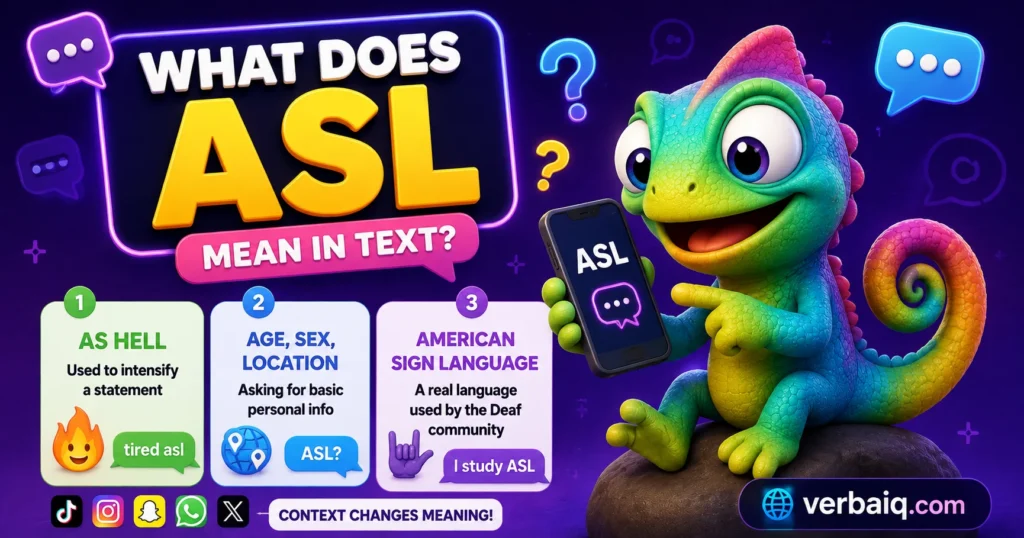
The meaning of ASL in text depends on context. It can mean “as hell,” “age, sex, location,” or “American Sign Language.” The lowercase “asl” after an adjective usually means “as hell,” while “ASL?” traditionally means “age, sex, location?”
What Is the Meaning of ASL in Text?
There are three important meanings to know when you see ASL online:
- asl = as hell — modern internet slang used to intensify a description.
- ASL? = age, sex, location? — an older internet-chat abbreviation used to ask basic personal details.
- ASL = American Sign Language — the name of a distinct visual language used primarily in the United States and parts of Canada.
The surrounding words usually make the intended meaning clear.
For example:
“I’m tired asl.”
Here, asl = as hell, meaning “I’m extremely tired.”
But:
“Hey, ASL?”
is the older age, sex, location? question.
And:
“She’s learning ASL.”
almost certainly refers to American Sign Language.
Dictionary.com recognizes both “age, sex, location” and the “as hell” slang meaning, while ASL also has its established linguistic meaning.
The Most Common Texting Meaning: ASL = “As Hell”
In modern social-media slang, asl often means “as hell.”
It works as an intensifier. In other words, it makes the word or description before it stronger.
Examples:
- “tired asl” = extremely tired
- “funny asl” = extremely funny
- “cold asl” = extremely cold
- “cute asl” = extremely cute
- “busy asl” = extremely busy
The abbreviation normally appears after the adjective or description it modifies.
“This movie is scary asl.”
means:
“This movie is scary as hell.”
This modern usage is especially visible in TikTok and other social-media environments. Dictionary.com notes that lowercase asl is often used as a shortening of “as hell” on TikTok and other social platforms.
Why Is It Usually Lowercase?
Lowercase asl is a useful visual clue because the modern slang form is commonly written that way:
“That song is good asl.”
By contrast:
“I know ASL.”
is much more likely to refer to American Sign Language.
However, capitalization is not a guaranteed rule. People don’t always follow consistent spelling conventions online, so the sentence itself matters more than whether the letters are uppercase or lowercase.
ASL = Age, Sex, Location
The older internet meaning is:
A = Age
S = Sex
L = Location
So:
“ASL?”
traditionally means:
“What is your age, sex, and location?”
The abbreviation became strongly associated with early internet chatrooms, where strangers could communicate without having detailed profiles.
A typical exchange might have looked like:
Person 1: “Hey.”
Person 2: “Hi.”
Person 1: “ASL?”
Person 2: “19, female, Chicago.”
The question was a quick way to establish basic information about the person on the other side of the screen.
Historical evidence shows that A/S/L was especially common in early chatroom culture. A 2001 Pew report on teenagers and the internet identified A/S/L as a common question in chatrooms.
Is “Sex” Sometimes Replaced by “Gender”?
Yes, people may interpret the middle letter more loosely today as sex/gender, but the traditional expansion is “age, sex, location.”
You may also see:
- A/S/L
- ASL
- asl?
The punctuation and formatting vary, but the underlying question is the same.
ASL = American Sign Language
The third major meaning has nothing to do with internet slang.
ASL stands for American Sign Language, a distinct, rule-governed language used by Deaf communities primarily in the United States and parts of Canada. The American Speech-Language-Hearing Association describes ASL as a natural language with its own linguistic structure and regional variation.
For example:
“My sister is taking an ASL class.”
Here, ASL definitely means American Sign Language, not “as hell.”
Similarly:
“Do you know ASL?”
is probably asking whether someone knows the language.
This meaning is important because ASL is not merely a collection of hand gestures or a coded version of English. It is a genuine language with its own linguistic characteristics.
How to Tell Which ASL Meaning Someone Means
The fastest way to decode ASL is to look at where it appears in the sentence.
| Example | Likely Meaning | Why |
|---|---|---|
| “I’m hungry asl.” | As hell | It follows an adjective |
| “That was funny asl.” | As hell | It intensifies “funny” |
| “ASL?” | Age, sex, location | Standalone question |
| “What’s your ASL?” | Age, sex, location | Asking personal information |
| “I’m studying ASL.” | American Sign Language | Language/education context |
| “ASL interpreter” | American Sign Language | Accessibility/language context |
A useful shortcut is:
If “as hell” fits naturally in the sentence, “asl” probably means “as hell.”
If someone simply writes:
“ASL?”
the older age, sex, location meaning becomes much more plausible.
If the conversation concerns Deaf culture, interpreting, signing, or accessibility, American Sign Language is the obvious interpretation.
A Common Misunderstanding About ASL
A surprisingly common misunderstanding is assuming that ASL always means American Sign Language.
That’s understandable because ASL is the standard abbreviation for the language.
But internet culture gave the letters another life.
Someone writing:
“I’m exhausted asl.”
isn’t talking about sign language.
They’re saying:
“I’m exhausted as hell.”
There is a second misunderstanding in the opposite direction: older internet users may automatically interpret “ASL?” as “age, sex, location?” even when younger social-media users intended something completely different.
That generational overlap is one reason ASL can cause confusion online. Know Your Meme documents the newer “as hell” interpretation as a recontextualization of the older abbreviation, with its earliest known documented example appearing on X in 2018 and its use becoming much more visible on TikTok in the early 2020s.
Which Apps Use ASL?
ASL is not tied to one platform. The meaning changes according to how and where it appears.
TikTok
TikTok has been particularly important to the newer “as hell” meaning.
Examples include:
“This edit is clean asl.”
or:
“I’m tired asl.”
The modern slang usage became increasingly visible on TikTok during the early 2020s.
TikTok also contains plenty of genuine American Sign Language content, including lessons, signing demonstrations, and Deaf-community content.
The lowercase slang form also appears in Instagram captions, comments, and messages:
“That outfit is cute asl.”
Instagram has also been documented as a place where people use the older age/sex/location interpretation when meeting strangers online.
Snapchat
Both meanings can occur on Snapchat.
A message such as:
“That filter is funny asl.”
uses the modern slang meaning.
But:
“ASL?”
from a stranger may be the older personal-information question.
X
X played an important role in the documented history of the newer “as hell” interpretation. Know Your Meme identifies a June 20, 2018 X post as the earliest known instance it found connecting ASL with “as hell,” although it explicitly notes that the true origin is unknown.
ASL can certainly occur in ordinary private messaging, but there is not strong evidence that WhatsApp created a separate meaning for it. Treat it as general texting shorthand and use the surrounding sentence to determine what the sender means.
Is ASL an Acronym, Abbreviation, or Slang?
It can be all three depending on the meaning.
“As hell”
This is best understood as internet slang/abbreviated slang.
“busy asl”
is a shortened form of:
“busy as hell.”
“Age, sex, location”
This is an internet initialism/abbreviation.
The letters represent the first letters of three words:
Age + Sex + Location.
“American Sign Language”
This is a conventional initialism for the language’s name.
So calling every ASL usage simply “slang” isn’t technically accurate.
How ASL Works Grammatically
When asl = “as hell,” it generally works as an intensifying modifier.
It normally comes after the word being intensified:
“happy asl”
“late asl”
“loud asl”
“expensive asl”
It isn’t normally used as a standalone noun or verb in this sense.
You generally wouldn’t write:
“I asl today.”
Instead:
“I’m tired asl today.”
Can “asl” Stand Alone?
Yes, but usually with a different meaning.
“ASL?”
can function as a complete question meaning “age, sex, location?”
The modern “as hell” version generally needs something before it:
“That was crazy asl.”
That’s one of the easiest grammatical clues to remember.
Where Did ASL Come From?
The answer depends on which ASL you mean.
Origin of “Age, Sex, Location”
The exact person who invented A/S/L is unknown.
It developed within early online chat culture and became widely recognized in chatrooms and instant messaging. Know Your Meme traces its widespread early use to IRC and later services such as AOL Instant Messenger and MSN Messenger, while noting that the exact origin is uncertain.
A 2001 Pew study provides evidence of how familiar the expression had become among teenagers using chatrooms.
So it would be inaccurate to claim that a particular website or individual invented it.
Origin of “As Hell”
The exact inventor of asl = as hell is also unknown.
What can be documented is that a June 2018 X post is the earliest known example identified by Know Your Meme, while later usage spread through social media and became especially prominent on TikTok.
That means the honest answer is:
The exact origin is unclear, but the newer meaning is documented online from at least 2018 and became more visible in the early 2020s.
Origin of American Sign Language
American Sign Language has a much older and completely different history.
ASL emerged in the 19th century through contact among signing communities in the United States and French Sign Language. The American School for the Deaf was established in Hartford in 1817 through the work of Thomas Hopkins Gallaudet and Laurent Clerc.
Gallaudet University notes that Clerc brought the sign language of Paris to Hartford, where it mixed with sign languages already used in America. That language contact contributed to what became American Sign Language.
So the language ASL is centuries older than the internet slang uses of the same three letters.
4 Short Example Conversations
Funny
A: I just ate three slices of pizza.
B: Hungry asl?
A: Apparently.
B: Your stomach is working overtime.
Sarcastic
A: This meeting is exciting asl.
B: Really?
A: Absolutely. I almost fell asleep twice.
Playful
A: Your new haircut looks good asl.
B: Finally, someone noticed.
A: It was impossible not to notice.
B: I’ll take that compliment.
Serious
A: I saw your message about the ASL course.
B: Yeah, I’m thinking about taking it.
A: That’s great.
B: I’ve wanted to learn American Sign Language for years.
12 More ASL Example Conversations
1. Friends
A: This weather is hot asl.
B: Seriously.
A: I’m melting.
B: Same.
2. Family
A: Mom, I’m hungry asl.
B: There’s food in the kitchen.
A: I’m already going.
3. Coworkers
A: That deadline is close asl.
B: I know.
A: I’ll finish my section tonight.
B: I’ll do mine too.
4. Dating
A: You looked good asl in that picture.
B: Oh, really?
A: Very really.
B: I’ll remember that.
5. Group Chat
A: That ending was confusing asl.
B: I thought I was the only one.
C: Nope. Totally lost.
D: Same here.
6. TikTok Comment
A: This dog is cute asl.
B: The little face 😭
A: Exactly!
B: Instant follow.
7. Instagram
A: Your vacation photos are beautiful asl.
B: Thank you!
A: Where was this?
B: Northern Italy.
8. Snapchat Stranger
A: Hey, ASL?
B: What do you mean?
A: Age, sex, location.
B: Oh. I don’t share personal details with strangers.
9. Older Internet Chat Style
A: Hey, ASL?
B: 21, female, Toronto.
A: Nice. I’m 22, male, Boston.
B: Cool.
10. ASL Class
A: Do you know ASL?
B: A little.
A: I’m taking a beginner course.
B: That’s awesome.
11. Workplace Accessibility
A: Will there be an ASL interpreter at the event?
B: Yes, the organizers confirmed one.
A: Great.
B: I’ll send you the schedule.
12. Casual Text
A: I’m tired asl tonight.
B: Go to bed 😂
A: I probably should.
B: Finally, some sense.
How to Reply to ASL
Your response depends entirely on which meaning the sender intended.
If “asl” Means “As Hell”
You don’t need to address the abbreviation itself.
Them: “I’m hungry asl.”
Funny reply:
“Go feed yourself immediately 😂”
Neutral reply:
“Same honestly.”
If “ASL?” Means Age, Sex, Location
You do not have to provide personal information, especially to a stranger.
A neutral response:
“What do you mean by ASL?”
Or:
“I don’t share personal details online.”
That’s particularly sensible when the person is unknown to you.
If ASL Means American Sign Language
You can answer directly:
“I know a little ASL, but I’m still learning.”
Flirty Reply
If “asl” means “as hell” and the conversation is already clearly flirtatious:
“You noticed that, huh? 😉”
Don’t use a flirty response simply because the abbreviation appears. Context matters more than the letters.
ASL vs Similar Terms
| Term | Meaning | Tone | Popularity | Confusion Risk |
|---|---|---|---|---|
| ASL / asl | As hell, age/sex/location, or American Sign Language | Depends on context | High | High |
| ASF | As f***; strong intensifier | Very casual | High | Medium |
| AF | As f***; intensifier | Casual | Very high | Low |
| FR | For real | Casual | Very high | Low |
| WYD | What you doing? | Casual | High | Low |
| A/S/L | Age/sex/location | Old-school chat | Moderate/declining | Medium |
| ASAP | As soon as possible | Neutral | Very high | Low |
The closest confusing term is A/S/L, because it is simply another way of formatting the older “age, sex, location” meaning.
Who Uses ASL?
There is no reliable rule saying only Gen Z uses ASL.
However, the newer “as hell” usage is strongly associated with younger internet culture and became particularly visible among Gen Z users on TikTok. Know Your Meme and other reporting document the generational confusion caused by the newer interpretation.
Older internet users may be more likely to recognize:
ASL? = age, sex, location?
because that was common in earlier chatroom culture.
At the same time, people of different ages can use either meaning today.
There is no reliable gender-based rule for ASL usage, and there is not enough evidence to claim that one U.S. region or country universally uses the abbreviation differently.
Is ASL Rude or Safe?
The answer depends on the meaning.
“As Hell”
The phrase contains “hell,” so it is informal and mildly profane to some audiences. It’s generally fine among friends and in casual social-media communication, but it’s not ideal for formal writing.
“Age, Sex, Location”
The phrase itself isn’t profanity, but asking strangers for age, sex, and location can be intrusive.
Don’t assume someone owes you those details.
This is especially important when a stranger asks for the information from a young person. The abbreviation itself isn’t dangerous, but the information being requested can be sensitive.
American Sign Language
There is nothing rude about referring to American Sign Language as ASL.
However, don’t confuse ASL with a generic system of gestures. It is a real language with its own structure and history.
A Better Way to Think About ASL
One useful trick is to read the grammar before reading the letters.
Compare:
“That test was hard asl.”
The word comes after hard, so it is functioning as an intensifier.
Now:
“ASL?”
It’s a standalone question, so the older “age, sex, location?” meaning is plausible.
And:
“I’m learning ASL.”
The word is functioning as the name of a language.
This is more reliable than memorizing a single definition.
Why Does ASL Keep Causing Confusion?
ASL is unusually sticky because three completely different language systems collided around the same three letters.
The older chat abbreviation came from a world where strangers met in text-only rooms. The modern “as hell” version emerged from fast-moving social-media slang. Meanwhile, American Sign Language already had a long-established identity as a real language.
That means the same letters can signal internet history, modern slang, or Deaf culture depending on three or four words around them. The abbreviation isn’t inherently confusing; its meanings simply belong to very different contexts.
FAQ
What does ASL mean in text messages?
ASL can mean “as hell,” “age, sex, location,” or “American Sign Language.” If it appears after an adjective, such as “tired asl,” it usually means “as hell.” If someone sends “ASL?” by itself, the older “age, sex, location?” interpretation is more likely.
What does “asl” mean on TikTok?
On TikTok, lowercase asl commonly means “as hell.” It intensifies a word, as in “funny asl” or “tired asl.” TikTok has played a major role in spreading and popularizing this newer slang usage.
What does ASL mean when someone asks “ASL?”
If someone simply asks “ASL?”, they may mean “age, sex, location?” This is an older internet-chat abbreviation used to ask basic personal details. If the person is a stranger, you don’t have to provide that information.
Does ASL mean American Sign Language?
Yes. ASL is the standard abbreviation for American Sign Language, a distinct natural language used primarily in the United States and parts of Canada. In conversations about Deaf culture, interpreting, signing, or accessibility, this is usually the intended meaning.
Why does Gen Z use ASL to mean “as hell”?
The exact person who created this usage is unknown. Know Your Meme identifies a June 2018 X post as the earliest known example it found and documents the meaning becoming more widespread on TikTok during the early 2020s.
Is ASL slang or an acronym?
It depends on which definition you mean. “As hell” is informal internet slang, while “age, sex, location” and “American Sign Language” are abbreviations or initialisms. Calling every use of ASL simply “slang” misses the distinction between them.
Is “asl” offensive?
The “as hell” meaning is informal and mildly profane because it abbreviates a phrase containing “hell,” but it isn’t generally considered a slur or inherently offensive. The “age, sex, location” usage isn’t profanity, although asking strangers for personal information can be intrusive.
How can I tell which ASL meaning someone means?
Look at the sentence structure and topic. “Cute asl” means “cute as hell,” “ASL?” can mean “age, sex, location?”, and “I’m learning ASL” means American Sign Language. When the context is unclear, simply ask the sender what they mean.
Conclusion
The meaning of ASL in text isn’t just one definition.
Today, the most important interpretations are:
- asl = as hell — a modern intensifier, especially common in casual social-media language.
- ASL? = age, sex, location? — an older internet-chat abbreviation.
- ASL = American Sign Language — a real language with a long history in Deaf communities.
The easiest way to avoid confusion is to look at position and context.
If you see:
“That movie was amazing asl.”
think “as hell.”
If you see:
“ASL?”
consider “age, sex, location?”
If you see:
“She teaches ASL.”
think American Sign Language.
And don’t assume capitalization alone settles the question. Online writers often ignore capitalization, so the words surrounding ASL are the better clue.