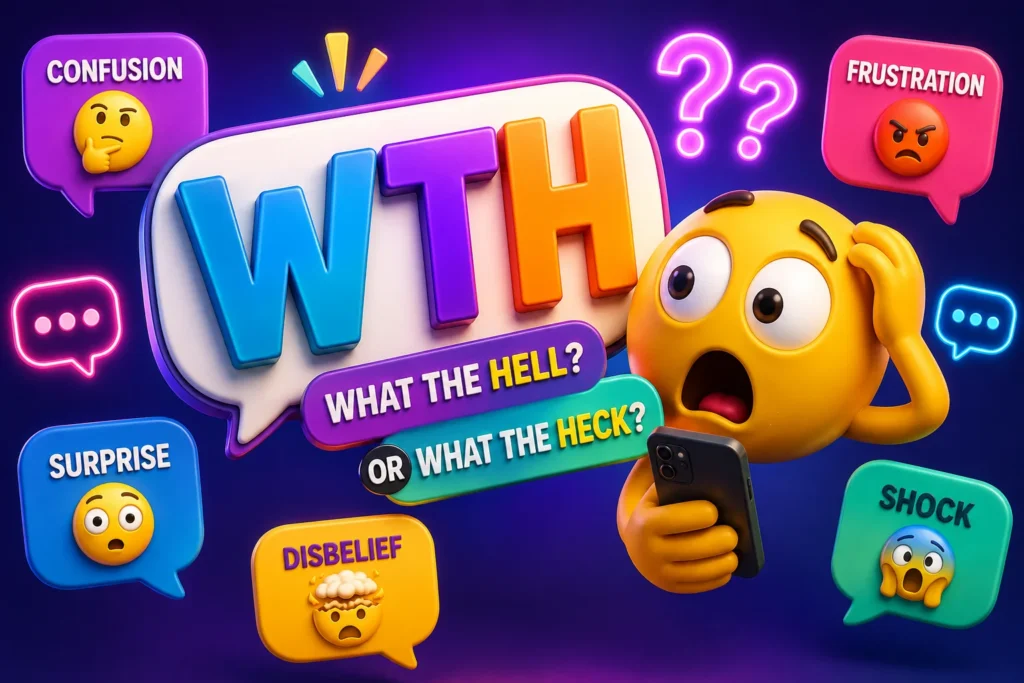
WTH most commonly stands for “What the Hell.” It’s an internet abbreviation people use to express surprise, confusion, disbelief, frustration, or annoyance. In more family-friendly conversations, many people also interpret it as “What the Heck,” making it a milder alternative with the same general meaning. The intended expansion usually depends on the speaker, the audience, and the tone of the conversation.
For example:
- “WTH just happened?”
- “WTH are you talking about?”
- “WTH was that noise?”
- “WTH, I wasn’t expecting that!”
In every example, WTH acts as an emotional reaction rather than providing new information. It tells readers that the speaker finds something surprising, shocking, confusing, or hard to believe.
Is WTH an Acronym, Abbreviation, or Slang?
From a linguistic perspective, WTH is an initialism, a type of abbreviation formed from the first letters of several words.
- W = What
- T = The
- H = Hell (or Heck)
Although each letter represents a word, people almost always refer to WTH as internet slang because it’s primarily used in digital conversations rather than formal writing. Today, you’ll see dictionaries, slang websites, and communication guides describe it as both an internet abbreviation and a slang expression, which is accurate in everyday usage.
All Real Meanings of WTH
1. What the Hell (Most Common Meaning)
This is the original and most widely recognized meaning.
People use it when they’re reacting to something unexpected, frustrating, confusing, or unbelievable.
Examples:
- “WTH is going on?”
- “WTH did I just watch?”
- “WTH happened here?”
- “WTH are they thinking?”
Here, “hell” functions as an intensifier. It doesn’t usually refer to religion or theology; instead, it emphasizes the speaker’s emotional reaction.
2. What the Heck (Family-Friendly Alternative)
Many parents, teachers, workplaces, and family-friendly communities interpret WTH as “What the Heck.”
The overall meaning stays almost identical, but the tone becomes less harsh.
For example:
- “WTH? I thought the store opened at nine.”
- “WTH happened to my homework?”
Whether someone mentally reads WTH as hell or heck often depends on personal preference rather than the writer’s intention.
3. Other Context-Specific Uses
Outside texting and social media, the letters WTH occasionally appear as initials for businesses, organizations, technical terms, or project names.
However, these are context-specific abbreviations, not internet slang. If someone texts:
“WTH was that?”
they are almost certainly using the slang meaning rather than referring to an organization or technical term.
A Common Misunderstanding
One common misconception is that WTH always means profanity.
That’s not entirely true.
While the traditional expansion is “What the Hell,” many people consciously use it because it softens the phrase. Some readers automatically interpret it as “What the Heck,” especially in family-friendly environments.
Another misunderstanding is that WTH always signals anger. In reality, it’s just as often used to express:
- surprise
- confusion
- amusement
- disbelief
- mild frustration
For example:
“WTH 😂”
often expresses laughter and disbelief rather than genuine anger.
Which Apps Is WTH Actually Used On?
Unlike platform-specific slang, WTH appears almost everywhere people communicate online.
TikTok
TikTok users frequently write WTH in comments reacting to unexpected videos, surprising endings, or unusual situations.
Examples include:
- “WTH did I just watch?”
- “WTH 😂”
Because TikTok encourages quick reactions, WTH fits naturally into comment sections.
You’ll often find WTH in:
- comments
- direct messages
- Story replies
- meme captions
People commonly use it to react to funny, shocking, or confusing posts.
Snapchat
Snapchat conversations are informal by nature, making WTH a common reaction in private chats and Story responses.
Example:
“WTH are y’all doing? 😂”
Friends and family frequently use WTH in WhatsApp conversations when reacting to unexpected news, photos, or voice messages.
Example:
“WTH happened while I was gone?”
X (Formerly Twitter)
WTH has long been popular on X because the platform encourages short, reaction-based posts.
People often use it while responding to:
- breaking news
- sports moments
- celebrity stories
- memes
- viral videos
Its brevity makes it ideal for fast-moving conversations.
Grammar: How Does WTH Work?
Unlike ordinary nouns or verbs, WTH functions as an interjection or discourse marker.
Its purpose is to express emotion rather than describe an object or action.
Part of Speech
Most grammarians classify WTH as an interjection because it communicates an immediate emotional reaction.
Example:
WTH! That scared me.
Sentence Position
WTH most commonly appears at the beginning of a sentence.
Examples:
WTH happened?
WTH is going on?
It can also appear in the middle of a sentence.
So WTH were you thinking?
Occasionally, it appears at the end for emphasis.
You actually bought that? WTH.
Can WTH Be a Complete Reply?
Yes.
Unlike many abbreviations, WTH can stand entirely on its own.
Example:
A: I accidentally deleted the project.
B: WTH?
That single response immediately communicates surprise or disbelief without needing additional words.
Where Did WTH Come From?
The full phrase “What the hell?” has existed in spoken English for generations as an emphatic way to express surprise or frustration.
The abbreviation WTH emerged much later during the growth of online chat rooms, internet forums, and SMS texting in the late 1990s and early 2000s. As people looked for faster ways to type common expressions, abbreviations such as LOL, BRB, OMG, and WTH became part of everyday digital communication.
There is no reliable evidence linking WTH to AAVE or any single cultural community. Instead, its spread reflects the broader evolution of internet communication, where shortening familiar expressions became a practical habit before smartphones introduced predictive text and voice typing.
Why Do People Use WTH?
Many articles define WTH but overlook why people continue using it despite modern keyboards making full words easier to type.
One reason is emotional efficiency.
Typing:
“WTH?”
immediately communicates surprise, confusion, or disbelief without requiring a full explanation.
Another reason is tone control.
Compared with writing “What the hell?”, the abbreviation feels slightly softer and less confrontational. Readers often perceive it as a casual internet reaction rather than outright profanity.
Finally, WTH has become part of the shared vocabulary of online culture. Most internet users recognize it instantly, allowing conversations to move quickly while still conveying emotion.
WTH vs. Similar Expressions
Although several abbreviations seem similar, each carries a different level of intensity.
| Expression | Meaning | Typical Tone |
|---|---|---|
| WTH | What the Hell / What the Heck | Surprise, confusion, frustration |
| WTF | What the F*** | Stronger shock or anger |
| OMG | Oh My God | Surprise, excitement, amazement |
| SMH | Shaking My Head | Disappointment or disbelief |
| Huh? | Request for clarification | Confusion without emotional emphasis |
| No Problem (opposite conversational tone) | Indicates everything is fine | Calm, reassuring |
The biggest difference is between WTH and WTF.
Both express surprise, but WTF is significantly stronger and more explicit, while WTH is generally viewed as the milder, more socially acceptable alternative.
Why Has WTH Stayed Popular?
Thousands of internet abbreviations have disappeared over the years, yet WTH remains common because it expresses a universal reaction. People will always encounter situations that leave them confused, surprised, or momentarily speechless.
Instead of typing an entire sentence, WTH captures that emotion in just three letters. Its combination of brevity, familiarity, and flexibility has allowed it to survive from the early days of text messaging into today’s conversations on TikTok, Instagram, Snapchat, WhatsApp, and X.
WTH in Different Conversation Tones
Although WTH always expresses surprise, confusion, or disbelief, its tone changes depending on the situation. It can sound humorous, sarcastic, playful, or genuinely concerned without changing its core meaning.
Funny
A: I ordered one burger and they sent me twelve.
B: WTH? Are they feeding the whole neighborhood?
A: I guess dinner’s sorted for the week.
B: Best delivery mistake ever.
Sarcastic
A: My laptop updated right before the presentation.
B: WTH, because that’s exactly the perfect timing.
A: Couldn’t have happened at a worse moment.
B: Technology always knows when to disappoint.
Playful
A: You ate my last cookie?
B: It looked lonely.
A: WTH, that’s not an excuse!
B: I regret nothing.
Serious
A: WTH happened at the office today?
B: The power went out and everything stopped.
A: Is everyone okay?
B: Yes, thankfully no one was hurt.
Real Chat Examples
These examples show how WTH naturally appears in different conversations, relationships, and platforms.
1. Friends (WhatsApp)
A: WTH just happened in that movie?
B: I have absolutely no idea.
A: That ending made no sense.
B: We definitely need to watch it again.
2. Instagram Comments
A: WTH, how did you take that photo?
B: Perfect timing and a little luck.
A: It looks unreal.
B: Thanks!
3. Snapchat
A: WTH are you doing awake at 3 a.m.?
B: Couldn’t sleep.
A: Same here.
B: At least I’m not the only one.
4. Family Group Chat
Mom: WTH happened to the kitchen?
Son: I tried baking.
Mom: I can see that.
Son: It tasted better than it looked.
5. Dating Conversation
A: WTH, you remembered my favorite coffee?
B: Of course I did.
A: That’s really sweet.
B: I pay attention.
6. Office Chat
A: WTH happened to the shared document?
B: Someone accidentally deleted half of it.
A: Is there a backup?
B: Luckily, yes.
7. Gaming Friends
A: WTH was that final boss?
B: Way harder than I expected.
A: Took me an hour.
B: Same here.
8. College Friends
A: WTH, the professor moved the deadline earlier.
B: Seriously?
A: Check your email.
B: I better start working now.
9. Group Chat
A: WTH is everyone talking about?
B: You missed yesterday’s conversation.
A: Fill me in.
B: It’s a long story.
10. Travel Conversation
A: WTH, our flight got delayed again.
B: That’s the third delay today.
A: At this rate we’ll arrive tomorrow.
B: Looks like it.
11. Sports Fans
A: WTH was that referee thinking?
B: I honestly don’t know.
A: Worst decision of the match.
B: Everyone in the stadium was confused.
12. X (Formerly Twitter)
A: WTH is happening on my timeline today?
B: Every post is more chaotic than the last.
A: I can’t stop scrolling.
B: Same here.
How to Reply to WTH
The best reply depends on why someone said WTH.
Funny Reply
“I’m wondering the same thing 😂”
Serious Reply
“Let me explain what happened.”
Flirty Reply
“Maybe I’ll tell you… if you buy me coffee 😉”
A flirty response only fits if the conversation is already lighthearted and mutual.
Neutral Reply
“Here’s what happened.”
or
“It’s a long story.”
WTH Compared with Similar Expressions
| Term | Meaning | Tone | Popularity | Confusion Risk |
|---|---|---|---|---|
| WTH | What the Hell / What the Heck | Surprise, disbelief | Very High | Low |
| WTF | What the F*** | Strong shock or anger | Very High | Medium |
| OMG | Oh My God | Surprise, excitement | Very High | Low |
| SMH | Shaking My Head | Disappointment | Very High | Low |
| HUH? | Asking for clarification | Neutral | High | Very Low |
| No Problem (opposite conversational tone) | Everything is okay | Calm, reassuring | Very High | Very Low |
Although WTH and WTF are often compared, they aren’t interchangeable in every situation. WTH is generally considered the milder option, making it more suitable for mixed audiences and everyday conversations.
Who Uses WTH?
Age Groups
WTH is recognized by people of many ages because it has been part of internet communication for decades. Teenagers, university students, working professionals, and older internet users all understand it, although how often they use it varies.
Gen Z vs. Millennials
Gen Z frequently uses WTH in text messages, memes, TikTok comments, Instagram replies, and gaming chats. It often appears alongside emojis or other internet slang.
Millennials also use WTH regularly, especially because it became popular during the early SMS and instant messaging era. Many Millennials still prefer WTH over the stronger abbreviation WTF because it sounds less aggressive.
Rather than belonging to one generation, WTH has become a widely recognized part of online English.
Regional Usage
There is no reliable evidence that WTH belongs to one specific English-speaking country.
You’ll commonly see it used across:
- United States
- Canada
- United Kingdom
- Australia
- New Zealand
- Other English-speaking online communities
Its popularity comes from internet culture rather than regional dialects.
Is WTH Rude or Safe?
Is It Offensive?
Usually, no, but context matters.
Although WTH often expands to “What the Hell,” many people interpret it as the softer “What the Heck.” Because the abbreviation hides the full phrase, many readers view it as less offensive than writing the complete expression.
Is It Profanity?
It’s generally considered mild profanity or a euphemistic abbreviation, depending on whether the reader interprets the final word as hell or heck.
Compared with WTF, WTH is usually regarded as much more acceptable in casual conversations.
Is It Appropriate for School or Work?
In casual workplace chats between colleagues, some people use WTH without issue. However, it’s still better to avoid it in:
- business emails
- academic writing
- formal presentations
- customer communication
- professional reports
Using the full phrase “What happened?” or “I’m confused” is more professional.
Why WTH Still Works So Well in Conversations
One reason WTH has survived while many internet abbreviations have faded is its versatility.
It can express surprise without sounding overly dramatic, confusion without asking a long question, and frustration without immediately becoming offensive. In just three letters, it captures a reaction that almost everyone has experienced.
Another reason is familiarity. Even people who don’t regularly use internet slang usually recognize WTH instantly, making it an efficient way to communicate emotion across different ages and online communities.
Common Mistakes to Avoid
When using WTH, keep these points in mind:
- Don’t assume everyone reads it as “What the Heck.” Some people will naturally interpret it as “What the Hell.”
- Avoid using it in formal or professional communication.
- Don’t confuse WTH with the much stronger WTF.
- Remember that it expresses a reaction, not an explanation.
- Use it sparingly—repeating WTH in every message can make conversations feel exaggerated.
Frequently Asked Questions About WTH
Does WTH always mean “What the Hell”?
Most of the time, yes. The most widely recognized expansion of WTH is “What the Hell.” However, many people intentionally interpret or use it as “What the Heck” in family-friendly or professional settings because it sounds less harsh. In everyday texting, the exact expansion often depends on the speaker’s tone and the audience rather than a strict rule.
Is WTH considered rude?
Not usually, but it isn’t completely neutral either. Because it often stands for “What the Hell,” some people consider it mild profanity. It’s generally much less offensive than WTF, making it acceptable in many casual conversations, though it’s still best avoided in formal communication or when speaking with someone who may find it inappropriate.
Is WTH the same as WTF?
No. Although both abbreviations express surprise or disbelief, WTF contains a much stronger profanity and usually conveys greater anger, frustration, or shock. WTH is the milder alternative and is often chosen when people want to soften their reaction while still expressing emotion.
Can I use WTH at work?
It depends on your workplace culture. In casual team chats among coworkers, some people use WTH without any issue. However, it should generally be avoided in professional emails, presentations, customer communication, or formal business documents where more neutral language is appropriate.
Is WTH used only in text messages?
No. While WTH became popular during the SMS era, it’s now widely used across social media and online communication. You’ll regularly see it in comments, captions, direct messages, gaming chats, forums, and messaging apps such as TikTok, Instagram, Snapchat, WhatsApp, Discord, Reddit, and X.
Can WTH be used jokingly?
Absolutely. Many people use WTH humorously when reacting to funny videos, harmless mistakes, or unexpected situations. In these contexts, it often expresses playful disbelief rather than genuine frustration.
Why do people write WTH instead of the full phrase?
The abbreviation is quicker to type and feels slightly less direct than writing the complete phrase. Many users also prefer it because it softens the emotional impact while still communicating surprise or confusion. Over time, WTH has become so familiar that most internet users understand it instantly.
Is WTH still popular in 2026?
Yes. Unlike many short-lived internet abbreviations, WTH has remained common because it expresses a universal reaction that people experience every day. Whether someone is responding to unexpected news, a funny meme, or a confusing situation, the abbreviation continues to fit naturally into online conversations.
What does WTH mean in texting?
In texting, WTH usually means “What the Hell” or, more politely, “What the Heck.” People use it to react to something surprising, confusing, or frustrating. It’s one of the most recognizable reaction abbreviations in digital communication.
What does WTH mean on Snapchat?
On Snapchat, WTH is commonly used in private chats and Story replies when someone is surprised or confused by a photo, video, or message. The meaning is the same as in texting and other social media platforms.
What does WTH mean on TikTok?
TikTok users frequently comment “WTH?” on videos that are shocking, funny, unexpected, or difficult to believe. It’s often paired with laughing or shocked emojis to emphasize the reaction.
Is WTH bad language?
WTH is generally considered a mild euphemistic abbreviation rather than strong profanity. While some readers associate it with the phrase “What the Hell,” many others interpret it as “What the Heck.” Because of this ambiguity, it’s usually viewed as less offensive than spelling out the stronger phrase.
When Should You Use WTH?
WTH works best when you want to express surprise, confusion, or disbelief in a casual conversation.
Good situations include:
- Texting friends
- Social media comments
- Group chats
- Gaming conversations
- Reacting to memes or viral videos
- Casual online discussions
It’s better to avoid WTH when:
- Writing business emails
- Communicating with customers
- Preparing academic assignments
- Speaking in formal meetings
- Writing professional reports
When clarity and professionalism matter, using complete sentences is usually the better choice.
Final Thoughts
WTH has remained one of the internet’s most recognizable abbreviations because it expresses a familiar human reaction in just three letters. Whether someone is surprised by unexpected news, confused by a situation, or reacting to something funny online, WTH provides a quick, widely understood way to communicate that emotion.
Unlike many internet slang terms that disappear after a few years, WTH continues to appear across texting, social media, gaming communities, and messaging apps because it isn’t tied to one specific trend. Its meaning has stayed remarkably consistent, making it easy for people of different ages and online communities to understand.
The key is knowing your audience. In casual conversations, WTH feels natural and conversational. In formal settings, replacing it with a complete sentence is usually the more appropriate choice.
Quick Usage Tips
- Use WTH to express surprise, confusion, or mild frustration.
- Choose it over WTF when you want a less intense reaction.
- Keep it for casual conversations, texts, and social media.
- Consider your audience before using it in mixed or professional settings.
Common Mistakes
- Assuming WTH is always offensive.
- Confusing WTH with the much stronger WTF.
- Using it in formal workplace or academic writing.
- Believing it has multiple unrelated slang meanings.
- Overusing it until every reaction sounds exaggerated.