
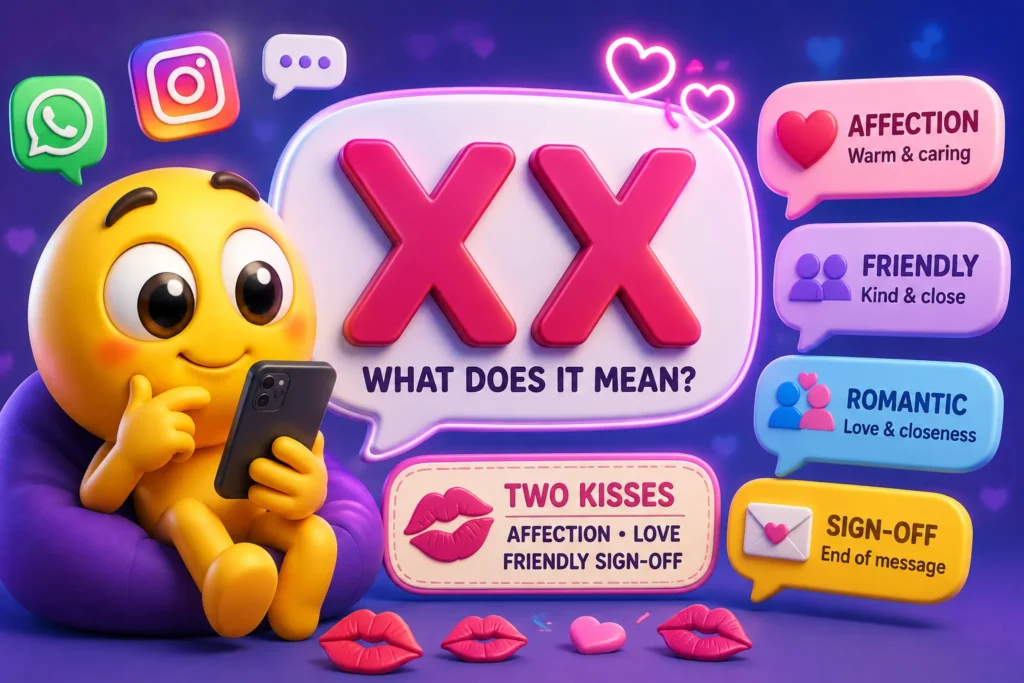
XX usually means “two kisses” at the end of a text message or online conversation. It’s a friendly sign-off used to show affection, warmth, appreciation, or closeness. Many people search for its meaning after receiving a message ending with “xx” and wondering whether it’s romantic, platonic, or simply polite.
Is XX an Acronym, an Abbreviation, or Slang?
Unlike abbreviations such as LOL, BRB, or IMO, XX is neither an acronym nor an abbreviation.
Instead, it’s a symbolic sign-off.
Each “X” represents a kiss, so:
- x = one kiss
- xx = two kisses
- xxx = three kisses
The number of kisses someone includes usually reflects personal texting habits rather than a strict rule about affection.
Today, XX is considered part of internet and texting culture, even though the symbol itself existed long before smartphones and social media.
All Real Meanings of XX
1. Two Kisses (Most Common Meaning)
The primary meaning of XX is “two kisses.”
People place it at the end of a message to make their words feel warmer or friendlier.
Examples:
See you tomorrow xx
Thanks for helping me today xx
Hope you have a lovely weekend xx
Unlike emojis, XX isn’t meant to replace words. Instead, it changes the emotional tone of the message.
2. Friendly Affection
Many people automatically assume XX is romantic.
In reality, that’s often not true.
In countries like the United Kingdom, ending messages with x or xx is common between:
- close friends
- family members
- coworkers (depending on workplace culture)
- classmates
- neighbors
In these situations, the kisses simply signal friendliness rather than romantic interest.
3. Romantic Sign-Off
XX can also be romantic.
Partners often use:
- xx
- xxx
- xoxo
to end affectionate conversations.
Whether XX feels romantic depends far more on the relationship between the people than on the symbol itself.
4. Email or Letter Closing
Outside texting, some people finish informal emails or handwritten notes with xx after their name.
Example:
Love,
Sarah xx
Again, this usually signals warmth rather than formal communication.
A Common Misunderstanding
One of the biggest misconceptions is:
“XX always means someone likes me romantically.”
That’s incorrect.
In many English-speaking communities—particularly the UK—people routinely add x or xx to messages sent to friends, siblings, parents, grandparents, and even acquaintances.
Receiving xx does not automatically mean someone is flirting.
Instead, consider:
- your relationship
- previous conversations
- local culture
- the person’s normal texting habits
Someone who ends every message with xx is probably just being friendly.
Which Apps Is XX Actually Used On?
Unlike reaction slang such as LOL or WTH, XX is mainly used when ending conversations.
WhatsApp is one of the most common places to see XX.
Friends and family often finish messages like:
Goodnight xx
Speak soon xx
On Instagram, XX commonly appears in:
- direct messages
- Story replies
- private conversations
It’s less common in public comments because it’s designed as a personal sign-off.
Snapchat
Snapchat users sometimes finish chats with:
Thanks xx
or
Night xx
especially among close friends.
Facebook Messenger
Messenger conversations often end with XX between:
- relatives
- close friends
- partners
Again, it’s most common in private conversations rather than public posts.
X (Formerly Twitter)
XX occasionally appears in replies or direct messages on X.
However, because X emphasizes public conversation rather than personal messaging, it’s less common there than on WhatsApp or Messenger.
TikTok
Evidence suggests XX appears far less frequently on TikTok than on messaging platforms.
While it may occasionally appear in direct messages or creator replies, it isn’t a characteristic TikTok slang term in the same way phrases like POV, GRWM, or IYKYK are.
Read More: What Does WTH Mean? Text, Slang & Social Media Guide
Grammar: How Does XX Work?
XX behaves differently from ordinary words.
It doesn’t function as a noun, verb, adjective, or interjection.
Instead, it’s best understood as a symbolic conversational marker.
Part of Speech
Linguistically, XX acts as a message closing or symbolic sign-off rather than a grammatical word.
Sentence Position
Almost always, XX appears:
At the very end.
Examples:
Have a great day xx
Talk later xx
Congratulations xx
Seeing XX in the middle of a sentence is unusual.
Can XX Be a Complete Reply?
Generally, no.
Unlike:
LOL
or
OMG
XX normally cannot stand alone as an entire conversation.
Instead, it accompanies another message.
For example:
Thanks xx
rather than simply:
xx
Although someone might occasionally send only xx after another message, it’s understood as an affectionate sign-off rather than a complete statement.
Where Did XX Come From?
The tradition of using X to represent a kiss existed long before texting and smartphones.
One widely repeated historical explanation traces it back to the Middle Ages, when many people who couldn’t write signed documents with an X representing the Christian cross. They then kissed the mark to show sincerity or agreement.
While historians agree that X has represented a kiss for centuries, the exact origin remains uncertain. No single theory has been conclusively proven, and several explanations have been proposed over the years.
By the late twentieth century, people naturally carried this tradition into handwritten letters, greeting cards, emails, SMS messages, and eventually social media.
Today, ending a message with x or xx is simply part of digital communication in many English-speaking communities.
Why Do People Use XX?
Most articles explain what XX means, but fewer explain why people keep using it.
The answer lies in emotional tone.
Written messages don’t include facial expressions, voice, or body language. Adding xx softens the message and helps communicate warmth that might otherwise be missing.
Compare these examples:
Thanks.
versus
Thanks xx
The words are identical, yet the second message usually feels more personal and friendly.
That’s one reason XX has survived despite the rise of emojis. It adds emotional context without requiring additional words.
XX vs. Similar Expressions
Several texting sign-offs look similar but don’t carry exactly the same meaning.
| Expression | Meaning | Typical Tone |
|---|---|---|
| XX | Two kisses | Friendly, affectionate |
| X | One kiss | Warm, casual |
| XXX | Three kisses | More affectionate or enthusiastic |
| XOXO | Hugs and kisses | Romantic or very affectionate |
| ❤️ | Heart emoji | Love, appreciation, care |
| Regards (opposite tone) | Formal message closing | Professional, neutral |
The biggest difference is between XX and XOXO.
While XX usually signals warmth or friendliness, XOXO is often more openly affectionate because it combines both kisses (X) and hugs (O).
Why Has XX Remained Popular?
Unlike many pieces of internet slang that fade within a few years, XX has survived because it isn’t tied to a trend or meme.
Instead, it fulfills a simple human need: making written conversations feel warmer.
Whether it’s sent between lifelong friends, siblings, partners, or close family members, XX quietly adds emotional nuance without changing the actual message.
That’s why it continues to appear in texts, messaging apps, and online conversations—even as digital communication keeps evolving.
XX in Different Conversation Tones
Although XX always represents a kiss or a warm sign-off, the feeling behind it changes depending on the relationship and the conversation. The same “xx” can sound humorous, affectionate, playful, or comforting.
Funny
A: I finally assembled that bookshelf without reading the instructions.
B: I’m honestly impressed.
A: Only one extra screw was left over.
B: That’s a victory 😂 xx
Sarcastic
A: My phone battery died at 99%.
B: Of course it did.
A: Perfect timing.
B: Technology never disappoints… xx
Playful
A: Don’t forget it’s your turn to buy coffee tomorrow.
B: I was hoping you’d forget.
A: Nice try!
B: See you tomorrow xx
Serious
A: Thank you for being there today.
B: Anytime.
A: It really meant a lot.
B: Take care of yourself xx
Real Chat Examples
These examples show how XX naturally appears in different relationships, messaging apps, and situations.
1. Friends (WhatsApp)
A: Thanks for helping me move today.
B: You’re welcome!
A: Couldn’t have done it alone.
B: Happy to help xx
2. Family Group Chat
Mom: Dinner will be ready at seven.
Son: I’ll be there.
Mom: Drive safely.
Son: Will do xx
3. Instagram DM
A: Love your holiday photos!
B: Thank you so much!
A: They look amazing.
B: That’s so kind of you xx
4. Dating Conversation
A: I had a really nice time tonight.
B: Me too.
A: Looking forward to seeing you again.
B: Same here xx
5. College Friends
A: Did you finish the assignment?
B: Finally.
A: Send it over when you can.
B: No problem xx
6. Workplace Friends
A: Thanks for covering my shift.
B: Anytime.
A: I owe you one.
B: Don’t worry about it xx
7. Siblings
A: Happy birthday!
B: Thank you!
A: Hope you have an amazing day.
B: Thanks, see you later xx
8. Facebook Messenger
A: Congratulations on your new job!
B: Thank you!
A: You deserve it.
B: That’s really sweet xx
9. Long-Distance Friends
A: Miss our weekend coffee chats.
B: Me too.
A: Let’s call this weekend.
B: Definitely xx
10. Neighbors
A: Thanks for collecting my parcel.
B: No problem.
A: I really appreciate it.
B: Anytime xx
11. Grandparent and Grandchild
Grandparent: Have a wonderful day at school.
Grandchild: Thanks!
Grandparent: Love you.
Grandchild: Love you too xx
12. Group Chat
A: Great seeing everyone today.
B: We should do it again soon.
A: Absolutely.
B: Have a lovely evening xx
How to Reply to XX
If someone ends a message with xx, you don’t have to respond with the exact same sign-off. Your reply should match your relationship with the sender.
Funny Reply
“Only two kisses? I was expecting at least three 😂”
Serious Reply
“Thank you. Take care too.”
Flirty Reply
“I’ll happily send two back… xx 😉”
A flirty response only makes sense if the relationship is already romantic or clearly playful.
Neutral Reply
“Thanks! Speak soon.”
or
“You too xx”
Both are perfectly natural in casual messaging.
XX Compared with Similar Expressions
| Term | Meaning | Tone | Popularity | Confusion Risk |
|---|---|---|---|---|
| XX | Two kisses | Friendly, affectionate | Very High | Low |
| X | One kiss | Casual, warm | Very High | Low |
| XXX | Three kisses | More affectionate | High | Medium |
| XOXO | Hugs and kisses | Romantic or affectionate | High | Low |
| ❤️ | Heart emoji | Love, appreciation, care | Very High | Low |
| Regards (opposite tone) | Formal closing | Professional, neutral | Very High | Very Low |
While all of these expressions can end a message warmly, XX usually strikes a balance between friendliness and affection. It often feels less intimate than XOXO and more personal than simply writing “Thanks.”
Who Uses XX?
Age Groups
People of all ages use XX, but how often they include it varies by habit and culture.
- Teenagers often use x or xx with close friends.
- Young adults commonly include it in texts, WhatsApp chats, and Instagram DMs.
- Older adults who have used texting for many years may also finish messages with xx, especially when communicating with family.
Gen Z vs. Millennials
Gen Z tends to mix xx with emojis, GIFs, or internet slang. Some Gen Z users prefer emojis instead of text-based sign-offs, while others still use xx regularly in private messages.
Millennials often grew up using SMS and instant messaging, making xx a familiar habit. Many continue using it naturally in WhatsApp conversations, emails, and Messenger chats.
Rather than belonging to one generation, XX has become part of everyday digital etiquette for many English speakers.
Regional Usage
Regional differences are one of the most interesting aspects of XX.
In the United Kingdom, adding x or xx at the end of messages is extremely common. Friends, relatives, and even some acquaintances may use it routinely without any romantic meaning.
In countries like the United States, xx is less automatic. Some Americans associate it more strongly with romantic affection because it isn’t used as universally in everyday messaging.
In Australia, New Zealand, and parts of Ireland, usage is generally closer to the UK, where ending messages with x or xx is a familiar sign of friendliness.
Is XX Romantic, Rude, or Safe?
Is It Offensive?
No.
XX contains no profanity, offensive language, or explicit content. It’s widely considered a polite and affectionate way to end informal messages.
Is It Always Romantic?
Not at all.
Context matters far more than the symbol itself.
Between partners, xx may express affection.
Between friends or relatives, it often means nothing more than warmth, kindness, or friendliness.
Is It Appropriate for School or Work?
For casual conversations with classmates, friends, or close colleagues, xx is usually acceptable.
However, it’s best to avoid using xx in:
- formal business emails
- customer service messages
- professional reports
- job applications
- official correspondence
In professional settings, a simple closing like “Kind regards” or “Best wishes” is more appropriate.
Why XX Continues to Feel Personal
One reason XX has survived the rise of emojis and stickers is that it doesn’t compete with them—it complements them.
Unlike a heart emoji, which can sometimes feel very emotional, xx is subtle. It adds warmth without drawing attention to itself.
That’s why many people continue using it even after decades of texting. It’s a small gesture that helps written conversations feel more human, especially when facial expressions and tone of voice aren’t available.
Frequently Asked Questions About XX
Does XX always mean kisses?
In almost every texting and messaging context, XX represents two kisses. However, those “kisses” don’t always imply romance. Many people, especially in the UK and some other English-speaking countries, use xx simply as a warm, friendly way to end a message to friends, relatives, or colleagues they know well.
What’s the difference between X and XX?
The difference is simply the number of symbolic kisses. X represents one kiss, while XX represents two. There is no universal rule that XX is more romantic than X—many people use whichever feels natural based on habit rather than intending a stronger meaning.
Is XX flirting?
Sometimes, but not necessarily. If two people are dating or showing romantic interest, xx may be part of that affectionate communication. However, in many friendships and family conversations, it’s simply a polite, caring sign-off with no romantic intention.
Should I reply with XX if someone sends it to me?
You don’t have to. Many people mirror the sender’s style and reply with xx, especially if they already have that type of relationship. If you’re unsure or want to keep the conversation neutral, replying without xx is perfectly acceptable.
Is XX common in the United States?
It’s understood in the United States, but it’s generally less common than in the UK. American texters are more likely to use emojis, hearts, or words like “love you” instead of adding xx to the end of messages. Because of this, some Americans may interpret xx as more romantic than people in the UK would.
Can XX appear in professional emails?
Generally, no. While close coworkers who know each other well may occasionally use x or xx in informal chats, it’s better to avoid it in business emails, customer communication, academic writing, or official correspondence. Professional closings such as “Best regards” or “Kind regards” are more appropriate.
Is XX still popular in 2026?
Yes. Unlike many internet abbreviations that disappear over time, xx has remained part of digital communication because it isn’t tied to a single platform or trend. It continues to appear in text messages, WhatsApp chats, Facebook Messenger, Instagram DMs, and emails, especially among people who prefer warm, personal communication.
Can someone misunderstand XX?
Yes. Cultural differences play a significant role. Someone from a country where xx is rarely used may assume it’s a romantic gesture, while someone from the UK may see it as nothing more than friendly politeness. When in doubt, it’s always better to interpret xx within the context of your relationship with the sender.
People Also Ask
What does XX mean in a text message?
In texting, XX almost always means “two kisses.” People add it to the end of messages to express friendliness, affection, appreciation, or warmth. Its meaning depends on the relationship between the people rather than the letters themselves.
What does XX mean from a girl?
There isn’t one universal answer. Some women use xx with almost everyone they know, while others reserve it for close friends or romantic partners. It’s best not to assume romantic interest based on xx alone—look at the overall conversation and the person’s usual texting style.
What does XX mean from a guy?
Just like with women, the meaning depends on context. Some men rarely use xx, while others include it regularly when messaging family members, friends, or partners. The symbol itself doesn’t automatically reveal romantic feelings.
Is XX better than a heart emoji?
Neither is “better”—they simply communicate warmth in different ways. XX often feels subtle and conversational, while a ❤️ emoji can appear more emotionally expressive. Many people even use both together when speaking with close friends or loved ones.
When Should You Use XX?
Adding xx is appropriate when you want your message to sound warm, friendly, or caring without writing extra words.
Good situations include:
- Texting close friends
- WhatsApp conversations with family
- Instagram or Facebook Messenger DMs
- Thank-you messages
- Birthday wishes
- Casual conversations with people you know well
It’s usually better to avoid xx in:
- Business emails
- Job applications
- Customer support messages
- Academic assignments
- Formal workplace communication
- Messages to people you don’t know well
When you’re unsure about the relationship or the level of formality, it’s safer to leave xx out.
Final Thoughts
Although XX consists of only two letters, it carries a surprising amount of social meaning. Rather than acting as an acronym or slang word, it functions as a symbolic sign-off that adds warmth to digital conversations.
The most important thing to remember is that context always comes first. In some friendships, xx is an everyday habit. In romantic relationships, it may express affection. In formal communication, however, it’s usually inappropriate.
Understanding these differences helps you interpret messages more accurately and avoid reading too much into a simple pair of letters.
Quick Usage Tips
- Use XX to add warmth and friendliness to informal messages.
- Consider your relationship with the other person before including it.
- Remember that XX often means different things in different cultures.
- Use it naturally—there’s no need to add it to every message.
Common Mistakes
- Assuming XX always means romantic interest.
- Confusing XX with XOXO, which often feels more affectionate.
- Using XX in formal business or academic communication.
- Ignoring cultural differences when interpreting the symbol.
- Overthinking the number of kisses someone sends—many people use x, xx, or xxx simply out of habit.