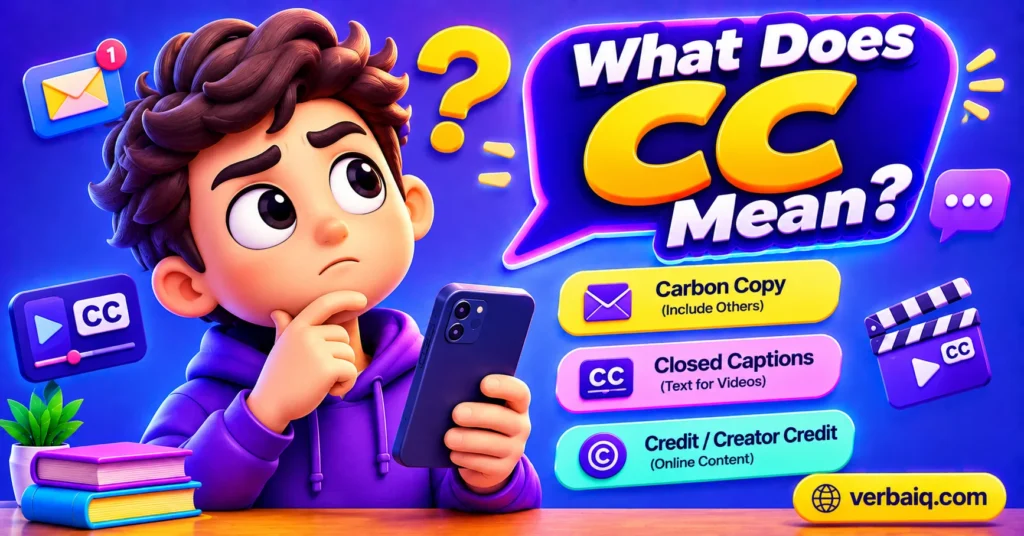
CC in text usually means “carbon copy,” meaning someone is being included in a message or kept informed. In social-media and video contexts, CC can also mean closed captions or, in some communities, credit/creator credit. The exact meaning depends on where you see it.
What Does CC Mean in Text?
When someone writes “CC me” in a message, they usually mean “include me,” “keep me informed,” or “send me a copy.” This use comes from email and business communication, where CC means carbon copy. Cambridge and Oxford both define cc as an abbreviation used when a copy of a letter or email is sent to another person.
For example:
“CC me on that email.”
means:
“Include me so I can see it too.”
Although CC began as a formal communication term, people sometimes carry it into text messages, group chats, and DMs when they want someone included in information.
However, CC does not have one universal meaning online. If you see it attached to a video, it may mean closed captions. If you see “CC: @username” under reposted creative content, it may indicate credit to the creator.
So context matters more than the two letters themselves.
Is CC an Acronym, Abbreviation, or Slang?
CC is best described as an initialism/abbreviation, rather than a conventional slang word.
When CC means carbon copy, it comes from the phrase carbon copy. It is pronounced by saying the individual letters: “see see.”
When people use CC casually in messages, they are usually borrowing an established communication abbreviation rather than creating a new slang word.
That distinction is useful because many websites loosely label every short form as “slang.” CC has a much older history than modern internet slang.
The Main Meanings of CC
1. CC = Carbon Copy
This is the most established communication meaning.
In email, adding someone to the CC field sends that person a copy of the message while another person may remain the primary recipient. The same concept can be expressed in conversation with the verb “CC.” Merriam-Webster lists cc as a verb meaning to send someone a copy of an email, letter, or memo.
Example:
“I’ll CC Maria on the email.”
In casual texting, someone might write:
“CC me when you send it.”
The practical meaning is “include me so I know what’s happening.”
2. CC = Closed Captions
If CC appears around a video, it commonly means closed captions.
Closed captions display spoken dialogue as text and can also communicate relevant sounds or other audio information. Accessibility guidance from Section508.gov specifically uses CC for captions that viewers can turn on or off.
This is particularly relevant on video platforms. TikTok, for example, has long used CC in connection with closed-captioned videos.
Example:
“Turn CC on.”
Here, the person almost certainly means:
“Turn on the closed captions.”
3. CC = Credit or Creator Credit
On social media, particularly when people share or repost creative work, CC can sometimes mean credit.
You may see:
“CC: @username”
This can indicate that the named account deserves recognition for the original content.
This use is less standardized than carbon copy or closed captions, so it should not automatically be assumed whenever CC appears on Instagram or TikTok. Social-media guides document CC being used for creator/content credit, particularly around reposts, edits, artwork, and other creative material.
In other words, “CC” does not universally mean “credit” on every social-media post. Look at what surrounds it.
4. CC = Casually Chilling
There is also a niche slang use documented by Slang.net: CC can mean “casually chilling.” It is considerably less established than carbon copy, closed captions, or credit.
For example:
“What are you doing?”
“NM, CC.”
In that particular slang usage, CC means the person is casually chilling or relaxing.
Because this meaning is relatively uncommon, you should not assume it when a friend simply types “CC.”
5. CC = Cubic Centimeter
Outside texting, cc is also an established measurement abbreviation for cubic centimeter.
You might see:
“A 750cc motorcycle”
Here, CC has nothing to do with messaging. It refers to engine displacement or volume. Cambridge and Oxford both list cc as an abbreviation for cubic centimeter/cubic centimetre.
This meaning generally becomes obvious from the subject of the conversation.
Other Established Uses
CC has additional meanings in specialized contexts, including credit card, cashier’s check, Creative Commons, community college, city council, and other domain-specific abbreviations. Collins lists several established dictionary meanings beyond carbon copy and cubic centimeters.
Those meanings should not automatically be treated as texting slang. If someone says:
“I need my CC to pay for this.”
they may mean credit card, not carbon copy.
A Common Misunderstanding About CC
One of the biggest mistakes is assuming that CC always means carbon copy simply because that is its best-known definition.
That works in an email conversation:
“Please CC me.”
But it may be completely wrong under a video:
“The video has CC.”
There, the likely meaning is closed captions.
Likewise:
“CC: @artist”
may be about crediting the creator, not copying someone into a message.
The useful rule is simple:
Look at what CC is attached to.
- Message or email → usually carbon copy
- Video → often closed captions
- Reposted creative content → possibly credit
- Relaxing/chat slang → occasionally casually chilling
- Engine or volume → cubic centimeters
This context-first approach is more reliable than memorizing a single definition.
What Does CC Mean on Different Apps?
CC in WhatsApp
WhatsApp does not have a traditional email-style CC field. Therefore, when someone writes “CC John” in a WhatsApp conversation, they are usually borrowing the email idea and informally saying that John should be included or kept informed.
The meaning is understandable, but it is not a special WhatsApp feature.
CC in Instagram
Instagram can produce several interpretations.
If CC appears beside a username on reposted artwork, edits, photographs, or similar content, it may mean credit or creator credit. Some Instagram-specific references also document CC in editing communities as credit-related shorthand.
If CC appears on or around a video, it may instead refer to closed captions.
Therefore, Instagram is one of the places where context is especially important.
CC on TikTok
On TikTok, closed captions is a well-established interpretation of CC in video contexts. TikTok-related explanations have documented CC being used to indicate captioned content.
Credit is also possible in creator and reposting contexts, but it should not automatically be assumed.
CC on Snapchat
CC may appear in shared content or messages, but there is no strong evidence that Snapchat has created one dominant special slang meaning for CC.
If someone sends:
“CC me”
the safest interpretation is usually “include me/keep me informed,” provided the conversation is about sharing information.
If CC appears on a video, closed captions may be the more likely interpretation.
CC on X
On X, CC can similarly depend on context. A post discussing a video may use CC for closed captions, while a conversation about sending information may use CC in the carbon-copy sense.
There is no single X-specific meaning that should override context.
Grammar: How Is CC Used in a Sentence?
When CC means carbon copy, it can function as a verb.
Examples:
“CC me on the email.”
“She CC’d her manager.”
“I’ll CC you tomorrow.”
Merriam-Webster specifically records cc as a transitive verb, with forms such as cc’d and cc’ing.
It can also function as a noun in communication contexts:
“I was only on the CC.”
In social-media contexts, CC may instead function as a label:
“CC: @originalcreator”
When it means closed captions, it usually behaves like a noun or label:
“Does this video have CC?”
So CC does not have one fixed grammatical role.
Can “CC” Be a Complete Text Reply?
Yes, but it is uncommon and highly context-dependent.
If someone asks:
“Who should be included?”
A reply such as:
“CC Sarah.”
makes sense.
But receiving only:
“CC”
without any context can be confusing.
Unlike highly established texting abbreviations such as “TY” or “LOL,” CC usually needs surrounding information to make its intended meaning obvious.
Where Did CC Come From?
The carbon copy meaning predates email and modern texting.
Before digital document systems became widespread, carbon paper could be placed between sheets of paper so that pressure from writing or typing transferred text onto the underlying sheet. A duplicate was therefore a carbon copy.
The abbreviation CC became associated with indicating recipients who received copies of business correspondence. When electronic mail adopted a CC field, the old abbreviation continued even though no carbon paper was involved.
That history explains why a seemingly old-fashioned term still appears in modern messages.
The later social-media meanings developed through different communication practices rather than having one single origin. Closed captions, for example, use CC as an established accessibility label, while creator-credit uses grew within online content-sharing communities.
There is no reliable evidence that CC’s main communication meaning originated in AAVE or another specific cultural dialect. Its documented history is tied to copying documents and electronic correspondence.
Four Tone-Based Example Conversations
Funny
Alex: I’m sending the group the vacation plan.
Jamie: CC me before they choose the hotel.
Alex: Why?
Jamie: Because apparently I’m the only one with taste.
Here, CC me means “include me in the information.”
Sarcastic
Mia: I’ll send the complaint to management.
Ryan: CC me.
Mia: Want me to CC the entire building too?
Ryan: Only if you want maximum chaos.
Again, CC means include me on the message.
Playful
Sam: Guess what I found for our trip.
Nina: Wait, CC me on the details!
Sam: You mean you want screenshots?
Nina: Obviously. I need evidence before I get excited.
Serious
Manager: I’m sending the updated schedule tonight.
Employee: Please CC me so I have the final version.
Manager: Absolutely.
Employee: Thanks. I want to make sure I follow the correct schedule.
More Realistic Examples of CC in Conversation
1. Friends — Group Chat
Lena: I’m sending the restaurant options to everyone.
Chris: CC Maya too.
Lena: She isn’t in this chat.
Chris: Exactly. Send it to her separately.
2. Coworkers — Email
Jordan: Did you send the proposal to the client?
Taylor: Yes.
Jordan: Can you CC me next time?
Taylor: Sure, I’ll include you on the next update.
3. Family — Text
Mom: I’m sending Dad the appointment details.
Sara: CC me too, please.
Mom: I’ll forward everything.
Sara: Perfect.
4. Dating — Text
Ryan: I found two hotels for Friday.
Ella: CC me on the links 😂
Ryan: “CC” in a text message now?
Ella: I like to sound professionally invested in our date.
5. Work Group Chat
Aisha: The client changed the deadline.
Ben: CC the whole project team.
Aisha: Already doing it.
Ben: Good. Nobody can say they didn’t know.
6. Instagram — Creator Credit
Maya: Where did you get that artwork?
Nora: I reposted it from another artist.
Maya: Did you add CC?
Nora: Yes, I tagged the original creator.
Here CC means credit, not carbon copy.
7. TikTok — Captions
Leo: I can’t hear the video.
Chris: Tap CC.
Leo: Found it.
Chris: Much easier now.
Here CC means closed captions.
8. WhatsApp
Ali: I’m sending the itinerary to the family group.
Sara: CC Uncle Hamid too.
Ali: He isn’t on WhatsApp.
Sara: Okay, I’ll send it to him separately.
9. Group Project
Noah: I uploaded the final presentation.
Emma: CC me when you send it to the teacher.
Noah: Will do.
Emma: Thanks.
10. Reposted Content
Chris: Who made this edit?
Dylan: I think it was @someone.
Chris: Add CC before reposting it.
Dylan: Good point.
Here CC refers to credit.
11. Casual Slang
Jake: What are you doing tonight?
Ryan: Nothing, just CC.
Jake: You mean casually chilling?
Ryan: Yeah, exactly.
This is the less common slang use documented by slang references.
12. Motorcycle Conversation
Dan: What size engine does it have?
Mike: 650cc.
Dan: Nice.
Mike: Yeah, plenty of power for what I need.
Here cc means cubic centimeters, not texting slang.
How Should You Reply to “CC”?
Your response depends on what the sender means.
If They Mean “Include Me”
You can say:
“Sure, I’ll CC you.”
Or:
“No problem, I’ll keep you in the loop.”
Funny Reply
“Already CC’ing you. You’re officially on the list.”
Serious Reply
“Absolutely. I’ll include you on the message so you have the complete information.”
Flirty Reply
If the conversation is romantic and CC simply means “include me”:
“You don’t need a CC. I’ll make sure you get the VIP version 😉”
Neutral Reply
“Sure, I’ll send you a copy.”
CC vs Similar Terms
| Term | Meaning | Tone | Popularity | Confusion Risk |
|---|---|---|---|---|
| CC | Carbon copy, closed captions, or credit depending on context | Neutral | High | High |
| BCC | Blind carbon copy; recipients are hidden from other recipients | Formal/technical | High in email | Medium |
| Tag | Mentioning or identifying a person/account | Casual | Very high | Low |
| Credit | Giving recognition to the original creator/source | Neutral | High | Low |
| FYI | For your information | Neutral | High | Medium |
| Caption | Text accompanying or appearing with media | Neutral | Very high | Medium |
| No credit | Content shared without attribution | Negative/critical | Common phrase | Low |
The important distinction is that CC and BCC are communication-routing concepts, while tag and credit describe different social-media actions.
CC vs BCC: Why the Difference Matters
CC and BCC are often confused because both involve sending copies.
With CC, recipients can generally see the other recipients included in the CC field.
With BCC, the copied recipients are hidden from the other recipients.
So:
“CC my manager”
means the manager is openly included.
“BCC my manager”
means the manager receives a hidden copy.
That difference matters in professional communication.
How to Tell Which CC Meaning Someone Intended
Instead of memorizing dozens of definitions, look for context signals.
If CC is followed by a person’s name:
“CC Alex”
it probably relates to including Alex.
If CC appears next to a video:
“Turn CC on”
it probably means closed captions.
If it appears next to a username:
“CC @artist”
it may mean credit.
If it appears beside a motorcycle specification:
“500cc”
it means cubic centimeters.
If someone says:
“I’m just CC tonight”
the niche casually chilling interpretation may fit.
This is one of the easiest ways to avoid misreading abbreviations: identify the object or action surrounding the abbreviation first.
Who Uses CC?
CC is not limited to one generation.
The carbon-copy meaning is particularly familiar in workplace and email communication, where the abbreviation has been established for decades. It can therefore be used by younger and older adults alike.
The closed-caption meaning is widespread in digital video environments, while credit usage appears in some online creator and reposting communities.
There is not strong evidence for a meaningful US-versus-UK regional slang divide for these main meanings. The differences are primarily contextual rather than geographic.
Claims that CC belongs exclusively to Gen Z, Millennials, teenagers, or a particular region would be too broad.
Is CC Rude or Offensive?
Generally, CC is not rude, offensive, or profane.
“CC me” is normally a practical request to be included in information.
However, the action of CC’ing someone can sometimes carry a social implication depending on the situation.
For example:
“I’m CC’ing your manager.”
may sound more serious than:
“I’ll CC you on the update.”
In workplace communication, copying additional people can sometimes be interpreted as increasing visibility or accountability. The abbreviation itself is neutral; the surrounding situation determines the tone.
The closed-caption meaning is also completely neutral.
The credit meaning is generally associated with attribution and recognition.
Is CC Safe for School or Work?
Yes, but context and formality matter.
In professional email, CC is completely standard.
In a school project, you might encounter CC when discussing email, media attribution, or closed captions.
However, if you are writing a formal document, it is usually better to spell out what you mean the first time rather than assuming every reader understands a niche use.
For example:
“Please add me to the CC field.”
is clearer than simply writing:
“CC me.”
A Useful Insight: CC Survived Because the Concept Survived
CC is interesting because its technology changed while its basic communication function stayed useful.
Carbon paper disappeared from ordinary office communication, but the idea of giving another person a copy remained valuable. Email preserved the abbreviation, and casual digital communication sometimes borrowed it again.
Meanwhile, video platforms gave CC another practical role: making spoken content readable through captions.
That is why CC has lasted much longer than many internet abbreviations. It is not simply trendy slang. It represents several recurring communication needs: include someone, make information accessible, or acknowledge a source.
FAQ
What does CC mean in a text message?
In a text message, CC most commonly refers to carbon copy and means including someone or keeping them informed. For example, “CC me” can mean “include me in the message or information.” However, if CC appears around a video, it may instead mean closed captions.
Does CC mean “credit” on social media?
Sometimes. In reposting and creator communities, CC can be used to indicate credit to an original creator. This usage is documented on platforms such as Instagram, but it is not a universal rule for every CC appearing on social media. Always look at whether a username or original piece of content follows the abbreviation.
What does CC mean on TikTok?
On TikTok, CC commonly refers to closed captions when it appears in a video or discussion about captions. TikTok-related sources document this use, particularly for videos containing on-screen captions.
What does “CC me” mean?
“CC me” means include me or send me a copy. It comes from the email concept of carbon copying someone on a message. In a casual chat, the speaker is usually asking to be kept informed.
Is CC the same as BCC?
No. CC openly includes additional recipients, while BCC hides the copied recipients from the other recipients. Both terms originated in correspondence practices, but they serve different purposes in email.
Does CC mean closed captions?
Yes. CC is a widely recognized abbreviation for closed captions, especially in video and accessibility contexts. Closed captions can provide dialogue and relevant audio information as text on screen.
Can CC mean casually chilling?
Yes, but this is a niche slang meaning, not the main definition. Slang references document CC as “casually chilling,” but you should not assume that meaning unless the surrounding conversation clearly involves relaxing or hanging out.
What does CC mean on Instagram?
It depends on where it appears. In reposting or creative-content contexts, CC can refer to credit, while on videos it can mean closed captions. If someone says “CC me” in a direct conversation, the carbon-copy idea of including someone may make more sense.
Conclusion
CC in text most commonly connects to the idea of including someone or sending them a copy, because CC traditionally stands for “carbon copy.” But the abbreviation has several established uses.
The quickest way to interpret it is to check the context:
- “CC me” → include me / send me a copy
- “Turn on CC” → closed captions
- “CC: @username” → likely credit in a creator/repost context
- “650cc” → cubic centimeters
- “I’m CC” → possibly “casually chilling,” but this is uncommon
The biggest mistake is treating every CC as having the same meaning. CC is a context-sensitive abbreviation, and the words around it usually tell you which interpretation makes sense.
For work or formal communication, use CC in its standard email sense. For social media, check whether the surrounding content points toward captions or creator credit. And if someone sends only “CC” with no context, asking what they mean is better than confidently choosing the wrong definition.