
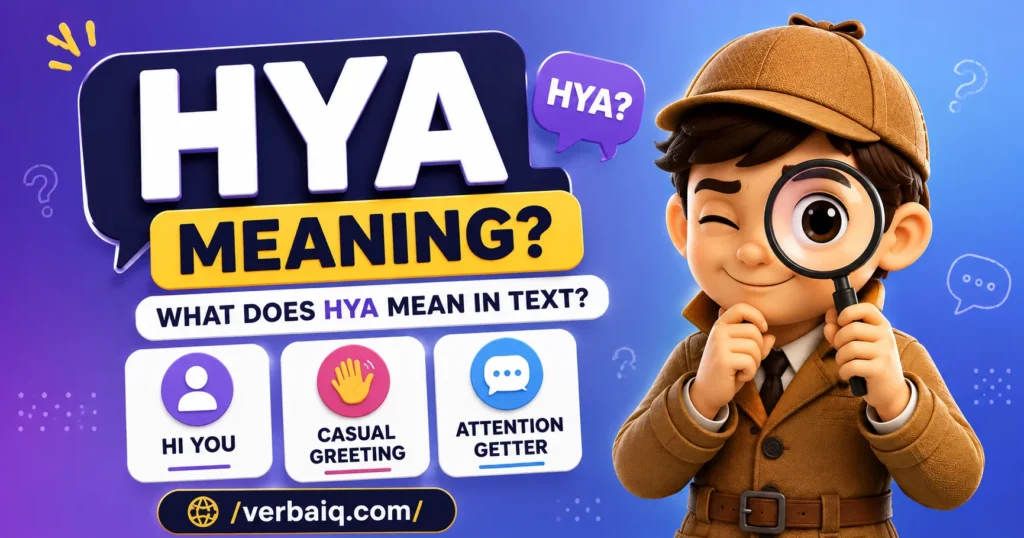
If someone sends you HYA in a text or chat, it can mean “Hi you”—a casual, friendly way to greet someone. However, the spelling can also be confused with “hiya,” an informal version of “hello,” so the surrounding message matters.
HYA is one of those short expressions that looks simpler than it really is.
The problem is that three very similar forms—HYA, HY, and HIYA—can appear in online conversations, but they are not necessarily the same thing. If you assume they all have one meaning, you can easily misread the message.
This guide breaks down what HYA means, how to recognize it in context, how it differs from similar greetings, and when another meaning may be more likely.
What Does HYA Mean in Text?
In internet slang references, HYA most commonly means “Hi you.”
It works as a casual greeting, usually directed at another person.
For example:
HYA! How have you been?
In that sentence, HYA is essentially a friendly way of saying:
“Hi, you!”
or more naturally:
“Hey you!”
The exact wording “Hi you” may sound unusual in formal written English, but informal greetings do not always follow the same grammatical patterns as complete sentences.
The important thing is the function: HYA is being used to get someone’s attention and greet them warmly.
Is HYA an Acronym, an Abbreviation, or Slang?
HYA is best described as an informal texting abbreviation or slang shorthand when it means “Hi you.”
It is not a standard English word in the same sense as hello or greeting.
The capitalization can also vary:
- HYA
- Hya
- hya
In casual messaging, people often do not follow strict capitalization rules. Someone typing hya may simply be writing quickly, while someone using HYA may be emphasizing the greeting.
That means capitalization alone usually cannot tell you exactly what the sender means.
Read More: SMD on Snapchat: The Meaning You Might Not Expect
The Most Important Thing: HYA, HY, and HIYA Are Not Automatically the Same
This is probably the biggest source of confusion around HYA.
HYA
In slang references, HYA = “Hi you.”
It functions as a casual greeting.
Example:
HYA! What are you doing tonight?
HY
HY is more ambiguous in online communication.
Depending on context, articles and slang references commonly interpret it as a casual hi/hey or an enthusiastic “hell yeah.”
Example:
Want to order pizza?
HY!
Here, HY could mean an enthusiastic yes rather than a greeting.
HIYA
Hiya is an established informal greeting similar to:
- Hi
- Hey
- Hello
Example:
Hiya! How are you?
This distinction matters because someone searching for HYA meaning may actually have seen a casual spelling of hiya rather than a deliberate acronym.
How Can You Tell What HYA Means?
The easiest way is to look at where it appears in the conversation.
If It Starts a Conversation
When HYA appears at the beginning of a message, a greeting is the most likely interpretation.
Example:
HYA! Haven’t talked to you in ages.
Here, the sender is clearly opening the conversation.
If It Appears Before a Name
It is probably being used to get someone’s attention.
Example:
HYA Sarah! Are you coming today?
The meaning is similar to:
Hey, Sarah!
If It Appears as a Reply to a Question
Pause before assuming it means “Hi you.”
In this position, the sender might have meant something else, made a typo, or used a personal shorthand that is not widely standardized.
For example:
Person 1: Are you coming tonight?
Person 2: HYA
That does not naturally fit the “Hi you” meaning. In a case like this, the safest interpretation is to ask for clarification rather than inventing a definition.
If It Looks Like “Hiya”
Sometimes the answer is even simpler: the person may just be spelling the greeting hiya in a shortened or stylized way.
This is why context is more reliable than searching for one universal definition.
Does HYA Mean “Hiya”?
Sometimes people may use hya as a casual representation of hiya, especially in informal writing or dialect-influenced communication.
But it is useful not to claim that every HYA automatically means HIYA.
The spelling hiya has a longer history as an informal greeting, while HYA also appears in slang directories as an abbreviation for “Hi you.”
So if someone sends:
Hya! You okay?
it may simply function as a greeting equivalent to:
Hiya! You okay?
But if you see HYA presented as an abbreviation in a slang list, “Hi you” may be the intended expansion.
A Common Misunderstanding: Does HYA Mean “Hell Yeah”?
Usually, don’t assume that it does.
This confusion probably happens because HY is sometimes used online for enthusiastic agreement such as “hell yeah” or “hell yes.”
Adding the letter A changes the abbreviation.
So these two messages should not automatically be interpreted the same way:
HY! Let’s go!
and:
HYA! How are you?
The first may be enthusiastic agreement.
The second is much more likely to be a greeting.
This is one reason short abbreviations can be tricky: one additional letter can completely change the interpretation.
Where Is HYA Used?
There is not strong evidence that HYA belongs exclusively to one specific app.
It can potentially appear in:
- Text messages
- Private chats
- Social media DMs
- Online communities
- Informal group chats
However, it would be misleading to say that HYA is a major, uniquely established slang term on TikTok, Snapchat, Instagram, WhatsApp, or X.
Unlike some expressions that become strongly associated with a particular platform, HYA appears to be a relatively loose and less standardized piece of internet shorthand.
That means the sender’s personal writing style may matter more than the app itself.
Where Did HYA Come From?
The exact origin of HYA as the internet abbreviation “Hi you” is unclear.
There is no reliable evidence pointing to one inventor, one viral post, or one specific social-media community that created it.
The related greeting “hiya” has been discussed by linguists as a reduced or blended greeting form. Historical linguistic research notes competing explanations for its development, including an association with “hi you” and another explanation connecting it with a shortened form of “how are you?” influenced by “hi.”
That uncertainty is important.
Rather than pretending there is one clean origin story, the most accurate explanation is:
The exact history is debated for the related greeting “hiya,” and the specific texting abbreviation HYA does not have a clearly documented single origin.
How Does HYA Work Grammatically?
HYA is not normally used as a noun, verb, adjective, or other traditional grammatical category.
As a greeting, it functions more like an interjection or conversational opening.
Similar examples include:
- Hi!
- Hey!
- Hello!
- Yo!
- Hiya!
You can use HYA as a complete message:
HYA! 👋
Or you can place it at the beginning of a sentence:
HYA! What are you doing?
You normally would not use it in formal grammatical structures such as:
I HYA my friend.
That would not make sense.
Think of HYA as a conversation opener, not a word that performs many different grammatical jobs.
HYA Meaning in Real Conversations
The best way to understand a greeting is to see how its tone changes with the people involved.
1. Funny Tone
Mia: HYA!
Lena: Why are you shouting at me in three letters? 😂
Mia: Because a normal hello wasn’t dramatic enough.
Lena: Fair enough. HYA back at you.
Here, HYA is simply a playful greeting.
2. Playful Tone
Alex: Hyaaa, stranger!
Sam: Stranger? We talked yesterday.
Alex: Yesterday was basically a lifetime ago.
Sam: Okay, dramatic. HYA 😭
The extended spelling makes the greeting feel more playful.
3. Sarcastic Tone
Chris: HYA! Ready for another exciting Monday?
Jamie: Absolutely not.
Chris: Same. I just wanted to sound optimistic.
Jamie: That was your first mistake.
The sarcasm comes from the surrounding conversation, not from HYA itself.
4. Serious and Friendly Tone
Nora: HYA, are you okay?
Ella: Honestly, not really.
Nora: Want to talk about it?
Ella: Yeah. Thanks for checking on me.
A casual greeting can still begin a serious conversation.
5. Friends Reconnecting
Ryan: HYA! Long time no see.
Ben: Seriously. Where have you been?
Ryan: Busy with work and life.
Ben: Same here. We need to catch up.
Here, HYA helps create a relaxed opening.
6. Family Chat
Aunt: Hya! Did you get home safely?
You: Yes, just got in.
Aunt: Good. I wanted to make sure.
You: Thanks for checking!
The greeting itself is casual and warm.
7. Group Chat
Jordan: HYA everyone! Who’s joining the call?
Maya: Me!
Owen: Give me five minutes.
Jordan: Perfect. I’ll wait.
In a group setting, HYA works as an attention-getting opener.
8. Coworkers in an Informal Chat
Tom: Hya, are you free for a minute?
Priya: Sure. What’s up?
Tom: Can you check something for me?
Priya: Send it over.
The casual greeting works between coworkers who already communicate informally.
For a formal workplace message, however, Hello or Hi would usually be clearer.
9. Dating Conversation
Taylor: HYA 😊 How’s your day going?
Morgan: Better now that someone’s checking on me.
Taylor: Smooth answer.
Morgan: I had to try.
HYA itself is not automatically flirty. The emoji and the rest of the conversation create the flirtatious tone.
10. Gaming Chat
Player 1: HYA, you joining the match?
Player 2: Yep, loading in now.
Player 1: Hurry before the next round starts.
Player 2: I’m here!
Short greetings fit naturally into fast-moving informal chats.
How to Reply to HYA
You don’t need a complicated response.
Funny Reply
HYA! Is this our secret password now? 😂
Friendly Reply
Hey! How are you?
Neutral Reply
Hi! What’s up?
Playful Reply
HYA 😄 What brings you here?
Flirty Reply
If the conversation already has a flirtatious tone, you could say:
HYA 😉 I was wondering when you’d text me.
The flirting comes from the context—not from the abbreviation itself.
Serious Reply
If someone uses HYA before asking an important question:
Hey. I’m here. What’s going on?
That response keeps the conversation open and supportive.
HYA vs Similar Terms
| Term | Meaning | Tone | Popularity | Confusion Risk |
|---|---|---|---|---|
| HYA | Usually “Hi you” in slang references | Casual, friendly | Less common | High |
| Hiya | Informal “hello” | Warm, casual | Common | Medium |
| HY | Can mean hi/hey or “hell yeah,” depending on context | Casual or enthusiastic | More common online | High |
| Hey | Casual greeting or attention-getter | Neutral to friendly | Extremely common | Low |
| Hi | Standard informal greeting | Neutral | Extremely common | Low |
| Hello | Standard greeting | Neutral to formal | Extremely common | Very low |
| Goodbye | A farewell rather than a greeting | Neutral | Extremely common | Very low |
There is no perfect “opposite” of HYA in the same grammatical sense because greetings do not have a direct opposite.
The closest contrast is a farewell, such as “goodbye” or “bye.”
Who Uses HYA?
There is not enough reliable evidence to assign HYA to one generation, gender, or region.
It would be inaccurate to say:
- Only Gen Z uses HYA.
- Millennials invented it.
- Men use it more than women.
- It belongs to one country.
The related greeting hiya is especially familiar in British English and in some regional varieties of English, but that does not mean every person writing HYA is using it in the same way.
Online language also crosses national boundaries quickly.
A person’s individual texting habits may be more important than their age or location.
Is HYA Rude?
No. HYA is not profanity or an offensive expression.
When used as a greeting, it is generally friendly and harmless.
The main issue is formality.
You would probably avoid HYA in:
- A job application
- A formal business email
- A message to a client you don’t know
- Academic writing
Instead, use:
Hello,
or:
Hi,
HYA is better suited to casual conversations where unusual shorthand will not confuse the reader.
Is HYA Safe to Use at School or Work?
It depends on the situation.
Casual student chat?
Usually fine.
Friends in a group project?
Probably fine if everyone communicates informally.
Message to a teacher?
Better to use Hello or Hi.
Formal workplace email?
Avoid it.
The reason is not that HYA is rude. The problem is that it is not universally recognized.
A standard greeting prevents confusion.
Why Does a Tiny Expression Like HYA Work?
Short greetings work because conversation often begins with a social signal rather than information.
Before asking a question, making a request, or starting a longer discussion, people often need a quick way to say:
“I’m here, and I’m talking to you.”
HYA can perform that job in just three letters.
Its usefulness comes from speed and informality. But its weakness is the same thing: because it is not strongly standardized, the person reading it may interpret it differently.
That makes HYA a good example of how online language values efficiency—but still depends heavily on shared context.
Frequently Asked Questions
What does HYA mean from a guy?
The meaning generally does not change because of the sender’s gender. If he uses HYA as a greeting, it most likely functions like “Hi you,” “hey,” or possibly a stylized version of “hiya.” Look at the rest of the conversation before reading romantic meaning into three letters.
What does HYA mean from a girl?
Again, the basic meaning does not depend on gender. It may simply be a casual greeting. Emojis, message wording, relationship history, and the rest of the conversation provide better clues about tone than HYA alone.
Does HYA mean “hey you”?
Some people may interpret it that way because “Hi you” and “hey you” serve similar conversational functions. However, slang references specifically list HYA as “Hi you.” If the intended phrase is “hey you,” context may still make that interpretation understandable.
Is HYA the same as HY?
No, you should not automatically treat them as the same abbreviation. HY has several commonly discussed meanings, including casual greetings and enthusiastic agreement such as “hell yeah.” HYA is documented separately as “Hi you” in slang references.
Does HYA mean “hell yeah”?
Not as its commonly listed HYA slang definition. This confusion is more likely to come from HY, which can be used differently depending on context. If someone writes HYA as a response to a question, ask for clarification rather than assuming.
Is HYA the same as hiya?
They can look similar and may occasionally function similarly in informal writing, but they are not necessarily identical. “Hiya” is an established informal greeting, while HYA is also listed separately as a slang abbreviation. The spelling and context help determine which interpretation fits.
Can I use HYA in a text?
Yes, but only if you’re comfortable with the other person understanding it. Because HYA is less universally recognized than “hi,” “hey,” or “hiya,” a standard greeting may be clearer. Use HYA mainly in relaxed conversations.
What should I reply when someone says HYA?
A simple “Hey!” or “Hi! What’s up?” works perfectly. You can also match their energy with “HYA!” if the conversation is playful. There is no special response required.
Final Thoughts
The most commonly listed slang meaning of HYA is “Hi you,” making it a casual greeting used to start or open a conversation.
But the term deserves a little more caution than many other abbreviations.
HYA, HY, and HIYA are similar-looking forms with potentially different meanings. HY can have multiple interpretations, while HIYA is an established informal greeting. HYA may be used as shorthand for “Hi you,” and in some casual writing it may also be visually confused with or used like “hiya.”
The easiest way to understand it is to ask one simple question:
What is the message doing in the conversation?
If it starts a chat, addresses someone, or gets their attention, it is probably functioning as a greeting.
If it appears in an unusual position where “Hi you” makes no sense, don’t force that definition. Context always wins over a dictionary list when interpreting informal online language.
And if you want the clearest possible greeting, “Hi,” “Hey,” or “Hello” will always create less confusion than HYA.