
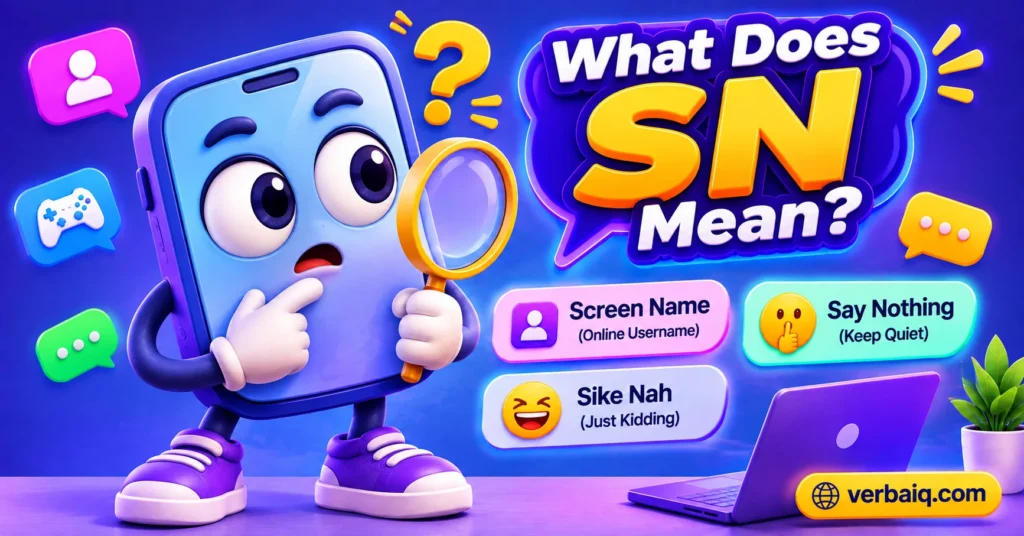
“SN” in text can mean “screen name,” “say nothing,” or “sike nah,” depending on the conversation. The context matters: a username question points to “screen name,” while a joke or secret can point to one of the slang meanings.
What Does SN Mean in Text?
The abbreviation SN does not have one universal meaning in texting.
The three most useful meanings to know are:
- SN = Screen Name — an online username or name used to identify someone.
- SN = Say Nothing — a casual way to mean “don’t mention it,” “keep quiet,” or sometimes “it’s fine.”
- SN = Sike Nah — a joking reversal meaning something like “just kidding” or “fooled you.”
These meanings are documented in slang references, although they are not equally common everywhere. “Screen name” is an established internet term, while “say nothing” and “sike nah” are more context-dependent slang uses.
So if someone simply sends you “SN”, there is no reliable way to decode it without looking at the surrounding conversation.
For example:
“What’s your SN?”
Almost certainly refers to a screen name.
But:
“SN about the surprise.”
is much more naturally read as “say nothing about the surprise.”
And:
“I hate you 😂 SN”
could be using “sike nah” to signal that the first statement was a joke.
That context-based difference is the key to understanding SN.
The Main Meanings of SN
1. SN Means “Screen Name”
Screen name is an established internet term for a name someone chooses to use when communicating online.
Dictionaries define a screen name as a name adopted by an internet user for online communication, including forums and instant messaging. In modern usage, words such as username, handle, account name, or online name often perform a similar function.
You might see:
“What’s your SN?”
“Send me your SN.”
“Do you remember my old SN?”
In each example, SN means screen name.
This meaning is particularly easy to recognize when the conversation is about an account, profile, gaming identity, or online username.
The term “screen name” itself is much older than many current social-media abbreviations. It was associated with earlier internet communication, including chat rooms, forums, and instant messaging. Accounts from internet culture in the 1990s describe people using screen names as online aliases.
That history explains why SN = screen name can sometimes feel like an older internet abbreviation even when someone uses it today.
2. SN Means “Say Nothing”
Another documented texting use is “say nothing.”
In this sense, SN can tell someone not to reveal something or not to mention a particular subject.
For example:
“SN about the party. It’s supposed to be a surprise.”
Here, SN means:
“Say nothing about the party.”
It can also have a softer meaning after someone says thank you.
“Thanks for helping me out.”
“SN, anytime.”
In that situation, “say nothing” has the conversational sense of “don’t mention it” or “you’re welcome.” Cyber Definitions specifically documents both uses.
There is an additional nuance worth knowing. In some slang usage, “say nothing” can function closer to “okay,” “cool,” or “no problem.” User-generated slang references document this conversational use as well. Because that usage is informal and community-dependent, it should not be treated as a universal definition.
So if someone replies:
“SN.”
after you thank them, they may simply be saying:
“No problem.”
But if they write:
“SN about what I told you.”
they are much more clearly telling you:
“Don’t tell anyone.”
3. SN Means “Sike Nah”
The third documented slang meaning is “sike nah.”
“Sike nah” is used to reverse or undermine something that was just said, usually as a joke. It can communicate:
- “Just kidding.”
- “Fooled you.”
- “I wasn’t serious.”
- “Gotcha.”
Cyber Definitions documents SN as a shortened form of “sike nah,” while also explaining that “sike” itself is used to indicate that a previous statement was a joke or prank.
For example:
“I’m deleting your number.”
“WHAT?”
“SN 😂”
Here, SN changes the meaning of the previous message. The sender is essentially saying, “Sike nah — I’m joking.”
This meaning is much less predictable than “screen name.” You generally need the surrounding conversation to recognize it.
Online community discussions also show that this use is not universally recognized. Some people report using SN for “sike nah,” while others say they have never encountered it that way.
That disagreement is important. Slang is often shared unevenly between social groups, so seeing one definition online does not mean every person will understand SN that way.
A Common Misunderstanding About SN
One common mistake is assuming that SN always means “screen name.”
That interpretation makes sense when someone is discussing an account:
“What’s your SN?”
But it makes little sense in:
“SN, don’t tell Mom.”
Here, the likely meaning is “say nothing.”
There is also a reverse problem: someone may know SN as “say nothing” and misunderstand a username question.
For example:
“Drop your SN.”
If someone is asking how to find you online, they probably mean your screen name or username, not “say nothing.”
The safest approach is therefore not to memorize one definition. Instead, look at the verb and topic around SN.
Words such as “send,” “drop,” “old,” “account,” and “username” strongly suggest screen name.
Words involving secrets, favors, thanks, or discretion point toward say nothing.
A sudden reversal after a joke points toward sike nah.
Which Apps Is SN Used On?
SN is not an abbreviation that belongs exclusively to one messaging platform.
It can appear in informal online conversations, but the available evidence does not justify claiming that it is equally common on every major social platform.
Snapchat
Snapchat is one of the clearest platform-specific contexts documented for SN. References to Snapchat explain SN as screen name, say nothing, or sike nah, depending on context.
For example:
“What’s your SN? I’ll add you.”
Here, screen name is the natural interpretation.
SN can appear in casual Instagram-related conversations, particularly when people are discussing usernames or accounts. However, there is not strong evidence that SN is an official or standardized Instagram abbreviation.
So it is better to say it may be used in Instagram chats than to claim Instagram has a special “SN” meaning.
SN can similarly appear in WhatsApp conversations because users can use ordinary texting abbreviations there. Its meaning comes from the conversation rather than from a WhatsApp-specific definition.
TikTok
SN may appear in TikTok-related chats or comments, but there is no strong evidence that TikTok assigns SN one fixed meaning.
X
The same principle applies to X: users may use SN as informal shorthand, but the platform itself does not give the abbreviation one standardized meaning.
Bottom line: Snapchat has particularly clear documentation for SN, while on other platforms the meaning is primarily determined by the users and the surrounding conversation.
Is SN an Acronym, Abbreviation, or Slang?
Technically, SN is best described as an initialism/abbreviation rather than a conventional acronym when it represents phrases such as “screen name” or “say nothing.”
You normally read the letters separately:
“ess-en.”
An acronym is generally pronounced as a word, while an initialism is pronounced letter by letter.
The slang meanings can also be described as texting abbreviations because the sender has reduced a longer expression to its initial letters.
So the simplest description is:
SN is an informal abbreviation/initialism whose meaning depends on context.
Grammar: How Is SN Used in a Sentence?
SN is not a traditional noun or verb in the same way as ordinary English words.
Its grammatical role depends on the phrase it abbreviates.
As “screen name”
It can function like a noun:
“What’s your SN?”
“I changed my SN.”
“Her SN is StarGirl.”
As “say nothing”
It can function more like a short imperative or conversational response:
“SN about this.”
“SN, I’ve got you.”
It can also stand alone:
“Thanks!”
“SN.”
As “sike nah”
It functions more like a conversational reaction marking a joke or reversal:
“I’m never talking to you again. SN 😂”
Because SN is shorthand, punctuation and surrounding words often do more grammatical work than the abbreviation itself.
Where Did SN Come From?
There is no single confirmed origin for all uses of SN.
That distinction matters.
The underlying phrase “screen name” has a documented history connected with online identity. Dictionaries recognize it as the name a person adopts for internet communication, and examples from earlier internet culture show how screen names were used in chat rooms and other online spaces.
The abbreviation SN naturally follows from the initials of “screen name,” but I did not find reliable evidence establishing one specific person, website, or date when people first coined the abbreviation in texting.
The “say nothing” use appears in user-generated slang documentation, including examples dating back years.
The “sike nah” meaning comes from the phrase “sike nah,” itself related to the slang use of sike to signal a joke or reversal. Cyber Definitions describes SN as one abbreviation of that phrase.
So the responsible conclusion is:
The history of the underlying phrases is clearer than the exact origin of the two-letter abbreviation SN. There is no well-established single origin story for SN as a whole.
Four Short Conversations: Different Tones
Funny
Alex: I just ate the entire birthday cake.
Mia: You did NOT. 😭
Alex: SN 😂 There’s still half left.
Mia: You nearly gave me a heart attack.
Here, SN means “sike nah” because Alex reverses the statement as a joke.
Sarcastic
Sam: I totally remembered to bring the charger.
Lee: You actually remembered for once?
Sam: SN. I left it on my desk.
Lee: Incredible. Truly impressive.
Here, SN signals a sarcastic reversal.
Playful
Nora: What’s your SN? I want to add you.
Eli: You finally found me?
Nora: Apparently 😂
Eli: Sending it now.
Here, SN means screen name.
Serious
Maya: Please don’t tell anyone about the interview yet.
Chris: Of course.
Maya: SN until I know whether I got it.
Chris: You have my word.
Here, SN means say nothing.
12 More Realistic SN Conversations
1. Friends — Username
Jake: What’s your SN on the game?
Ryan: Same one as Discord.
Jake: I can’t find you.
Ryan: I’ll send it directly.
Here, SN clearly means screen name.
2. Family — Keeping a Secret
Sister: Mom doesn’t know about the surprise.
Brother: Got it.
Sister: SN please 😭
Brother: I won’t say a word.
Here, SN means say nothing.
3. Dating — Social Account
Ava: What’s your SN?
Noah: Why? 👀
Ava: So I can follow you.
Noah: Smooth. Sending it now.
Here, SN means screen name and the context is mildly flirtatious.
4. Group Chat — Joke
Liam: Guys, I’m quitting the group.
Mia: Wait, what happened?
Liam: SN 😂
Mia: You are so annoying.
Here, SN means sike nah.
5. Coworkers — Online Account
Jordan: What’s your SN for the conference platform?
Taylor: It’s TaylorM_92.
Jordan: Perfect, found you.
Here, SN means screen name.
6. Friends — Thank You
Chris: Thanks for covering for me.
Dev: SN.
Chris: Seriously, I owe you.
Dev: You’re good.
Here, SN has the sense of “say nothing / don’t mention it.”
7. Snapchat — Adding Someone
Ella: What’s your SN?
Zoe: zoecreates.
Ella: Added you!
Zoe: Got it 👍
The account context makes screen name the likely meaning.
8. Group Chat — Surprise
Mason: I accidentally told Ben about the gift.
Ryan: You WHAT?
Mason: SN 😭 I’m joking.
Ryan: Don’t do that to me.
Here, SN means sike nah.
9. Family — Discretion
Dad: Don’t mention the new car to your sister yet.
Mom: Why?
Dad: It’s a surprise.
Mom: SN. Understood.
Here, SN means say nothing.
10. Gaming — Username
Kai: Send me your SN.
Leo: You mean my gamer tag?
Kai: Yeah, that.
Leo: Got you.
Here, SN is being used for screen name, with “gamer tag” functioning as the modern equivalent.
11. Casual Chat — Joke
Nina: I’m blocking you.
Sara: WHAT DID I DO?
Nina: SN 😭
Sara: I hate you.
Here, SN signals that the first statement was a joke.
12. Friend — “Don’t Mention It”
Ben: Thanks for picking me up.
Adam: SN.
Ben: Appreciate it.
Adam: Anytime.
The intended meaning is “say nothing / don’t mention it.”
How to Reply When Someone Says “SN”
The best reply depends entirely on which meaning the sender intended.
If SN means “screen name”
Give your username:
“Sure, mine is Alex_92.”
If SN means “say nothing”
A reassuring response works:
“Don’t worry, I won’t tell anyone.”
If SN means “sike nah”
Play along:
“Bro, you actually got me 😂”
Funny reply
“SN? You gotta use your words 😂”
Serious reply
“Got it. I’ll keep it private.”
Flirty reply
If the context is someone asking for your online name:
“You could’ve just said you wanted to find me 😉”
Neutral reply
If you genuinely cannot tell:
“Wait, what do you mean by SN?”
That last option is often the smartest. Asking is better than confidently choosing the wrong meaning.
SN vs. Similar Texting Terms
| Term | Meaning | Tone | Popularity | Confusion Risk |
|---|---|---|---|---|
| SN | Screen name, say nothing, or sike nah | Casual | Moderate/contextual | High |
| Username | Name identifying an online account | Neutral | Very high | Low |
| Handle | Online/social-media identity | Casual/neutral | High | Low |
| JK | Just kidding | Casual/playful | High | Low |
| NVM | Never mind | Casual | High | Medium |
| DM | Direct message | Neutral/casual | Very high | Low |
| Reveal | Make information known | Neutral/formal | Common | Low |
The closest replacement depends on which SN meaning you are dealing with.
For screen name, “username” or “handle” is usually clearer.
For sike nah, “JK” or “just kidding” is easier for a broad audience to understand.
For say nothing, phrases such as “don’t mention it,” “keep it quiet,” or “no worries” can be clearer depending on the situation.
Who Uses SN?
There is not enough reliable evidence to claim that SN belongs exclusively to Gen Z, Gen Alpha, Millennials, or one particular gender.
It is better understood as informal internet and texting shorthand whose meaning varies between communities.
The “screen name” sense has roots in older internet culture, while slang references document the “say nothing” and “sike nah” uses among contemporary online users.
There are also signs that interpretation differs by community. For example, online discussions about “SN” show that some users recognize “sike nah” immediately while others say they have never seen that meaning.
That makes it risky to attach a precise age or regional label to the abbreviation.
What About the US vs. UK?
The evidence is stronger for saying that “say nothing” has slang usage in British English contexts than for claiming that SN itself is uniquely British.
User-generated slang references associate “say nothing” with informal British youth slang, but that is not enough evidence to say that all British users understand SN that way.
So regional differences may influence how someone interprets SN, but there is no reliable basis for treating one definition as universally British or American.
Is SN Rude, Offensive, or Safe?
SN itself is not inherently offensive or profane.
The tone depends on what it means and how it is delivered.
“Screen name”
Usually completely neutral.
“What’s your SN?”
There is nothing rude about this.
“Say nothing”
Usually casual, but it can sound like an instruction:
“SN about this.”
Depending on the situation, that could feel friendly, secretive, or slightly commanding.
“Sike nah”
Usually playful, but the joke can still annoy someone if the prank is inappropriate or misleading.
For school or professional communication, it is generally better to write the full phrase or use clearer language.
Instead of:
“SN.”
you could say:
“No problem.”
Instead of:
“SN about this.”
write:
“Please keep this confidential.”
And instead of:
“SN 😂”
write:
“Just kidding.”
The clearer wording removes the possibility of misunderstanding.
A Useful Way to Decode SN
One of the easiest ways to understand SN is to examine what comes immediately before it.
If the conversation involves an account
Think:
Screen name
“What’s your SN?”
If someone has shared a secret
Think:
Say nothing
“SN about this.”
If someone suddenly reverses a statement
Think:
Sike nah
“I’m deleting the app. SN 😂”
If someone thanks the sender
Consider:
Say nothing / don’t mention it
“Thanks!”
“SN.”
This approach is more reliable than memorizing a single definition.
Why SN Can Be Confusing
SN is a good example of a broader problem with texting shorthand: the shorter the expression becomes, the more context has to do the work.
A full phrase gives you semantic clues.
“Screen name” tells you immediately that the speaker is talking about an online identity.
“Say nothing” tells you that someone should remain quiet.
“Sike nah” signals a joke or reversal.
But SN strips away all those clues.
That makes it efficient for people who already share the same slang conventions, while making it confusing for anyone outside that conversational circle.
This is also why two people can encounter the same abbreviation and genuinely understand it differently. Slang isn’t a fixed dictionary where every user agrees on every definition. It is shaped by communities, platforms, age groups, friendships, and repeated interaction.
Is “SN” the Same as “Username”?
Not exactly.
Username is the clearer modern term for the name associated with an online account.
Screen name is a broader older internet term for an online identity or chosen name. Dictionaries still recognize the term, including its use for internet communication.
In casual conversation, however, someone asking:
“What’s your SN?”
may effectively be asking:
“What’s your username?”
So while the words are not perfectly identical in every technical context, they can overlap heavily in everyday online conversation.
Can SN Mean “Side Note”?
You may encounter websites claiming that SN = “side note.”
This meaning does appear in some recent online slang material, but the evidence is considerably weaker than for screen name, say nothing, and sike nah.
For that reason, it is better not to treat “side note” as one of the primary established meanings of SN.
If someone writes:
“SN: I forgot to tell you…”
they may intend “side note,” but context alone does not make that a universally recognized SN definition.
If clarity matters, writing “side note” is safer.
Can SN Mean Other Things?
Yes. Outside informal texting slang, SN can represent completely different concepts.
For example, in technical contexts, Sn is the chemical symbol for tin, while “SN” can also be used for terms such as serial number or social networking.
These meanings should not automatically be imported into a casual text conversation.
If someone says:
“What’s your SN?”
while discussing a Snapchat account, “screen name” makes much more sense than “serial number.”
If someone says:
“Enter the SN printed on the device,”
then serial number is likely the intended meaning.
Again, the surrounding subject controls the interpretation.
The Real Insight: SN Works Because It Rewards Shared Context
SN survives because it compresses a longer phrase into two letters without requiring an explanation when the participants already understand the code. A gamer asking for an SN may instantly mean a screen name; two friends discussing a secret may understand “SN” as “say nothing”; someone joking may use it as “sike nah.”
The abbreviation is efficient precisely because the relationship and conversation supply the missing information. That same efficiency is also its weakness: outside the right context, two letters can be remarkably ambiguous.
FAQ
What does SN mean in text?
SN can mean “screen name,” “say nothing,” or “sike nah.” The surrounding conversation determines which meaning is intended. “Screen name” is especially likely when someone is asking for an online username, while “say nothing” fits secrets or thank-you exchanges.
What does SN mean on Snapchat?
On Snapchat, SN can refer to a screen name, but it can also be used for “say nothing” or “sike nah” in conversational slang. If someone asks “What’s your SN?” they are most likely asking for the name or username they can use to find you. Snapchat-specific references document all three interpretations.
Does SN mean “say nothing”?
Yes. “Say nothing” is a documented slang meaning of SN. Depending on context, it can mean “keep quiet,” “don’t mention it,” or “no problem.”
What does SN mean after someone says “thanks”?
When SN follows a thank-you, it can mean “say nothing,” “don’t mention it,” or “no problem.” For example, “Thanks for helping” → “SN” can be understood as a casual acknowledgment. The exact tone depends on the people and community involved.
What does SN mean in slang?
In slang, SN can mean “say nothing” or “sike nah.” It can also mean “screen name” when people are talking about online identities. Context is essential because the abbreviation does not have one fixed slang definition.
Does SN mean “sike nah”?
Yes, “sike nah” is a documented interpretation of SN. It is used to indicate that something previously said was a joke, prank, or deliberate reversal.
Is SN the same as a username?
Not exactly, but screen name and username overlap in many casual online conversations. A screen name is a name adopted for online communication, while “username” is the more common modern term for an account identifier.
Is SN appropriate for school or work?
SN is generally better suited to informal conversations than formal communication. Because several meanings are possible, using it in school or professional writing can create unnecessary ambiguity. In formal situations, write the intended phrase in full.
Conclusion
The meaning of SN in text depends on context.
The three meanings worth knowing are:
- Screen Name — an online username or chosen online identity.
- Say Nothing — keep something quiet, don’t mention it, or sometimes “no problem.”
- Sike Nah — a playful way to say “just kidding” or “fooled you.”
The most important mistake to avoid is assuming that SN always means one thing.
If the conversation is about an account or username, think screen name.
If someone is talking about a secret or responding to thanks, consider say nothing.
If someone suddenly reverses a joke or prank, sike nah may fit.
And if you genuinely cannot tell, simply ask what they mean. With an abbreviation this short, clarification is often better than guessing.