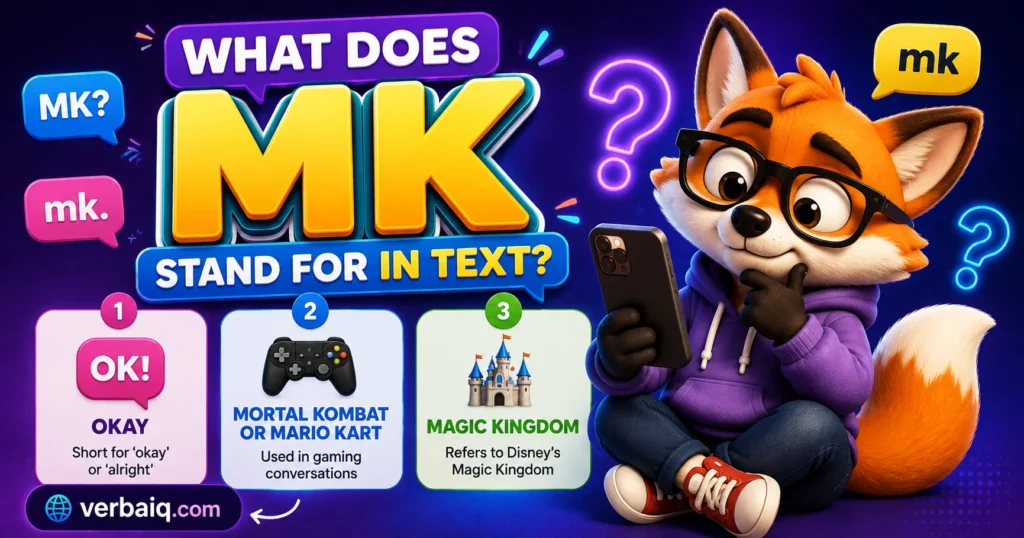
MK in text most commonly means “okay,” “alright,” or “got it.” It is an informal shorthand related to “m’kay” or “mm-kay,” and its tone can range from neutral acknowledgment to slightly dry or dismissive depending on context.
What Does MK Stand for in Text?
When someone sends “MK” in a text, they are usually saying “okay.” It can acknowledge what you said, accept a plan, show understanding, or simply move the conversation along.
For example:
“I’ll pick you up at 7.”
“MK.”
Here, MK is simply “Okay.”
It can also mean:
- Okay
- Alright
- Got it
- I understand
- Sure
- Fine
The important detail is that MK does not necessarily carry a special hidden meaning. In most casual conversations, it is simply a shortened, informal response.
Some dictionaries and slang references connect mk, mkay, mmkay, and m’kay as variants of an informal pronunciation of “okay.” Collins defines mkay as an informal variant of O.K., usually with an ironic flavor.
Is MK an Acronym?
Not really in the strictest sense.
MK is better described as informal texting shorthand or a phonetic abbreviation rather than a conventional acronym such as “LOL” or “FYI.” It represents the sound or shortened form of “m’kay/mm-kay/okay.”
That distinction matters because the letters aren’t normally intended to stand for two independent words beginning with M and K.
The Different Ways MK Can Sound
The dictionary meaning is simple, but the social meaning can change.
Neutral MK
“Dinner is at 8.”
“MK.”
This can simply mean:
“Okay, I understand.”
Friendly MK
“I’ll send you the pictures tonight.”
“mk 😊”
The emoji makes the response feel warmer.
Reluctant MK
“Can you help me clean up after the party?”
“mk…”
Here, the sender may be agreeing without sounding enthusiastic.
Dry or Dismissive MK
“I wrote you a whole paragraph explaining what happened.”
“mk.”
That extremely short response might feel like:
“Okay, whatever.”
But don’t automatically assume someone is annoyed. Written communication removes facial expression, voice, and body language, so a two-letter response can be easy to overinterpret.
A Common Misunderstanding: Does MK Always Mean Someone Is Mad?
No.
A bare “mk” can look cold because it contains very little information, but that doesn’t prove the sender is angry, annoyed, or trying to end the relationship.
Consider this:
You: “The movie starts at 7.”
Friend: “mk”
If that’s how your friend normally texts, there may be absolutely no attitude behind it.
Now compare:
You: “I’m sorry I didn’t tell you earlier. Here’s everything that happened…”
Friend: “mk.”
The second response may feel much colder because of the emotional context.
The letters didn’t change. The conversational situation did.
This is one of the most useful ways to interpret MK: don’t treat the abbreviation as a fixed emotional signal. Look at the message before it, punctuation, emojis, timing, and the sender’s normal texting habits.
Other Real Meanings of MK
Although “okay” is the main texting meaning, MK can refer to completely different things when the subject changes.
MK = Mortal Kombat
In gaming conversations, MK commonly refers to Mortal Kombat, the fighting-game franchise.
For example:
“Are you playing MK tonight?”
If the conversation is about video games, “Mortal Kombat” makes much more sense than “okay.”
MK = Mario Kart
MK can also be used as shorthand for Mario Kart in gaming contexts. Slang references document both Mario Kart and Mortal Kombat as possible meanings alongside “okay.”
So:
“MK tournament tonight?”
could mean a Mario Kart tournament, depending on the people involved.
MK = Magic Kingdom
In travel or Disney-related conversations, MK may refer to Magic Kingdom.
For example:
“We’re going to MK tomorrow.”
In that context, interpreting MK as “okay” would obviously make little sense.
MK as Initials or a Name
Sometimes MK is simply someone’s initials.
For example:
“MK approved the design.”
That doesn’t necessarily involve slang at all.
MK in Other Specialized Contexts
MK can also appear as a company abbreviation, product designation, place reference, technical term, or other specialized shorthand.
The practical rule is simple:
If MK appears as a standalone reply, “okay” is the strongest interpretation. If it appears inside a subject-specific conversation, consider the topic before decoding it.
Where Is MK Used?
The clearest evidence supports MK as a general texting and online-chat shorthand, rather than something exclusive to one particular social network.
It has been specifically documented in Snapchat-related usage, where MK is explained as “Mmm K” or “Mkay,” meaning an informal “okay.”
Current slang references also describe it in text messages, DMs, and social-media conversations.
Snapchat
MK is well documented on Snapchat as a shorthand for “Mmm K,” “Mkay,” or simply “okay.” It can acknowledge a message or express agreement, while sometimes sounding hesitant or judgmental depending on context.
MK can appear in Instagram DMs and casual conversations with the same basic meaning: okay, understood, or alright. There is no evidence that Instagram gives the abbreviation a fundamentally different definition.
TikTok
MK can appear in TikTok comments or conversations as a quick acknowledgment or agreement. However, it is better understood as general internet shorthand rather than a TikTok-exclusive term.
MK can also be used in WhatsApp conversations, particularly in casual chats and group messages. Again, the meaning generally remains “okay” rather than becoming a separate WhatsApp-specific abbreviation.
X and Other Chats
MK may also appear in casual social-media conversations on X and other messaging spaces. The platform generally doesn’t determine its definition; context does.
How MK Works Grammatically
MK is usually an interjection or standalone conversational response.
It doesn’t behave like an ordinary noun or verb.
For example:
“MK, I’ll be there at six.”
Here, MK appears at the beginning as an acknowledgment.
It can also appear by itself:
“MK.”
In that case, it functions as a complete response equivalent to “Okay.”
It can also follow another phrase:
“MK, sounds good.”
The abbreviation is particularly useful because it doesn’t need a full grammatical sentence to accomplish its conversational purpose.
Where Did MK Come From?
This is where it’s important not to invent a neat but unsupported origin story.
There is no reliable evidence showing that one person suddenly invented “MK” as a texting abbreviation at a specific date.
The more defensible history is that mk/mkay/m’kay is connected to the spoken, nasalized form of “okay.” Wiktionary describes m’kay as a nasalized variant of “okay” and lists mk, mkay, mmkay, and related spellings as alternative forms.
The form m’kay was also strongly popularized by the animated television series South Park, particularly through the character Mr. Mackey. Collins explicitly gives its word origin as a catchphrase from South Park.
However, the spelling mkay/m’kay existed in speech-related records before or around that period, so it would be inaccurate to say that South Park invented the underlying expression. Wiktionary gives an example of “Mkay” from a 1991 linguistic publication and later written examples from the late 1990s and early 2000s.
So the safest historical summary is:
“MK” in texting is part of a family of shortened spellings related to spoken “m’kay/mm-kay,” while popular culture—especially South Park—helped make the form recognizable. The exact moment when “mk” became a texting shorthand is unclear.
4 Short Example Conversations
Funny
A: I ate the entire pizza.
B: MK 😂
A: That’s all you have to say?
B: I’m still processing the evidence.
Sarcastic
A: I forgot my keys again.
B: Mk.
A: Don’t say it.
B: I wasn’t going to. Your face already said it.
Playful
A: You better save me some cake.
B: Mk 😌
A: That’s not a promise.
B: Fine. Mk, I’ll save you the biggest piece.
Serious
A: I’ll send you the documents tonight.
B: MK, thank you.
A: Let me know if anything is missing.
B: I will.
12 More MK Conversation Examples
1. Friends Making Plans
A: We’re meeting at the coffee shop at 5.
B: Mk.
A: Don’t be late this time.
B: No promises 😂
2. Family
A: Dinner will be ready in twenty minutes.
B: MK, I’ll be downstairs.
A: Great.
B: Save me some dessert.
3. Coworkers
A: Please review the final document before noon.
B: MK, I’ll check it.
A: Thanks.
B: No problem.
4. Dating
A: So we’re still meeting tonight?
B: Mk 😊
A: That’s a very enthusiastic answer.
B: I said yes, didn’t I?
5. Group Chat
A: Everyone bring snacks for movie night.
B: MK.
C: I’m bringing popcorn.
D: I’m bringing absolutely nothing.
6. Snapchat
A: Did you see the snap I sent?
B: Mk.
A: And?
B: I saw it. I’m still laughing.
7. Instagram DM
A: I’ll tag you in the post.
B: Mk, go for it.
A: Done.
B: Perfect.
8. TikTok Conversation
A: This video has been stuck in my head all day.
B: Mk 😂
A: Don’t pretend you don’t know the song.
B: I absolutely know it.
9. Parent and Teen
A: Please remember to take your lunch tomorrow.
B: Mk.
A: I’m serious.
B: I know, I know.
10. Dating — Slightly Dry
A: Are you actually coming this time?
B: Mk.
A: That’s not reassuring.
B: Yes, I’m coming.
11. Gaming
A: Want to play MK later?
B: Sure.
A: Mario Kart or Mortal Kombat?
B: Mario Kart first.
Here, MK does not mean “okay”. The gaming context changes the meaning.
12. Travel
A: We’re going to MK tomorrow.
B: Magic Kingdom?
A: Yep.
B: I’m bringing the camera.
Again, context immediately changes the interpretation.
How to Reply to MK
There isn’t one perfect response. Match your reply to the tone of the conversation.
Funny Reply
“Just MK? I deserve at least three more letters 😂”
Serious Reply
“Thanks for understanding. I appreciate it.”
Flirty Reply
If the conversation is already flirtatious:
“That ‘mk’ sounded suspiciously cute 😏”
Neutral Reply
“Okay, sounds good.”
If you’re uncertain whether the sender is annoyed, don’t immediately confront them. You can simply continue the conversation or ask:
“Everything good?”
MK vs Similar Terms
| Term | Meaning | Tone | Popularity | Confusion Risk |
|---|---|---|---|---|
| MK | Okay / m’kay / acknowledgment | Casual, sometimes dry | Moderate | Medium |
| OK | Okay / agreement | Neutral | Very high | Low |
| K | Okay | Very brief, can seem cold | High | Low |
| KK | Okay / got it | Casual, friendly | Moderate | Low |
| M’kay | Informal “okay” | Casual, sometimes ironic | Moderate | Medium |
| Alright | Agreement or acceptance | Neutral | Very high | Low |
| Nope | No / refusal | Casual, negative | Very high | Low |
There isn’t a perfect single opposite of MK because “okay” is context-dependent. But if MK means acceptance, “nope” or “nah” can function as an opposite response.
Who Uses MK?
There is not enough reliable evidence to establish a strict Gen Z-only, Millennial-only, male-only, female-only, U.S.-only, or U.K.-only usage pattern.
The expression belongs to broader informal English and internet communication. Its connection to m’kay predates today’s generational labels, while texting helped create shortened forms such as mk.
So if you’re wondering whether MK is “Gen Z slang,” the safest answer is:
It can be used by younger internet users, but it isn’t exclusive to Gen Z.
Likewise, don’t assume that a person uses MK differently because they are a man or woman. The sender’s personal texting style and the conversation are much better clues.
Is MK Rude or Safe?
MK is not inherently rude, offensive, or profane.
Its potential problem is tone, not vocabulary.
A friendly:
“mk 😊”
is unlikely to create much tension.
A bare:
“mk.”
after a long emotional message can feel dismissive.
Is MK Safe for School?
It’s fine when you’re casually texting friends, but it isn’t appropriate for a formal essay or academic assignment unless you’re discussing the slang itself.
Is MK Safe for Work?
It depends on the workplace culture, but “Okay,” “Understood,” or “Sounds good” is usually safer in professional communication.
For example:
“MK, I’ll handle it.”
is understandable but informal.
A more professional alternative is:
“Understood. I’ll handle it.”
When MK Actually Helps — and When It Creates Problems
MK is useful when the information has already been established and all you need to do is acknowledge it.
If a friend says:
“We’re meeting at 6.”
then:
“MK.”
does the job.
But MK becomes less useful when the conversation requires emotional clarity.
If someone says:
“I’m upset about what happened yesterday.”
responding:
“MK.”
can sound dismissive even if you simply meant “I understand.”
In those situations, a few extra words are worth typing:
“I understand. I’m sorry.”
This is an important distinction between efficient communication and incomplete communication. MK saves time when the message is simple, but it can create ambiguity when the subject is emotionally important.
Why Does MK Work in Conversation?
MK survives because it performs a very small but useful conversational job: acknowledgment without elaboration. The sender doesn’t always need to say “I understand what you are saying and accept the information you just gave me.” Two letters can handle that entire function. At the same time, its connection to spoken m’kay gives it a little more personality than a plain “OK.” That flexibility explains why the same spelling can sound relaxed in one exchange and dismissive in another.
A Simple Context Test for MK
When you see MK, don’t decode it in isolation.
Ask three questions:
1. Is it a standalone reply?
If yes, “okay” is probably the answer.
2. Is the conversation about games?
If yes, consider Mortal Kombat or Mario Kart.
3. Is it part of a name, place, brand, or organization?
If yes, MK may not be slang at all.
This approach prevents one of the biggest mistakes with abbreviations: assuming the same two letters must have the same meaning everywhere.
FAQ
What does MK mean in text?
MK usually means “okay,” “alright,” or “got it.” It is informal texting shorthand related to forms such as m’kay and mm-kay. The exact emotional tone depends on the surrounding conversation.
What does MK mean from a girl or guy?
There is no separate male or female definition of MK. A person of any gender can use it to mean “okay” or “alright.” If it sounds cold, that is more likely to come from the context and the person’s texting style than their gender.
Is MK the same as OK?
They have essentially the same basic meaning, but they can have slightly different tones. OK is more straightforward, while MK can sound more conversational, hesitant, playful, or occasionally dismissive. The difference is especially noticeable when the reply is just “mk.”
What does MK mean on Snapchat?
On Snapchat, MK generally means “Mmm K,” “M’kay,” or “okay.” It can acknowledge a message or confirm agreement. Depending on context, it can also sound unsure, dry, or slightly judgmental.
What does MK mean on TikTok?
On TikTok, MK can be used as general casual internet shorthand for “okay” or acknowledgment. It isn’t a TikTok-exclusive abbreviation with a separate definition. Its meaning should be interpreted from the surrounding comment or conversation.
Does MK mean Mortal Kombat?
It can. In a gaming conversation, MK commonly refers to Mortal Kombat. Context is the key: “MK?” in a gaming chat may refer to the game rather than “okay.”
Does MK mean Mario Kart?
Yes, MK can also be shorthand for Mario Kart. If someone says “Want to play MK?” while discussing Nintendo games, Mario Kart is a reasonable interpretation.
Is MK rude in texting?
Not automatically. MK is generally harmless and informal, but a very short “mk” can feel dismissive when used after a long, emotional, or important message. If you need to sound warm or professional, “Okay, thanks,” “Got it,” or “Understood” is clearer.
Conclusion
So, what does MK stand for in text?
In ordinary texting, MK most commonly means “okay,” “alright,” or “got it.” It is closely related to informal forms such as m’kay, mkay, and mm-kay, rather than being a traditional acronym with two separate words behind the letters.
Its history is more interesting than a simple “texting abbreviation invented on social media” explanation. The underlying m’kay form is a spoken variation of “okay,” and South Park helped popularize it, while the exact origin of MK specifically as a texting form remains unclear.
Use MK freely in casual conversations when a quick acknowledgment is enough. But if you’re discussing something emotional, important, academic, or professional, don’t rely on two letters when a few extra words can remove the ambiguity.
And remember: context beats the abbreviation. A friend saying “mk” after dinner plans probably means “okay.” A gamer asking “MK?” may mean Mortal Kombat or Mario Kart. The surrounding conversation usually tells you which one.